

Artificial intelligence has changed how content is created. Businesses generate marketing copy in seconds, designers create visual concepts with AI tools, YouTubers produce scripts using generative models, and developers integrate AI into products that automatically produce text, images, music, and even code. But a legal question is becoming increasingly urgent across Canada:
Who actually owns AI-generated content?
And perhaps more importantly:
Can you be sued for using it?
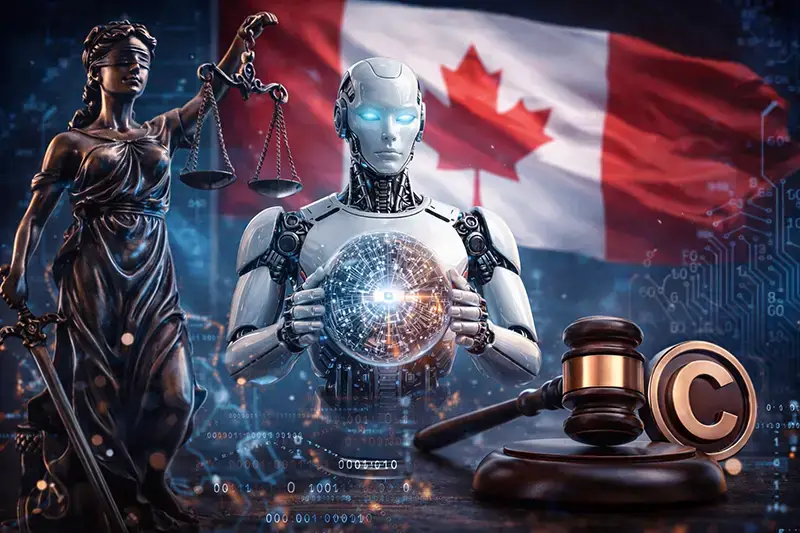
These questions are now central to AI copyright law in Canada, especially as courts around the world begin addressing disputes involving generative AI systems, training data, and ownership rights. For creators, startups, agencies, and technology companies, misunderstanding these rules could create significant legal exposure. That is why many organizations are starting to consult intellectual property and copyright lawyers before integrating AI deeply into their workflow.
If you are unfamiliar with the broader landscape of copyright protection in Canada, you may also want to read Olanur’s guide on copyright lawyers in Canada and how to protect your work:
Understanding the basics of copyright law helps clarify why AI raises new legal questions that traditional law never anticipated.
Why AI Is Creating New Copyright Challenges
Copyright law was designed for human creativity. The Canadian legal framework assumes that an identifiable author creates an original work and therefore receives copyright protection. Artificial intelligence complicates this assumption, AI systems generate outputs based on patterns learned from enormous datasets. These datasets often contain copyrighted works such as articles, books, images, music, or software code. When an AI tool produces a result, several legal questions emerge:
1. Who owns the output?
2. Did the AI copy from copyrighted material?
3. Does the user have legal rights to commercialize the result?
These questions are still being debated globally, and Canada is part of that evolving legal discussion.
According to the Canadian Intellectual Property Office, copyright protection generally exists automatically when an original work is created and fixed in a tangible form.
However, copyright law still assumes a human author. AI tools do not easily fit into that structure. As a result, Canadian courts and lawmakers are beginning to analyze whether AI-generated content should receive copyright protection at all, and under what circumstances.
Can AI-Generated Content Be Copyrighted in Canada?
The short answer is complicated.
Under the Canadian Copyright Act, copyright protection requires originality and human authorship. Because AI systems operate autonomously once prompted, many legal experts argue that purely AI-generated works may not qualify for copyright protection unless there is meaningful human creative input.
In practice, this creates three possible scenarios.
The first scenario involves AI as a creative tool. A designer uses an AI system to generate concepts, then modifies, edits, and arranges them into a final product. In this situation, the human user likely contributes enough creative input to claim authorship.
The second scenario involves AI-assisted creation where the user provides prompts but minimal editing. Ownership becomes less clear because the creative contribution may be limited.
The third scenario involves fully autonomous AI outputs where the user simply enters a prompt and publishes the result. In this case, there may be no copyright owner at all under current interpretations.
This ambiguity is why AI copyright law in Canada is rapidly becoming one of the most discussed areas of intellectual property law.
The Hidden Legal Risk: AI Training Data
One of the biggest legal controversies surrounding AI systems involves training data. Generative AI models learn from massive datasets that may contain copyrighted material such as books, images, news articles, music files, and software repositories.
Creators and publishers around the world have filed lawsuits arguing that AI companies used their content without permission during training. Although many of these lawsuits are occurring in the United States and Europe, the outcomes could influence Canadian law and business practices.
If courts determine that training on copyrighted material constitutes infringement, AI companies could face significant legal consequences. Businesses that rely heavily on those systems may also face new contractual and licensing issues. For Canadian companies building AI-powered products, this means copyright risks may extend beyond the final output. The training process itself could become part of the legal debate.
Can You Be Sued for Using AI Content?
Many businesses assume that using AI tools automatically protects them from copyright liability. Unfortunately, that assumption is not always correct. There are several ways AI-generated content can create legal exposure.
The first risk involves unintentional copying. AI models sometimes reproduce recognizable fragments of copyrighted material from their training data. If that happens and the content is used commercially, it may trigger infringement claims.
The second risk involves misleading ownership claims. Businesses sometimes publish AI-generated work while claiming exclusive copyright protection, even when the legal status of that work is unclear.
The third risk involves contractual restrictions. Many AI platforms include terms of service that limit how generated content can be used or distributed.
The fourth risk involves commercial misuse of copyrighted material embedded in AI outputs, especially for images, design elements, or music.
Because of these uncertainties, companies increasingly consult intellectual property lawyers before integrating AI content into commercial products.
AI Content and Business Risk in Canada
For businesses operating in Canada, the AI copyright law in Canada implicaies extend far beyond creators and artists. Technology startups are building AI tools that generate marketing copy, code snippets, and educational materials. Digital marketing agencies rely on AI for advertising content. SaaS companies integrate generative AI into customer-facing platforms.
If copyright ownership is unclear, several business problems can emerge. Investors may hesitate during due diligence if a company’s intellectual property rights are uncertain. Competitors could challenge ownership of AI-generated assets. Licensing agreements may become difficult to enforce.
For companies planning long-term growth, protecting intellectual property remains essential. This is why many founders begin consulting lawyers earlier in the product development process.
Olanur’s guide on business lawyers and legal risks companies overlook provides additional insight into these issues:
AI copyright law in Canada often intersect with broader business law concerns, especially when intellectual property becomes part of a company’s core assets.
What Canadian Lawmakers Are Considering
Canadian regulators are actively discussing how AI should be governed. The federal government has proposed regulatory frameworks addressing artificial intelligence and data usage, recognizing that AI technologies create new legal challenges.
While these initiatives focus largely on safety, accountability, and transparency, they also influence the intellectual property landscape. As AI becomes integrated into nearly every digital industry, lawmakers must determine how copyright law should evolve.
Some experts argue that existing copyright law is flexible enough to handle AI-related disputes through case law. Others believe new legislation will eventually be necessary. For now, businesses and creators must operate within a legal environment that is still evolving.
When You Should Consider Speaking With a Lawyer
Not every AI-related issue requires legal action. However, certain situations justify speaking with an intellectual property or copyright lawyer and specifically AI copyright law in Canada. One common scenario involves companies building AI tools that generate commercial content for clients. Clarifying ownership and licensing rights becomes essential before scaling the product.
Another scenario occurs when AI systems reproduce recognizable copyrighted material. Determining whether the output qualifies as infringement may require legal expertise. Businesses also consult lawyers when negotiating contracts with AI vendors or integrating generative models into proprietary products.
If your situation involves potential infringement or a formal dispute in relevance to AI copyright law in Canada, it is especially important to act quickly. Evidence preservation and strategic communication can influence the outcome of a case. You can find a lawyer using Find a Lawyer near in your province and specialised in your context.

For guidance on urgent legal issues, Olanur also provides resources on finding a lawyer quickly in Canada:
How Olanur Helps Businesses Navigate Emerging Legal Issues
Legal problems related to artificial intelligence often begin with confusion.
A startup founder may not know whether the issue involves copyright law, intellectual property licensing, contract disputes, or technology regulation. Olanur helps simplify this process by allowing users to describe their legal situation in plain language and connect with the right lawyer for their specific problem.
Instead of spending hours researching legal categories or contacting multiple firms, businesses can quickly identify lawyers experienced in the relevant field. As AI technology evolves, platforms that connect people with specialized legal expertise will likely become increasingly important.
Frequently Asked Questions
Who owns AI-generated content in Canada?
Ownership depends on the level of human involvement. If a person contributes meaningful creative input to the final work, they may be able to claim copyright. Fully autonomous AI-generated works may not qualify for copyright protection.
Is AI-generated content legal to use in Canada?
Using AI-generated content is generally legal, but the output must not infringe existing copyrighted material or violate platform licensing agreements.
Can AI companies be sued for copyright infringement?
Yes. Several lawsuits around the world are challenging whether AI companies used copyrighted material without permission when training their models.
Should businesses consult a lawyer before using AI content?
Companies using AI for commercial products, marketing, or intellectual property creation often benefit from legal advice to clarify ownership rights and avoid infringement risks.
Final Thoughts
Artificial intelligence is transforming how content is created, but copyright law has not fully caught up with the technology. As a result, AI copyright law in Canada remains one of the fastest-evolving areas of intellectual property law in 2026.
For creators, startups, and businesses, the safest approach is understanding the legal framework before problems arise. Ownership questions, training data disputes, and infringement claims can become complicated quickly. Seeking professional guidance early can help prevent small issues from becoming expensive legal conflicts.
Platforms like Olanur aim to make that process easier by connecting individuals and businesses with lawyers who understand the rapidly changing legal landscape surrounding copyright and artificial intelligence.