How much severance am I entitled to Ontario? If you’ve just been terminated and you’re staring at an offer letter, this is the most important question you can ask — and almost nobody at HR will give you an honest answer. Here’s the uncomfortable truth: in Ontario, the severance your employer offers is usually the legal minimum, and the legal minimum is often 3 to 10 times lower than what you may actually be entitled to.
This guide gives you the real answer — based on how Ontario courts actually calculate severance in 2026, not the number on the first offer letter.
If you have a termination letter in front of you right now, do not sign it today. You almost certainly have more time, and more leverage, than your employer is telling you.
How Much Severance Am I Entitled To Ontario? The 30-Second Answer
There are two parallel systems that determine severance in Ontario, and the difference between them is where most employees leave tens of thousands of dollars on the table:
ESA minimum (statutory): Under the Ontario Employment Standards Act, eligible employees get up to 8 weeks of termination pay, plus (if you’ve worked 5+ years for an employer with $2.5M+ payroll) an additional 1 week per year of severance, capped at 26 weeks.
Common-law reasonable notice: Judges in Ontario use a framework from Bardal v. The Globe & Mail Ltd. (1960) to award much more — routinely 1 to 2 months per year of service, and up to 24 months for senior, older, or long-tenured employees.
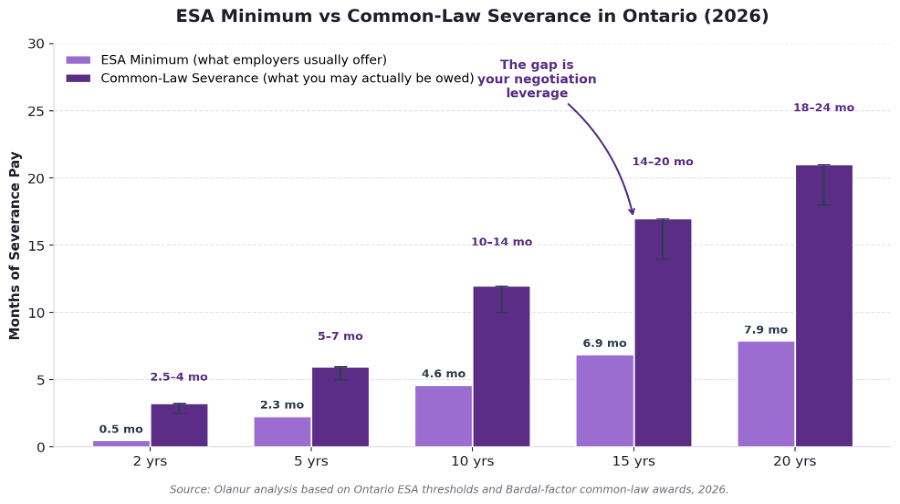
Most employers offer the ESA floor. Most employees don’t realize they’re entitled to the common-law amount. That gap is your negotiation leverage.
The gap between the ESA minimum and common-law severance grows with every year of service. A 10-year employee typically sees ESA pay out ~4.6 months, while courts commonly award 10–14 months.
How Ontario Courts Calculate Severance Pay: The Bardal Factors
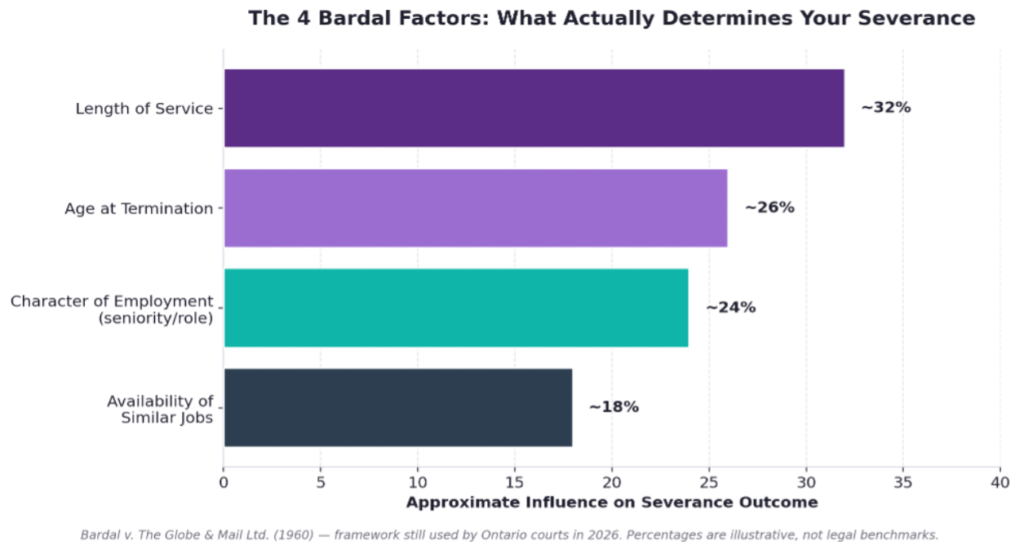
When you ask how much severance am I entitled to Ontario, the answer always comes back to one legal framework. In 2026, Ontario judges still rely on the rules laid out in the 1960 Bardal decision. There is no fixed formula — courts weigh four factors to decide how long a “reasonable” notice period should be.
The four Bardal factors courts use to determine reasonable notice. Length of service and age carry the most weight in most Ontario awards.
1. Length of service
The longer you’ve been with the employer, the longer your notice period. A 2-year employee and a 20-year employee doing the same job receive very different severance — not because the work changed, but because the law assumes you’ve built more dependency on the role.
2. Age at termination
Employees over 50 are consistently awarded longer notice periods. The legal reasoning is that older workers typically face a harder re-employment market, so they need a longer financial runway to find comparable work.
3. Character of employment (seniority and role)
Managers, directors, specialists, and executives generally receive longer notice than entry-level staff. The more senior the role, the fewer equivalent jobs exist in the market — and the longer it usually takes to find one.
4. Availability of similar employment
This is where 2026 matters. With Ontario’s unemployment rate sitting at 7.6% as of early 2026 according to Statistics Canada, and manufacturing and federal public service layoffs continuing through the year, courts are increasingly recognizing that finding comparable employment is taking longer — which supports longer notice awards.
Real Examples: How Much Severance Am I Entitled To Ontario (2026)
These ranges reflect common-law awards in comparable Ontario cases. Your actual entitlement depends on your specific facts and any enforceable termination clause in your contract.
Scenario
ESA Minimum
Likely Common-Law Range
32-year-old marketing coordinator, 2 years of service
1–2 weeks
3–5 months
42-year-old IT specialist, 7 years of service
7 weeks
7–10 months
55-year-old operations manager, 15 years of service
23 weeks (≈5.3 months)
14–20 months
60-year-old VP, 22 years of service (senior role)
26 weeks cap (≈6 months)
20–24 months
5 Mistakes That Cost Ontario Employees Their Severance
1. Signing the release too fast
Employers often push a 7-day deadline. In most cases, you have up to two years to claim your full entitlement, but the moment you sign a release, that window slams shut. Ask for more time. They will almost always extend it.
2. Assuming the offer letter is non-negotiable
First offers in Ontario are almost never the final number. They’re the opening bid. Most packages improve significantly once an employment lawyer sends a demand letter with a calculated common-law notice period.
3. Not knowing about your termination clause
If your employment contract contains a valid termination clause, it can legally limit you to ESA minimums. But many clauses are unenforceable — a single invalid word (like an improper “just cause” definition) can void the whole clause and unlock full common-law severance. Only a lawyer can tell you which one you have.
4. Failing to mitigate
You’re legally expected to look for comparable work after termination. Keep a log of job applications, interviews, and networking efforts — this protects your claim. Not mitigating can reduce your award.
5. Taking tax advice from HR
Severance paid as a lump sum, as salary continuance, or into an RRSP is taxed very differently. The Canada Revenue Agency’s guidance on retiring allowances is worth reading before signing — the structure of the payment can materially change your take-home.
When Your Employer’s Offer Is Almost Always Lowballed
When clients come to us asking how much severance am I entitled to Ontario, their employer’s first offer is most commonly underpriced in these six situations:
You’re over 50 and the employer offered under 1 month per year of service.
You held a senior, specialized, or management role.
You’ve been with the company 5+ years and the offer is at or near the ESA cap.
Your role was eliminated in a restructuring or layoff.
You were pushed to resign or sign a “mutual separation.”
Your duties, pay, or reporting structure were significantly changed before you left (this may be constructive dismissal).
Olanur’s AI matches you with a pre-vetted Ontario employment lawyer in minutes — free to use, no obligation. Describe your situation in plain language and we’ll route you to a lawyer who handles severance negotiations in your exact scenario.
In Ontario, your severance depends on whether your contract limits you to the ESA minimum or whether you’re entitled to common-law reasonable notice. ESA pays out up to 8 weeks of termination pay plus up to 26 weeks of severance (if eligible). Common law typically awards 1–2 months per year of service, with a ceiling of about 24 months for senior long-tenured employees. To answer how much severance am I entitled to Ontario specifically for your situation, an employment lawyer will weigh your age, length of service, role, and the current job market.
Is severance pay taxable in Ontario?
Yes. Severance is taxable as employment income. Lump-sum payments are subject to withholding tax at rates that vary with the amount. Part of a severance payment may qualify as a “retiring allowance” and can sometimes be transferred directly into an RRSP without immediate tax — this is why how the payment is structured matters.
Can I negotiate my severance package in Ontario?
Yes, and you should. In nearly every case, employer offers are opening positions, not final ones. Having an employment lawyer send a formal demand letter with a calculated common-law notice period typically results in a materially improved offer — often many multiples of the original package.
How long do I have to accept a severance offer in Ontario?
Employers often set short deadlines (5–7 days), but these are not legally required. You generally have up to two years to bring a wrongful dismissal claim. Ask for an extension in writing — it’s most of the times granted. Do not sign under pressure.
What’s the difference between termination pay and severance pay in Ontario?
Termination pay is the ESA payment in lieu of notice (up to 8 weeks). Severance pay is a separate ESA entitlement for employees with 5+ years of service at employers with $2.5M+ payroll (up to 26 weeks). Common-law reasonable notice is a third, larger amount that can be awarded on top of or instead of these statutory minimums.
Get your severance reviewed — in minutes.
Tell our AI what happened. We’ll match you with a pre-vetted Ontario employment lawyer who negotiates severance in cases exactly like yours. No upfront cost to use Olanur.
If you’ve been asking how much severance am I entitled to Ontario, the honest answer is: it depends on your facts, but almost always more than your employer is offering. Severance law in Ontario is one of the highest-stakes areas where a short phone call with the right lawyer changes the outcome by tens of thousands of dollars. If you’ve been terminated, laid off, or pressured to resign, the first move is a conversation — not a signature.
Disclaimer: This article is for general informational purposes only and does not constitute legal advice. Olanur is a technology platform, not a law firm or lawyer referral service. Legal outcomes depend on the facts of each case. Always consult a licensed Ontario employment lawyer about your specific situation.