

Few things cause more anxiety for Canadian taxpayers than receiving a letter from the Canada Revenue Agency announcing an audit. In 2026, that anxiety is well-founded. The CRA audit 2026 has ramped up enforcement with new funding, expanded data-matching technology, and artificial intelligence tools designed to flag returns that do not add up. If you file taxes in Canada this year, understanding what triggers a CRA audit, and knowing exactly what to do if one lands on your doorstep, could save you thousands of dollars and months of stress.
This guide covers the most common CRA audit 2026 triggers, walks you through every stage of the audit process, and explains when bringing in a tax lawyer in Canada is the smartest move you can make.
Why the CRA Audit 2026 is Auditing More Canadians
The increase in CRA audits is not accidental. Budget 2025 allocated $77 million over four years specifically to strengthen tax enforcement, with a focus on schemes like the “Driver Inc.” model in the trucking sector and broader non-compliance in cash-heavy industries. On top of that, the CRA’s 2025-2026 Departmental Plan confirms a strategic shift toward using machine learning and AI to detect suspicious filing patterns, enabling the agency to flag high-risk returns faster and more accurately than ever before.
The CRA now cross-references your tax return against data from employers, financial institutions, provincial agencies, and even international tax treaties. A mismatch between what you report and what the CRA already knows about your income is often all it takes to initiate an audit. With digital-only notices of assessment rolling out this year, many Canadians may not even realize they have been reassessed until penalties have already begun accumulating.
Understanding the Canada tax changes for 2026 is essential context for anyone concerned about audit risk this season.
The Top CRA Audit Triggers in 2026
The CRA selects files for audit based on a risk assessment system that evaluates the likelihood of errors or non-compliance. While any return can theoretically be selected, certain patterns dramatically increase your chances.
Inconsistent or Unreported Income
This is the single most common CRA audit trigger. The agency receives copies of every T4, T4A, T5, and T3 slip issued in your name. If the income on your return does not match what employers, banks, and investment firms have reported, the CRA’s system will flag the discrepancy automatically. Gig workers, freelancers, and anyone with multiple income streams are especially vulnerable because income from platforms, side jobs, and contract work often goes unreported.
Inflated Business Expenses and Deductions
Claiming expenses that are disproportionately large relative to your income – or that have jumped significantly from the previous year – is a red flag the CRA watches closely. This includes vehicle expenses where business use is overstated, meals and entertainment claimed at unusually high levels, and supplies or equipment purchases that seem inconsistent with the nature of your business. The CRA benchmarks your deductions against industry averages, and outliers get noticed.
Home Office Claims
Since the pandemic, home office deductions have surged across Canada. The CRA has responded by scrutinizing these claims more carefully in 2026. If you are claiming that 40% or 50% of your home is dedicated to business use, the agency may question whether that figure is realistic. The space must be used “regularly and exclusively” for earning income, and the CRA expects the percentage to be reasonable relative to the size of your home.
Repeated Business Losses
Reporting losses from a sole proprietorship or side business year after year raises a fundamental question at the CRA: is this a real business or a vehicle for writing off personal expenses? If your business has not shown a profit in three or more consecutive years, expect increased scrutiny. The CRA may determine that the activity lacks a reasonable expectation of profit and deny your loss claims entirely, potentially triggering reassessments for previous years as well.
Rental Property Red Flags
Rental income is another area where the CRA audit 2026 risk is elevated. Common issues include failing to report rental income at all, claiming excessive repair and maintenance costs to offset rental revenue, and incorrectly categorizing capital improvements as current expenses. If you own rental property, every dollar of income and every receipt for expenses should be meticulously documented.
Cash-Heavy Industries
If you work in construction, hospitality, food services, or retail, you already operate in a sector the CRA considers high-risk for unreported cash income. The agency uses industry benchmarking data to compare your reported income against businesses of similar size and type. Falling significantly below the benchmark is a reliable way to trigger a CRA audit 2026.
Cryptocurrency and Digital Assets
The CRA has made it clear that cryptocurrency transactions are taxable events, and enforcement in this area is tightening. Budget 2025 expanded the agency’s capacity to track digital asset transactions, and the CRA now receives data from Canadian crypto exchanges. Failing to report gains from trading, staking, or selling cryptocurrency is a growing audit trigger that catches many Canadians off guard.
Already received a CRA audit 2026 notice?
Do not respond before consulting a professional. A tax lawyer can review the notice, advise on your rights, and represent you throughout the process under solicitor-client privilege. Find a tax lawyer now on Olanur →
What to Do If You Get a CRA Audit Letter
Receiving a CRA audit letter does not automatically mean you have done something wrong. The CRA conducts audits for many reasons, including random selection. However, how you respond in the first days after receiving that letter can shape the entire outcome.
Step 1: Read the Letter Carefully
The CRA audit letter will specify the tax years under review, the areas being examined, and the documents you need to provide. It will also include the auditor’s name and contact information. Do not ignore this letter. Failing to respond gives the CRA authority to issue an arbitrary assessment based on its own estimates, which almost always results in a higher tax bill than what you actually owe.
Step 2: Gather Your Records
Pull together every receipt, bank statement, invoice, and supporting document related to the items under audit. The CRA expects organized, complete records. Gaps in your documentation weaken your position and can lead the auditor to make assumptions that are not in your favour.
Step 3: Decide Whether You Need Professional Help
For a straightforward review of a single deduction, an accountant may be sufficient. But if the audit involves significant amounts, multiple tax years, potential penalties, or any suggestion of fraud or evasion, you need a tax lawyer. This is not optional, it is the difference between having your communications legally protected and having everything you say potentially used against you. If you are unsure whether you need a lawyer, the complexity of your situation usually provides the answer.
Step 4: Respond Within the Deadline
The CRA typically gives you 30 days to respond to an audit letter or to the auditor’s proposed adjustments. Missing this deadline limits your options and can result in the CRA proceeding without your input. If you need more time, request an extension in writing before the deadline passes.
Why a Tax Lawyer Matters During a CRA Audit
There is a critical legal distinction between a tax lawyer and other tax professionals that becomes essential during a CRA audit. A tax lawyer’s communications with you are protected by solicitor-client privilege. This means the CRA cannot compel your lawyer to disclose anything you have discussed, including mistakes, concerns, or strategies. An accountant does not have this protection. Anything you tell your accountant can be requested by the CRA during an audit.
Beyond privilege, a tax lawyer understands the procedural rules that govern CRA audits, knows when the agency has overstepped its authority, and can negotiate settlements, file objections, or escalate disputes to the Tax Court of Canada if necessary. When the stakes are high, this expertise pays for itself many times over.
The key is acting early. Finding the right lawyer in Canada before you respond to the CRA gives you the strongest possible position from day one.
How to Reduce Your CRA Audit 2026 Risk
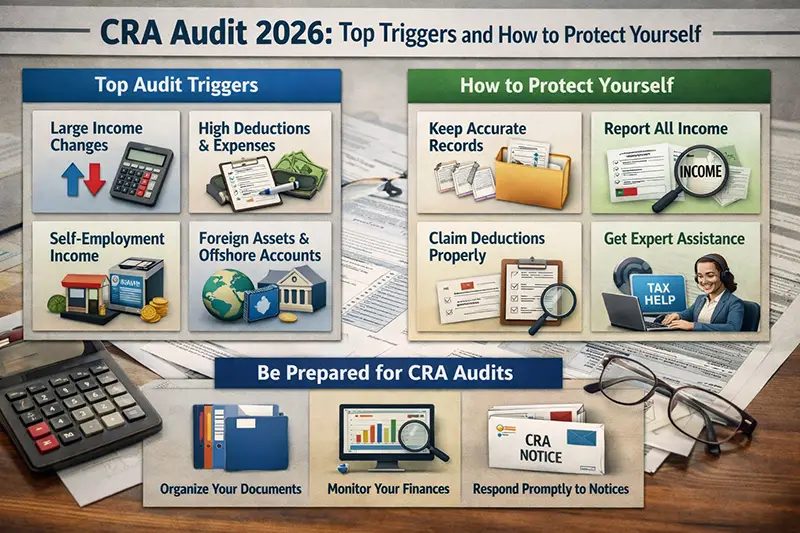
While no one can guarantee they will never be audited, there are practical steps every Canadian taxpayer can take to minimize the risk. File your return on time every year, late filings attract attention. Keep detailed records and receipts for every deduction you claim, organized by category and date. Report all income, even small amounts from side work or platforms that may not issue T4A slips. Avoid drastic year-over-year changes in your deductions without clear documentation supporting the reason. And if your tax situation is complex, multiple income sources, rental properties, investments, or self-employment, consider having a professional review your return before you file.
For an overview of the broader changes shaping this tax season, including the new 14% federal rate and digital-only CRA notices, see our critical guide to tax lawyers in Canada for 2026.
Don’t face a CRA audit alone.
Connect with an Experienced Tax Lawyer on Olanur →
Are you a tax lawyer with CRA audit experience?
Join Olanur and reach clients who need your help right now →
Frequently Asked Questions About CRA Audits
What triggers a CRA audit in 2026?
The most common CRA audit 2026 triggers include unreported income detected through data matching, inflated deductions relative to income, repeated business losses, excessive home office claims, unreported rental or cryptocurrency income, and operating in cash-intensive industries. The CRA is also using AI and machine learning to identify suspicious patterns more efficiently than in previous years.
Do I need a tax lawyer for a CRA audit 2026?
If the audit involves significant dollar amounts, multiple tax years, potential penalties, or any suspicion of fraud or tax evasion, hiring a tax lawyer is strongly recommended. Unlike accountants, tax lawyers offer solicitor-client privilege, which means your communications are legally protected and cannot be disclosed to the CRA. For simpler reviews, an accountant may be sufficient, but when the stakes are high, a lawyer is essential.
How long does a CRA audit take?
Simple audits focusing on a single deduction or credit can be resolved in a few weeks. More complex audits, especially those involving businesses, international income, or multiple tax years—can take several months to over a year. The CRA will outline the scope in your initial audit letter, and you can ask the auditor for an estimated timeline.
What happens if I ignore a CRA audit letter?
Ignoring a CRA audit letter is never advisable. The CRA has the legal authority to issue an arbitrary assessment based on its own calculations, which typically results in a significantly higher tax bill. Additional penalties and interest will apply, and in serious cases, non-cooperation can lead to criminal prosecution. Always respond within the stated deadline, and seek professional advice if you are unsure how to proceed.
Final Thoughts: Be Prepared, Not Panicked
A CRA audit does not have to be a disaster. Canadians who keep clean records, report all income, and respond promptly to CRA correspondence generally come through audits without major issues. But for those facing complex situations, unreported income, disputed deductions, business losses, or multi-year reviews, the CRA Audit 2026 environment is more aggressive than it has been in years.
The single best thing you can do if a CRA audit 2026 letter arrives is to pause, seek qualified legal advice, and respond strategically rather than emotionally. A tax lawyer ensures your rights are protected from the very first interaction with the CRA, and that protection can make all the difference in the outcome.
If you need professional help navigating a CRA audit this tax season, Olanur connects you with qualified tax lawyers who specialize in exactly this kind of work. The earlier you act, the stronger your position.