

CRA Tax Penalties Canada 2026: What You Must Know This Tax Season
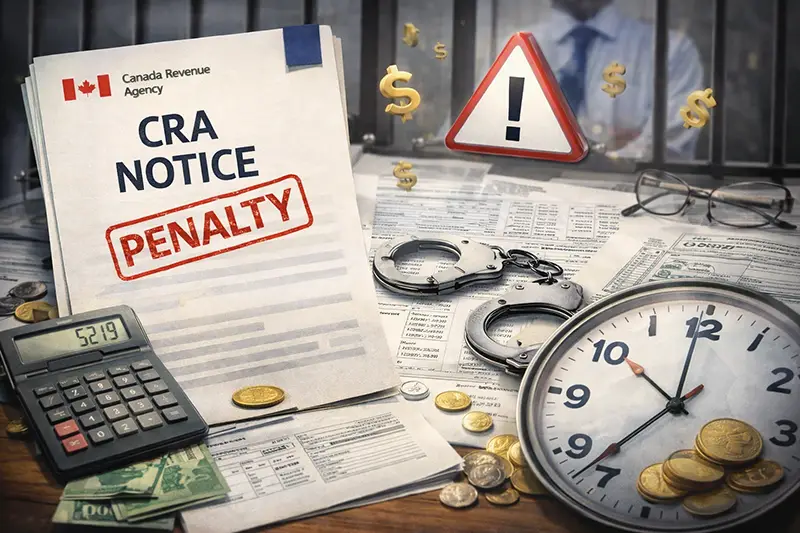
Tax season in Canada is in full swing, and February 2026 has already seen a surge in searches related to CRA tax penalties Canada 2026. As enforcement activity increases and compliance systems become more data-driven, even minor reporting mistakes can result in significant financial consequences caused by CRA tax penalties Canada 2026.
Whether you’re self-employed, incorporated, investing in foreign assets, or simply filed late, understanding how CRA penalties work is critical. In this guide, we break down the most common CRA tax penalties Canada 2026, how interest is calculated, and when you should consult a tax lawyer.
Why CRA Penalties Are Trending in 2026
Several factors are contributing to the spike in concern:
- Increased CRA audit automation
- Expanded data matching with financial institutions
- Tighter reporting requirements for digital income and foreign assets
- Higher interest rates applied to tax arrears
If you haven’t read our breakdown of audit risk factors yet, review CRA Audit 2026: Top triggers and how to protect yourself. Understanding penalties is the second step after understanding audit triggers.
1. CRA Late Filing Penalty (2026 Rules)
The most common penalty in Canada remains the late filing penalty.
If you owe taxes and file after the deadline, the CRA tax penalties Canada 2026 imposes:
- 5% of the balance owing, plus
- 1% of the balance owing for each full month the return is late (up to 12 months)
If you were charged a late filing penalty in any of the previous three years, the penalty increases to:
- 10% of the balance owing, plus
- 2% per month for up to 20 months
This can escalate quickly. A $25,000 tax balance could generate thousands in penalties alone.
For official CRA guidance, see: CRA tax penalties.
2. CRA Interest Charges in 2026
In addition to penalties, the CRA applies compound daily interest on:
- Unpaid tax balances
- Late remittances
- Certain penalties
Based on CRA tax penalties Canada 2026 Interest rates are set quarterly and reflect market conditions. Given elevated rates in recent years, interest can accumulate rapidly.
Important: Interest applies even if you dispute the assessment.
You can find out more on official CRA Interests and penalties website.
3. Gross Negligence Penalty (One of the Most Serious)
The gross negligence penalty is among the most severe consequences in Canadian tax law.
It applies when the CRA determines that a taxpayer knowingly, or under circumstances amounting to gross negligence, made a false statement or omission.
The CRA tax penalties Canada 2026 penalty equals:
- 50% of the understated tax or overstated credits
This often arises in cases involving:
- Inflated business expenses
- Fabricated deductions
- Offshore asset non-disclosure
- Repeated inaccurate reporting
If the CRA alleges gross negligence, legal representation is strongly advised.
4. Failure to Report Income Penalty
If you fail to report income in 2026 and also failed to report income in any of the previous three years, the CRA may impose:
- 10% of the unreported income federally
- Additional provincial penalty (varies by province)
This penalty applies even if the omission was unintentional.
Self-employed individuals, investors, and gig-economy earners are particularly exposed to this risk.
5. Penalties for Foreign Asset Non-Disclosure (T1135)
Canadian residents with foreign assets exceeding $100,000 CAD must file Form T1135.
Failure to file can result in:
- $25 per day (minimum $100, maximum $2,500)
- Higher penalties for gross negligence
- Potential criminal prosecution in extreme cases
With increased global financial reporting transparency, CRA enforcement in this area has intensified in 2026.
6. Corporate Tax Penalties in 2026
Corporations are subject to separate penalty regimes:
- Late filing penalties similar to individuals
- Failure to remit GST/HST
- Payroll deduction failures
- Director liability exposure
Corporate directors can be personally liable for certain unpaid source deductions.
If your business is facing enforcement, consider reviewing Canada tax changes 2026.
7. Can CRA Reduce or Cancel Penalties?
Yes, through the Taxpayer Relief (Fairness) Provisions.
The CRA tax penalties Canada 2026 may cancel or waive penalties if:
- You experienced serious illness
- Natural disasters affected compliance
- CRA processing delays caused the issue
- You faced extraordinary circumstances beyond your control
However, applications must be properly structured and supported with evidence.
A poorly drafted relief request can be denied.
When Should You Hire a Tax Lawyer?
You should strongly consider hiring a tax lawyer if:
- The CRA alleges gross negligence
- You face penalties exceeding $10,000
- You are under audit and penalties are proposed
- Criminal investigation risk exists
- You are disputing an assessment formally
Tax lawyers can:
- Negotiate with CRA collections officers
- File Notices of Objection
- Represent you before the Tax Court of Canada
- Structure voluntary disclosures properly
- Challenge penalty assessments
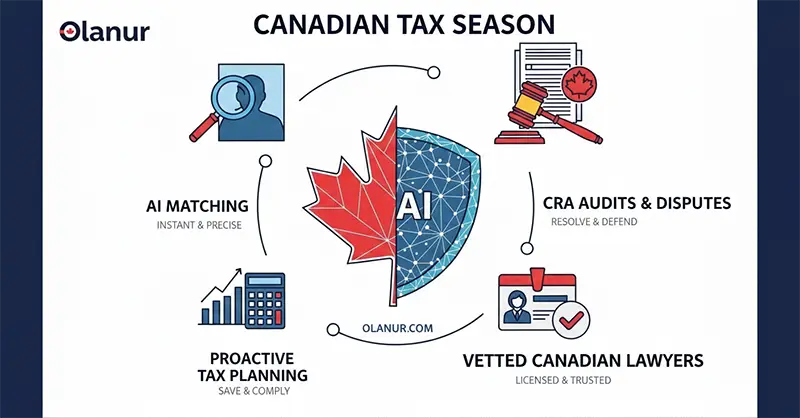
If you need assistance, you can use Olanur’s lawyer matching platform to connect with experienced tax lawyers in your region.
CRA Voluntary Disclosures Program (VDP) in 2026
If you realize you have made errors before the CRA contacts you, the Voluntary Disclosures Program may allow you to:
- Avoid gross negligence penalties
- Reduce interest
- Prevent criminal prosecution
Timing is critical.
Once the CRA initiates enforcement, eligibility may be lost.
How CRA Enforcement Has Evolved
The CRA Canada tax Penalties 2026 increasingly uses:
- Data analytics
- Automated income matching
- Third-party reporting
- Cross-border information exchange
This means underreporting is easier to detect than ever.
Relying on the assumption that “small errors won’t be noticed” is no longer realistic.
Practical Steps to Avoid CRA Penalties in 2026
- File on time — even if you cannot pay immediately.
- Keep organized documentation.
- Disclose foreign assets accurately.
- Review prior returns if you suspect errors.
- Seek legal advice before responding to serious CRA letters.
What Happens If You Ignore CRA Penalties
Ignoring CRA penalties can escalate matters:
- Wage garnishment
- Bank account freezes
- Liens on property
- Corporate asset seizure
- Legal proceedings
In extreme cases, criminal prosecution may follow.
Early intervention is significantly less costly than reactive litigation.
The Financial Impact of CRA Tax Penalties Canada 2026
Consider this scenario:
- $40,000 unpaid tax balance
- 5% late filing penalty = $2,000
- Monthly penalties for 8 months = $3,200
- Compound interest over 12 months = several thousand more
Within a year, your liability could exceed $50,000.
This is why CRA tax penalties Canada 2026 is trending — taxpayers are realizing how quickly balances grow.
Why Acting Early Matters
Many taxpayers wait until collections begin before seeking help.
By then:
- Negotiation leverage decreases
- Interest continues accumulating
- Legal complexity increases
Engaging a tax lawyer early can often reduce total financial exposure.
Final Thoughts: Don’t Let 2026 Penalties Spiral
CRA tax penalties Canada 2026 are not theoretical risks, they are actively being assessed every day this tax season.
With stronger enforcement tools, higher interest rates, and expanded reporting requirements, compliance mistakes are more expensive than ever.
If you are facing penalties, audit exposure, or potential enforcement, professional guidance can make a measurable financial difference.
To explore your options, connect with a qualified tax lawyer through Olanur’s platform today at Find a lawyer and avoid CRA tax penalties Canada 2026.