

Important: This guide is for general informational purposes only and is not legal advice. Laws and procedures vary by province/territory, and you should consult a licensed Canadian lawyer for advice about your situation.
Learn “how to find a lawyer in Canada” in 2026
If you’re trying to know how to find a lawyer in Canada, you’re not just picking a name from a list—you’re choosing someone whose practice area, jurisdiction, and approach match your situation. In 2026, legal services are more accessible than ever (virtual meetings, online intake, faster scheduling), but it also means you need a clear way to filter signal from noise.
Whether you’re dealing with immigration, employment, family, business, real estate, criminal, tax, or a traffic ticket, the best results come from a simple process: define your issue, confirm the lawyer’s fit, and contact with the right questions. If your situation can’t wait, see our guide on how to find a lawyer in Canada urgently.

1) Get specific about your legal issue (don’t start with “I need a lawyer”)
Before you begin to look for how to find a lawyer in Canada, describe the problem in plain language:
- What happened? (timeline + key facts)
- Where did it happen? (province/territory matters)
- What do you want to achieve? (resolve a dispute, review a contract, respond to a claim, etc.)
- What’s the deadline? (court dates, filing limits, immigration timelines)
This step helps you land in the right practice area, which is the #1 factor in getting relevant help quickly.
Example: “I was terminated without warning in Ontario” points toward employment law, while “My tenant stopped paying rent in Toronto” points toward landlord & tenant.
2) Match the practice area + jurisdiction (Canada is not one-size-fits-all)
To find a lawyer in Canada efficiently, confirm both:
- Practice area: A family lawyer may not be the right fit for a corporate shareholders’ dispute.
- Jurisdiction: Laws and processes vary across provinces and territories.
Also check if your issue is federal vs provincial (for example, some immigration matters are federal, while many family or tenancy matters are provincial).
If you’re unsure, your goal is category clarity—not guessing. A short intake summary often makes it obvious which category is best.
3) Use trustworthy sources to build a shortlist (3–7 lawyers)
In 2026, you can find a lawyer in Canada in several ways. The best approach is to combine sources:
- Provincial/territorial law society directories (great for verifying licensing)
- Referrals from people who had a similar issue (useful, but still verify fit)
- Local search + reviews (helpful for service signals, not legal skill guarantees)
- Legal marketplaces and tech platforms that help you narrow down by category, location, and availability
A smart move is to keep your shortlist small. Pick 3–7 candidates that clearly match your category and province. For deeper criteria on screening, read our guide on how to find a trustworthy lawyer in Canada.
4) Verify licensing + independence (quick credibility check)
When you find a lawyer in Canada, always verify they’re licensed and in good standing through the Before you decide to find a lawyer in Canada, it’s important to confirm that the lawyer is properly licensed and in good standing. This can be done in minutes through the appropriate provincial or territorial law society directory, or through national resources maintained by the Federation of Law Societies of Canada.
Verifying a lawyer’s status helps ensure you are dealing with an independent, licensed legal professional authorized to practise in Canada.
In addition to licensing, take a moment to confirm a few practical details:
- The lawyer actively practises in the legal area relevant to your issue
- They are currently accepting new clients
- They handle matters in your province or territory, or offer virtual services where appropriate
This step isn’t about distrust—it’s basic due diligence that can help reduce risk, save time, and ensure your legal matter is handled by the right professional from the start.
5) Compare fit using 5 practical factors (not hype)
Once you find a lawyer in Canada and have a shortlist, compare them using factors that matter:
- Relevant experience: Similar cases or work types (not just years in practice)
- Communication style: Clear explanations, transparent process, responsive expectations
- Availability: How soon you can speak, and realistic timelines
- Fee structure: Hourly, flat fee, limited-scope services, retainers
- Next-step clarity: What happens after the first call (documents, timelines, options)
Avoid relying solely on marketing language like “top” or “best.” Focus on evidence: what they do, how they work, and whether they’re aligned with your goals.
6) Ask strong questions in the first consult (and save time)
A faster way to find a lawyer in Canada you can actually work with is to ask the right questions early:
- “Do you handle cases like mine in [province/territory]?”
- “What are the likely next steps in the process?”
- “What documents should I gather before we proceed?”
- “How do you bill, and what costs should I expect?”
- “What’s the best way to communicate, and how often?”
Bring a one-page summary and your key documents. Lawyers can give more useful guidance when they have clear facts and clean paperwork.
7) Use technology to speed up matching without losing control
In 2026, many people find a lawyer in Canada faster by using tools that structure their intake and reduce back-and-forth—especially when they’re stressed or short on time. To understand why structured matching often beats raw search, see finding online lawyers in Canada: Google vs matching platforms.
This is where a platform like Olanur can be helpful in a practical, compliant way: you describe your legal issue in plain language, the platform helps classify the category, and you can connect with independent, licensed Canadian lawyers who practice in that area—so you spend less time searching and more time speaking to the right professional.
Key point: you stay in control of who you contact, and the lawyer remains fully responsible for their own services, fees, and advice. Before you commit, review the common pitfalls in how to hire an online lawyer in Canada.
Quick checklist: what to prepare before you contact a lawyer
To find a lawyer in Canada and get a productive first call, prepare:
- Your timeline (dates + events)
- Any letters/notices/contracts
- Screenshots/emails (organized)
- Names and roles of key people involved
- Your goal (what outcome you’re trying to achieve)
- Your deadline (if any)
This turns a vague call into an efficient consult.
FAQ: Finding a lawyer in Canada
How do I find a lawyer in Canada near me?
Start with your province/territory, confirm practice area, verify licensing, then compare availability and fees. Many lawyers also offer virtual consults. For Ontario specifically, see our walkthrough on Lawyer Lookup in Ontario.
Is it okay to contact multiple lawyers?
Yes. When you find a lawyer in Canada, it’s normal to speak with 2–3 lawyers before choosing—especially for complex or urgent matters.
What if I don’t know what type of lawyer I need?
Describe the issue in plain language and focus on categorization first. Tools and platforms can help you narrow the correct category before you contact a lawyer.
Final thoughts
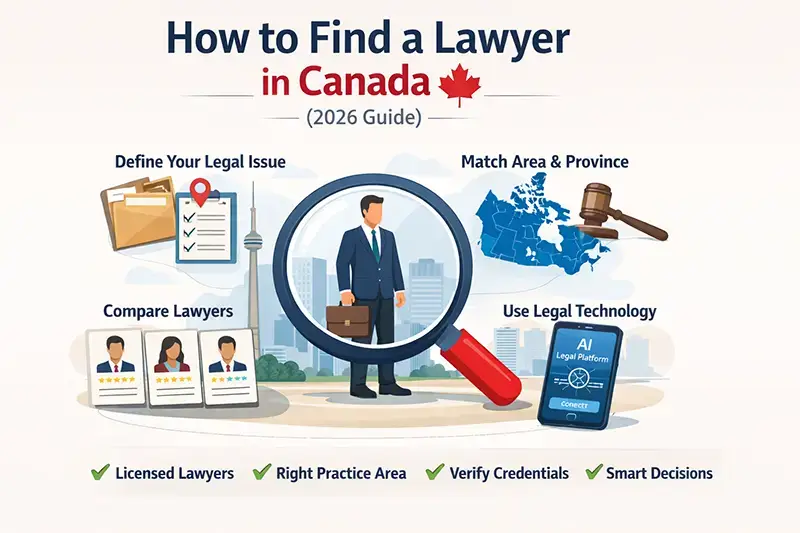
To find a lawyer in Canada in 2026, you don’t need endless searching—you need a repeatable system: define your issue, match the category and jurisdiction, verify licensing, compare fit, and contact with the right questions.
If you want to reduce guesswork, consider using a structured intake approach (like Olanur’s category-first flow) to help you find a lawyer in Canada faster—while keeping the decision entirely in your hands.