
Prefer to listen?
Finding an online lawyer in Canada should be simple. But for most people, it quickly becomes overwhelming.
You start with a search, open multiple websites, compare profiles, and still feel unsure whether you’re even looking at the right type of lawyer. Is your issue related to employment law, family law, tax, or something more specific?
This uncertainty wastes time, and in legal matters, time often matters more than people realize.
In 2026, the way people connect with legal professionals is changing. Instead of manually searching through directories and guessing, more Canadians now prefer to use platforms that connect them with a lawyer online quickly, accurately, and without friction.
That’s exactly where Olanur comes in.
This is general information about finding legal help, not legal advice. The Supreme Court of Canada cases and public resources mentioned below are linked to their official sources.
Why Finding an Online Lawyer in Canada Is Still Difficult
At first glance, finding legal help online seems easy. There are thousands of lawyers listed on the web, but the real challenge is not finding a lawyer, it’s finding the right one. Our cornerstone walkthrough on how to find a lawyer in Canada covers the exact decision framework.
Most users face three core problems:
First, they don’t know what type of lawyer they actually need. Legal categories are not always obvious, and choosing the wrong one can delay your case.
Second, there are too many options. A simple search can return dozens or even hundreds of results, all claiming expertise.
Third, there’s no efficient way to compare lawyers on the factors that matter, like experience, case relevance, pricing, and availability, which is why a structured matching platform often beats a raw Google search, as the next section explains.
This is why traditional searching often leads to frustration instead of clarity.
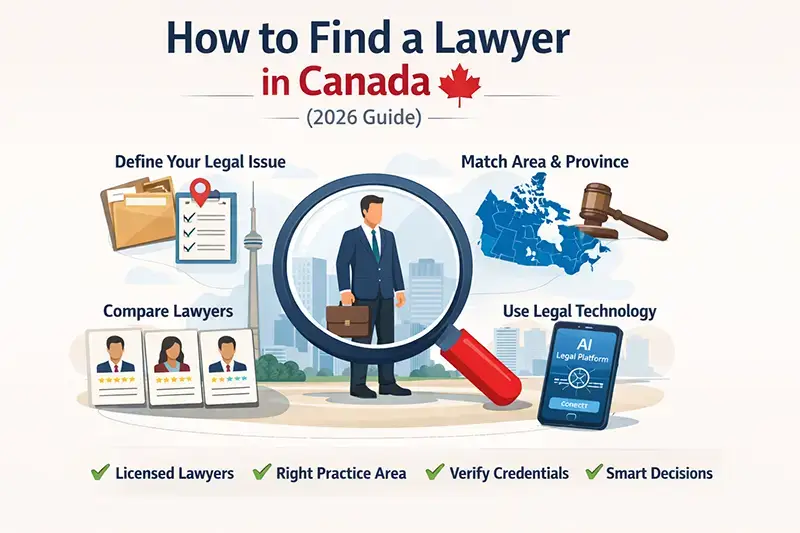
Google vs a Matching Platform: Which Is Better for Finding an Online Lawyer?
If you’re trying to find a lawyer online in Canada, Google is usually the first place you go. That makes sense, because it’s familiar, fast, and it feels neutral. But legal needs are not like shopping for a product. Legal issues are category-sensitive, jurisdiction-sensitive, and time-sensitive, and when those factors collide, search results can turn into a maze of ads, directories, and firm pages that don’t actually match your situation.
The core problem isn’t that Google is bad. It’s that Google is built to rank pages, not to understand your case. That gap shows up in a few recurring ways:
- Ads can dominate high-intent searches. That doesn’t mean the advertiser is the best fit, it means they bid for the click.
- Law firm pages are written to be broad. A firm might list “Family Law,” but your issue could be parenting-time enforcement, an urgent motion, or an interprovincial matter.
- Directories often list lawyers without context, so you still have to filter for practice area, location, availability, and fit yourself.
A matching platform starts from the other end. Instead of keywords, it starts with your situation, then uses structured questions to identify the legal category, narrow down jurisdiction, and connect you with lawyers who actually practise in that area. Here’s the difference at a glance:
| What matters | Google search | A matching platform |
|---|---|---|
| Where you start | Keywords you type | Your situation, in plain language |
| What it optimizes for | Ranking pages | Fit between your issue and a lawyer |
| Category and jurisdiction | You work them out | Structured questions sort them for you |
| Typical result | A long list to filter | A short list of relevant, licensed lawyers |
That shift, from searching to matching, is the real value, because the biggest cost in legal discovery isn’t money at first, it’s wasted time and misdirected outreach.
That doesn’t mean Google has no place. It’s genuinely useful for the early learning phase, when you’re still figuring out the terminology and the general steps, and for verifying a lawyer’s public profile and reviews afterward. So the most effective approach in 2026 is usually not “Google or platform,” but platform for fit, Google for verification: use a matching flow to confirm the category and shortlist relevant lawyers, then use Google to check reputation and public details before you reach out.
What to Look for When Choosing an Online Lawyer in Canada
To choose the right lawyer, it helps to focus on the factors that actually impact your outcome.
The most important factor is practice-area fit. Not every lawyer handles every case. A family lawyer may not be the right choice for a business dispute, and a general practitioner may not be ideal for complex legal matters.
The second factor is jurisdiction. Legal rules vary across Canada’s 10 provinces and 3 territories, so a lawyer who knows the rules in Ontario may not be the right fit for a matter in British Columbia or Alberta. Someone handling a Toronto tenancy dispute is not automatically right for one in Vancouver.
The third factor is experience with similar cases. A lawyer who has handled cases like yours before can move through the situation faster and more effectively.
The fourth factor is transparency. You should be able to understand consultation fees, next steps, and expectations before committing.
Finally, there is ease of communication. Since you are working with a lawyer remotely, the process should be smooth, responsive, and accessible.
7 Costly Mistakes to Avoid Before You Hire an Online Lawyer
Convenience can create a false sense of confidence. Just because a lawyer is easy to find online does not mean they are the right fit for your issue, your province, your timeline, or your budget. These are the seven mistakes that quietly cost people the most.
1. Choosing based on convenience instead of legal fit. A lawyer who is accessible online is not automatically appropriate for your issue. A family lawyer is not the default choice for a relocation dispute, and an employment lawyer who handles routine terminations may not be right for a complex executive-compensation matter.
2. Ignoring provincial licensing and jurisdiction. Law in Canada is heavily provincial in both regulation and practice. It’s worth confirming that the lawyer is licensed in the relevant jurisdiction, whether that’s Ontario, British Columbia, or Alberta, and familiar with the local context, because procedure and strategy can differ meaningfully from one province to another.
3. Assuming every online consultation is the same. Some lawyers use virtual consultations on top of a strong intake process. Others treat online intake like a rushed screening call. Before you commit, it helps to know whether the lawyer handles your case type regularly, what documents they want in advance, and how billing works if you move forward.
4. Overvaluing reviews and undervaluing case-type relevance. Reviews often reflect responsiveness and friendliness, which are useful but not a substitute for practice-area alignment. In Barendregt v. Grebliunas, 2022 SCC 22, the Supreme Court of Canada addressed a relocation dispute centred on the best interests of the child, the kind of matter that needs specific experience in mobility disputes, not just “family law” in the abstract. A better question than “does this lawyer look good online?” is “does this lawyer handle matters like mine often enough to spot the hidden risks early?”
5. Waiting too long because the problem “doesn’t feel serious yet.” Delay is one of the biggest silent costs in legal matters. Tax issues are a clear example: a CRA reassessment, audit, or penalty can escalate quickly, which is why resources like when to hire a tax lawyer in Canada and CRA tax penalties in Canada are worth reading early. If your matter is already time-sensitive, our guide on how to find a lawyer in Canada urgently covers the fastest verified routes.
6. Confusing what the platform does with what the lawyer does. A matching platform improves discovery, intake clarity, and speed. The lawyer provides the actual advice, strategy, and representation. Keeping that line clear helps you make a cleaner decision, because you’re not mistaking technology assistance for legal counsel.
7. Choosing before you compare the process itself. Most people compare lawyers but not the process that surfaced them. A better process helps you ask sharper questions and catch a mismatch earlier. It also protects the sensitive details you share at intake, so it’s worth looking for basics like encryption and clear privacy practices before you type your story into any form.

Real Examples: Why the “Right Lawyer” Matters
Choosing the wrong lawyer is more common than people think. Consider a situation where an employee is terminated and believes their severance is unfair. Many people search broadly and contact the first lawyer they find. But not every employment lawyer handles complex compensation disputes involving bonuses or stock options.
In another example, a family dispute involving relocation requires a very specific type of legal expertise. Hiring a general family lawyer without relocation experience can lead to weaker outcomes.
One of the biggest mistakes people make when they try to find legal help is assuming legal categories are simple. Real cases show the opposite. In Matthews v. Ocean Nutrition Canada Ltd., 2020 SCC 26, the Supreme Court of Canada dealt with dismissal, reasonable notice, and whether a long-term incentive payment should be included in damages. The Court ultimately held that Mr. Matthews should receive the bonus payment he lost during the notice period. That is a good example of why an employment issue is sometimes more specialized than it first appears. Someone who thinks they just need “a workplace lawyer” may actually need counsel experienced in termination compensation and complex incentive-plan disputes.
Business owners face similar challenges. A contract issue may actually involve deeper corporate or liability risks that require specialized knowledge, which is where guides like when to hire a tax lawyer in Canada can be a useful starting point.
These examples highlight a simple truth: finding legal help is not just about speed, it’s about precision.

How Olanur Helps You Find an Online Lawyer in Canada
To see the exact intake and matching steps, read how Olanur works.
Olanur is designed to eliminate the confusion and inefficiency of traditional searching. Instead of browsing endlessly, you follow a structured process:
-
Describe your legal issue in plain language.
-
The platform uses AI to analyze your situation and identify the appropriate legal category.
-
You are then matched with lawyers who are relevant to your case and your location.
-
An expert, pre-vetted and highly specialized lawyer will reach out to you.
Finally, you choose whether to book a consultation with the lawyer that fits your needs, so the process removes guesswork and dramatically reduces the time it takes to move forward.
Olanur is a technology platform, not a law firm, and it does not provide legal advice. The lawyers on the platform are independent, licensed, and responsible for their own services, fees, and outcomes, and you stay in control of who you choose to contact.
A Practical Checklist Before You Choose
Before you commit, it’s worth being able to answer these questions clearly:
-
What exact legal category does my issue likely fall into?
-
Is the lawyer licensed in the relevant province?
-
Do they handle this case type regularly, not occasionally?
-
How is the consultation structured and billed?
-
What documents should I prepare first?
-
What happens after the consultation if I decide to move forward?
-
Am I choosing based on real fit, or just convenience?
That checklist will save more money than most people expect. Before booking, it’s also worth running through our checklist on how to find a trustworthy lawyer in Canada, and if you’re in Ontario, the lawyer lookup in Ontario walkthrough shows how to confirm a lawyer’s standing.
Why Online Lawyer Matching Is Growing in Canada
The rise of digital services has changed expectations across every industry, including legal.
People now expect faster responses, more transparency, less friction, and better personalization. Finding legal help through a guided platform aligns with those expectations. It lets users avoid repetitive explanations, compare options easily, and make informed decisions faster.
Government resources still play an important support role. For example, the Department of Justice Canada points users to family justice services, dispute-resolution help, and public information for separation, parenting, and support issues. Those services matter, especially for people trying to understand their options before or alongside formal representation.

When You Should Use an Online Lawyer in Canada
You don’t need to wait until things get complicated. It’s worth considering online legal help when:
-
you’re unsure what type of lawyer you need
-
your situation involves money, contracts, or disputes
-
you need clarity before taking action
-
your issue has deadlines or legal consequences (see how to find a lawyer urgently)
-
you want to explore options without committing immediately
The earlier you take action, the more control you have.
Frequently Asked Questions
The fastest way to find an online lawyer in Canada is to use a lawyer-matching platform like Olanur. You describe your issue in plain language, and the platform connects you with relevant licensed lawyers based on your needs, your location, and your case type, so you skip most of the manual research.
Google is useful for early research and for verifying a lawyer’s profile, but it isn’t built to match you to the right professional. A matching platform starts with your situation, identifies the legal category, and connects you with lawyers who handle that exact type of matter, which usually means less wasted outreach.
Check the lawyer’s practice area, provincial licensing, experience with similar cases, consultation fees, responsiveness, and whether they regularly handle the type of matter you have. Fit for your specific case matters more than reviews alone.
Using Find a lawyer to connect with an online lawyer in Canada is free. You only pay legal fees if you decide to hire a lawyer after your consultation, and you can compare fee structures across matched lawyers before you choose one.
The most common mistakes are choosing based only on convenience, ignoring provincial licensing, relying too heavily on reviews, waiting too long to seek help, and not comparing lawyers based on genuine fit for the case.
Yes, as long as you use a reputable platform. Olanur connects users with licensed Canadian lawyers and lets you review their profiles before making a decision. You can also confirm a lawyer’s standing through the relevant provincial or territorial law society directory.
Final Thoughts
In 2026, the challenge is no longer finding information, it’s finding the right solution quickly.
Choosing an online lawyer in Canada should not require hours of research or guesswork. With the right approach, understanding the issue, checking the fit, respecting jurisdiction, and comparing intelligently, you can move from confusion to clarity in minutes.
Platforms like Olanur are changing how people connect with legal professionals by making the process faster, smarter, and more user-focused. If you’re a lawyer who wants to receive pre-qualified clients, you can register on the For Lawyers page.
If you’re dealing with a legal issue, the best next step is simple:
Stop searching. Start matching.
Aiden Bennett
Legal Technology & General Legal Contributor
Aiden writes on AI in law, digital copyright, legal technology platforms, and how Canadians can find and access legal help online, with a focus on making the legal system more approachable.