

Tax Lawyer in Canada: Do You Need One for the 2026 Tax Season?
If you’re like most Canadians, tax season 2026 is already in the back of your mind, especially with new CRA changes, backlogs, and strict filing deadlines. You might be wondering whether you can handle everything yourself, use a tax preparer, or if this is the year you actually need a tax lawyer in Canada to protect you.
This guide explains when a tax lawyer Canada can genuinely make a difference, what’s new for the 2026 tax‑filing season, and how to spot red flags that your situation has moved beyond routine filing. You’ll also see how Olanur can help you find the right type of tax lawyer without guessing or cold‑calling firms.
What’s Different About the 2026 Tax Season?
The 2026 tax season has more moving parts than usual. The CRA has signalled that this year is about catching up on past problems while enforcing new rules.
A few key points based on the CRA official website:
• The CRA opened online filing for 2025 returns on February 23, 2026.
• The filing deadline for most individuals is April 30, 2026; self‑employed individuals have until June 15, 2026, but still must pay any balance by April 30 to avoid interest.
• The RRSP contribution deadline for the 2025 tax year is March 2, 2026.
• CRA is rolling out one of the biggest sets of tax changes in recent years, including a reduced lowest federal tax rate and new reporting requirements for certain industries and payments.

If you want official details straight from the government, the Canada Revenue Agency’s 2026 tax‑filing season page is a good starting point for deadlines, benefit changes, and ways to file.
On top of that, CRA service delays and past errors mean many taxpayers are still waiting on adjustments, credits, or responses. In this environment, small mistakes can snowball into audits, reassessments, and collections, which is exactly when a tax lawyer in Canada can become crucial.
Tax Lawyer in Canada vs. Accountant: What’s the Difference?
Before you decide whether to hire a tax lawyer Canada, it helps to understand what they do differently from accountants or tax preparers.
• Accountants / tax preparers focus on preparing and optimizing your returns, keeping your books in order, and helping you claim deductions and credits correctly.
• A tax lawyer in Canada focuses on legal disputes, high‑risk situations, and strategy when you’re already in trouble or expect serious pushback from the CRA.
Think of it this way:
• If you want to file correctly and efficiently, an accountant or reputable tax preparer is usually enough.
• If you’re worried about penalties, prosecution, audits, offshore assets, or a serious CRA dispute, that’s when a tax lawyer Canada becomes the right professional.
9 Situations Where You Probably Need a Tax Lawyer in Canada
Here are the most common real‑life scenarios where hiring a tax lawyer in Canada is worth serious consideration.
1. You’ve Received a CRA Audit Letter or Proposal
If CRA has notified you of an audit, or you’ve received a proposal to reassess your returns, the stakes are high — these are exactly the warning signs the CRA is coming after you. A tax lawyer Canada can:
• Communicate with CRA on your behalf.
• Help you respond to information requests without oversharing.
• Build a strategy if CRA’s position seems unfair or incorrect.
2. You Have Several Years of Unfiled Returns
If you’ve missed filing for more than one tax year — especially if you owe money — penalties and interest can add up quickly. A tax lawyer in Canada can guide you through voluntary disclosure programs or other options to come clean while reducing the risk of prosecution.
3. You Omitted Income or Used Aggressive Tax Schemes
Maybe you didn’t report gig income, crypto gains, rental income, or foreign accounts, or you used an aggressive tax shelter that’s now under CRA scrutiny. A tax lawyer Canada helps you:
• Understand your exposure.
• Decide whether to voluntarily correct past returns.
• Negotiate with CRA while protecting your legal rights.
4. You Run a Business With Complex Tax Issues
If you own a corporation, have multiple income streams, or pay contractors in high‑risk sectors, 2026 brings new reporting and compliance requirements. A tax lawyer in Canada can work alongside your accountant to structure your business, handle audits, and reduce risk before CRA comes calling.
5. You’re Facing CRA Collections or Legal Action
If CRA has frozen your bank account, garnished wages, or placed a lien on your property, things are beyond “routine.” At this point, a tax lawyer Canada can:
• Challenge the underlying assessments where possible.
• Negotiate payment plans or relief.
• Represent you in objection and appeal processes.
6. You’re Considering the Voluntary Disclosures Program (VDP)
The VDP lets taxpayers correct past non‑compliance in exchange for reduced penalties and, sometimes, protection from prosecution. Because the stakes are high and rules are strict, the CRA itself recommends getting professional advice.
A tax lawyer in Canada is uniquely positioned to:
• Assess whether you’re a good candidate.
• Prepare a strong, complete disclosure package.
• Protect privileged communications while you explore options.
7. You Have Significant International or Cross‑Border Issues
Owning property abroad, working remotely for foreign employers, or having foreign corporations can create complex Canadian tax obligations. In these cases, a tax lawyer Canada with cross‑border experience can coordinate with foreign advisors and make sure you’re compliant in all relevant jurisdictions.
8. You’re Considering a Big Transaction With Tax Implications
Selling a business, restructuring ownership, or making large real‑estate or investment moves can create major capital gains and other tax issues. Bringing in a tax lawyer in Canada before you sign can help you:
• Structure the transaction in a tax‑efficient way.
• Avoid accidental triggers of extra tax, like deemed dispositions.
• Document things correctly in case CRA ever questions the deal.
9. You Believe the CRA Is Wrong , and It’s Not Getting Fixed
Sometimes you’ve done everything right, but CRA delays, processing errors, or repeated rejections leave you stuck. When informal channels fail, a tax lawyer Canada can file objections, appeals, and applications for judicial review to enforce your rights as a taxpayer.
In more complex disputes, additional guidance from resources like the Tax Court of Canada can help you understand how tax cases are resolved at a national level.
Signs You Can Probably Handle Things Without a Tax Lawyer (For Now)
Not everyone needs a tax lawyer in Canada this year. You may be fine with self‑filing or using an accountant if:
• Your situation is simple (T4 income, RRSP/TFSAs, maybe a small side gig) and you’re not behind on filings.
• You haven’t received any CRA letters suggesting audits, reassessments, or penalties.
• You’re confident you reported all income, including digital platforms, gig work, and small investments.
• You’re just looking for help getting a better refund or claiming credits correctly.
Even then, it’s smart to watch for red flags: repeated CRA adjustments you don’t understand, letters you’re ignoring, or a sense that you’ve “pushed the limits” in past returns. That’s when it’s time to revisit the idea of talking to a tax lawyer Canada rather than waiting until things explode.
How Olanur Helps You Find the Right Tax Lawyer in Canada
Knowing you might need a tax lawyer in Canada is one thing. Actually finding the right one, with the right experience, in the right province, for your specific problem, is another.
That’s where Olanur comes in.
Instead of scrolling through endless firm websites, you describe your situation in plain language: for example, “received CRA audit letter,” “years of unfiled taxes,” “foreign income I never reported,” or “business under CRA review.” Olanur uses that information to:
• Match you to the right type of tax lawyer Canada (audit defence, voluntary disclosure, business tax, cross‑border, etc.).
• Prioritize urgency – so if you have a hard deadline, you’re not stuck on a long wait list.
• Help you compare options so you’re not choosing based only on who appears first on a search result.
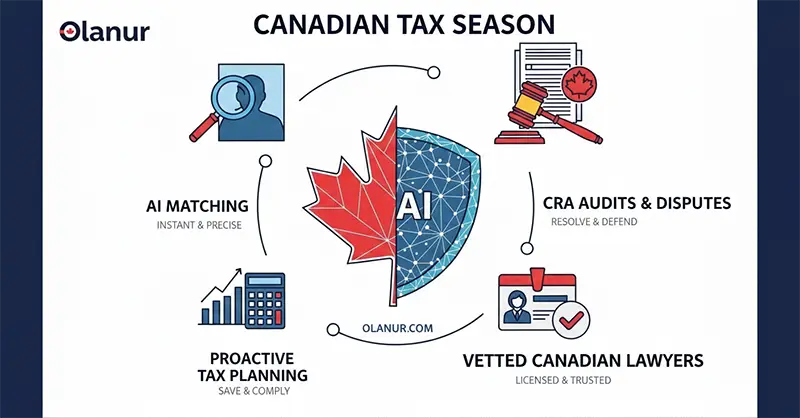
By the time you talk to a lawyer, they already understand the basic outline of your problem, and you can spend your first call getting real advice instead of repeating your story five times. you can Find a Lawyer and discuss your situation with them regarding tax lawyer Canada. you can also take a look at Finding the Right Lawyer article and if you are a lawyer willing to help you can take a look at For Lawyers section.
Questions to Ask Before You Hire a Tax Lawyer in Canada
Once Olanur connects you with potential lawyers, go into your first conversation prepared. Many of these questions overlap with the broader checklist for how to find a trustworthy lawyer in Canada. Consider asking:
• How much of your practice is devoted specifically to tax law in Canada and CRA disputes?
• Have you handled cases like mine (e.g., audits, unfiled returns, offshore income, VDP)?
• What are the realistic best‑case and worst‑case outcomes in my situation?
• How do you charge (hourly, flat fee, retainer), and what costs should I expect over the next 3–6 months?
• What information or documents should I gather before we move forward?
Their answers will help you decide whether this tax lawyer in Canada is the right fit — not just technically, but also in terms of communication style and budget. if you want to know more about tax lawyer Canada you can check out 7 common situations where tax lawyers in Canada.
Frequently Asked Questions
When should I hire a tax lawyer in Canada for the 2026 tax season?
You should consider hiring a tax lawyer in Canada if you have received a CRA audit letter, reassessment, penalty notice, collection warning, wage garnishment notice, or if you have unfiled returns, hidden income, foreign assets, business tax issues, or a possible voluntary disclosure situation.
Do I need a tax lawyer or an accountant for CRA issues?
For routine tax filing, deductions, bookkeeping, and return preparation, an accountant or tax preparer is usually enough. A tax lawyer is more appropriate when there is a legal dispute, CRA audit, penalty, reassessment, prosecution risk, collections action, voluntary disclosure, or complex tax strategy involved.
Can a tax lawyer help with CRA audits?
Yes. A tax lawyer can communicate with the CRA on your behalf, review audit requests, help prepare responses, challenge incorrect assumptions, and protect your legal position if the audit leads to reassessment, penalties, objections, or appeals.
Can a tax lawyer help with years of unfiled tax returns?
Yes. If you have several years of unfiled tax returns, a tax lawyer can help assess your risk, explain your options, and determine whether a voluntary disclosure or other corrective strategy may reduce penalties or prosecution risk.
What is the CRA Voluntary Disclosures Program?
The CRA Voluntary Disclosures Program allows eligible taxpayers to correct past tax non-compliance, such as unreported income or missing filings. In some cases, it may reduce penalties and prosecution risk, but the rules are strict, so professional advice is recommended before applying.
Can a tax lawyer stop CRA collections?
A tax lawyer may be able to help if the CRA has started collections, including wage garnishment, bank account freezes, liens, or payment demands. Depending on the case, they may challenge the assessment, negotiate payment arrangements, request relief, or start an objection or appeal.
Is it expensive to hire a tax lawyer in Canada?
The cost depends on the complexity of the issue, the lawyer’s experience, and whether the matter involves simple advice, CRA negotiation, voluntary disclosure, objections, appeals, or litigation. Many lawyers offer an initial consultation so you can understand the likely cost before committing.
How can Olanur help me find a tax lawyer in Canada?
Olanur helps you describe your tax issue in plain language and matches you with the right type of tax lawyer in Canada, such as a CRA audit lawyer, voluntary disclosure lawyer, business tax lawyer, or cross-border tax lawyer, based on your situation and urgency.
Related guides
- When to hire a tax lawyer in Canada (2026): 7 warning signs
- Tax law & tax lawyers in Canada: 7 situations where legal help matters
- How to find a lawyer in Canada (2026 step-by-step)
- Need a lawyer now? 7 fast ways to find one urgently
- Online lawyer in Canada: 2026 guide
Take Action Before the Deadlines Hit
Tax season deadlines are fixed, but your options shrink the longer you wait. If you are already past a deadline, see how to find a lawyer in Canada urgently. If any of the high‑risk situations in this article sound familiar — audits, unfiled returns, hidden income, collections, or big transactions — now is the time to talk to a tax lawyer Canada and understand your position.
Use this guide to decide whether you truly need a tax lawyer in Canada for the 2026 season. If the answer might be “yes,” let Olanur help you find the right professional quickly, so you can get ahead of CRA instead of waiting for another brown envelope to arrive.