

Hiring legal help used to mean phone calls, office visits, and a lot of guesswork. In 2026, that is no longer the only path.
Today, many Canadians want to hire an online lawyer in Canada because the process is faster, more flexible, and often less stressful than traditional searching. But convenience can create a false sense of confidence. Just because a lawyer is easy to find online does not mean they are the right fit for your issue, province, urgency, or budget.
That is where people make expensive mistakes.
They search broadly, skim a few profiles, trust surface-level reviews, and book the first consultation that feels “good enough.” Then they realize the lawyer does not handle that exact kind of matter, is not the best fit for the province involved, or charges in a way they did not fully understand.
If you want to hire an online lawyer in Canada the smart way, you need more than speed. You need fit, verification, clarity, and a system that reduces guesswork.
That is one reason platforms like Olanur.com are becoming more relevant. With Olanur users can describe their legal issue in plain language, have AI identify the likely legal category, and get matched with pre-vetted, licensed Canadian lawyers based on factors like location and case fit. Moreover, the platform is free for clients to use for matching and that legal services are provided only by the independent licensed lawyer the user chooses.
Need to legal help? Find a lawyer in minutes suitable with your case
Listen to Olanur’s podcast:
This guide breaks down the 7 costly mistakes to avoid before you choose, so you can move faster without making the wrong call.
Why more Canadians want to hire an online lawyer in Canada
The shift is simple: people want legal intake to feel more like modern digital services and less like a maze.
Instead of calling five offices, repeating the same story, and waiting for callbacks, users want a cleaner process. Olanur’s public pages reflect exactly that positioning: users describe their issue once, the platform analyzes the matter, and matching is based on legal category, location, and related fit signals. Olanur also says its lawyers are licensed, verified, and in good standing with their provincial law society.
That matters because legal problems rarely arrive in a calm, organized way. They usually show up as stress. Maybe you were terminated and need advice on severance. Maybe a business partner dispute is escalating. Maybe a family issue is becoming urgent. Maybe a CRA letter just landed in your inbox. In those moments, people do not want endless searching. They want a practical path forward.
But hiring an online lawyer still requires judgment. The right process can save time. The wrong one can waste weeks.

Mistake 1: Choosing based on convenience instead of legal fit
The most common error people make when they try to hire an online lawyer in Canada is assuming a lawyer who is accessible online is automatically appropriate for the issue.
That is not how legal matters work.
A family lawyer is not automatically the right fit for a relocation dispute. A business lawyer is not automatically the right fit for an IP-heavy licensing problem. An employment lawyer may handle routine termination matters but not necessarily complex executive compensation disputes.
A real example is Matthews v. Ocean Nutrition Canada Ltd., where the Supreme Court of Canada dealt with wrongful dismissal damages and whether a lost long-term incentive payout should be included during the notice period. The Court held that the dismissed employee was entitled to damages reflecting that payment, showing how termination issues can quickly become more specialized than they initially appear.
That is why legal category accuracy matters. Olanur’s model is useful here because it is built around issue analysis first, then matching, rather than forcing users to guess the legal category on their own.
Mistake 2: Ignoring provincial licensing and jurisdiction reality
A lot of users focus on the lawyer’s website, tone, and perceived professionalism, but forget a basic point: law in Canada is heavily provincial in practice and regulation.
The Canadian Bar Association’s public “Find a Lawyer” resource is organized around location and appropriate expertise, which reinforces that province and fit matter, not just generic legal capability.
If you want to hire an online lawyer in Canada, make sure the lawyer is actually licensed in the relevant jurisdiction and familiar with the practical context of your matter. Even when general legal principles overlap, procedure, local practice, and strategy can differ meaningfully by province.
This is one reason Olanur emphasizes matching by location in Canada in addition to category and other filters.
Mistake 3: Assuming every online consultation is the same
Not all online legal help is equal.
Some lawyers use virtual consultations as a convenience layer on top of a strong intake process. Others treat online intake like a rushed screening call. The difference matters.
When you hire an online lawyer in Canada, you want to understand:
- whether the lawyer actually handles your case type regularly
- what documents they want in advance
- whether the consultation is strategic or just introductory
- what happens after the meeting
- how billing works if you move forward
This is where a structured platform can reduce friction. Olanur says users can compare matched lawyers and that lawyers on the platform can be filtered by fit factors such as budget, urgency, and location, which creates more decision-making context before the consultation even happens.
Mistake 4: Overvaluing reviews and undervaluing case-type relevance
Reviews can help, but they are not enough.
A lawyer can have excellent reviews and still be the wrong person for your issue. Reviews often reflect responsiveness, friendliness, or general satisfaction. Those are useful signals, but they are not a substitute for practice-area alignment.
Consider family law. In Barendregt v. Grebliunas, the Supreme Court of Canada addressed a relocation dispute involving parenting and the best interests of the child. That kind of matter is not just “family law” in the abstract. It can require very specific experience in mobility disputes, evidence handling, and urgent decision-making.
So if you want to hire an online lawyer in Canada, ask a better question than “Does this lawyer look good online?” Ask: “Does this lawyer handle matters like mine often enough to see the hidden risks early?”
That is also why your article cluster matters. Users who are not sure whether they need a category-specific lawyer can continue reading related Olanur guides such as How to Find a Lawyer in Canada and How to Find a Trustworthy Lawyer in Canada.
Mistake 5: Waiting too long because the problem “doesn’t feel serious yet”
One of the biggest silent costs in legal matters is delay. If your matter has already become time-sensitive, our guide on how to find a lawyer in Canada urgently covers the fastest verified routes.
People hesitate because they do not want to overreact. They tell themselves they are “just gathering information.” Sometimes that is reasonable. Sometimes it becomes expensive.
Tax issues are a good example. Olanur has already built content around this because CRA matters can escalate quickly from confusion to legal risk. If a reassessment, audit, or penalties issue is developing, waiting too long can limit your options or worsen your position. That is why related resources like When to Hire a Tax Lawyer in Canada and CRA Tax Penalties Canada make strong supporting reads.
A Supreme Court example that shows how technically complex tax issues can become is Canada v. Alta Energy Luxembourg S.A.R.L., which dealt with treaty interpretation and the General Anti-Avoidance Rule. Most people will not face that exact scenario, but the case illustrates a bigger truth: tax issues can become highly legal very quickly.
If the stakes involve money, family, employment, immigration status, contracts, or government action, early clarity is usually cheaper than late correction.
Mistake 6: Not understanding what the platform does versus what the lawyer does
This is especially important for trust.
Olanur is clear in its public materials that it is a legal technology platform and online legal marketplace, not a law firm and not a provider of legal advice. The legal services themselves come from the independent licensed Canadian lawyers users choose through the platform.
That distinction is good, not bad.
It means the platform’s role is to improve matching, intake clarity, and speed. The lawyer’s role is to provide legal advice, strategy, and representation. If you want to hire an online lawyer in Canada, that separation actually helps you make a cleaner decision because you are not confusing technology assistance with legal counsel.
Mistake 7: Choosing before you compare the process itself
Many people compare lawyers, but not the process behind how they found them.
That is a mistake.
A smarter process helps you ask better questions, notice better signals, and avoid mismatches earlier. Olanur’s client-side flow, as described on its site, is built around: describe the issue, have AI classify the likely legal category, receive lawyer matches, and review fit before connecting. Olanur also highlights privacy features such as encryption, Canadian hosting for primary data, and no data selling.
Those details matter because when people hire an online lawyer in Canada, they are often sharing sensitive facts at the intake stage. A sloppy intake experience is not just annoying. It can undermine trust immediately.
How Olanur works if you want to hire an online lawyer in Canada
The strongest part of Olanur’s positioning is that it reduces guesswork at the start, the process works like this:
- You describe your legal issue in plain language.
- The system analyzes your wording and identifies the likely legal category.
- You are shown matched lawyers based on factors like location, need, and fit.
- You compare lawyer profiles and decide whether to connect.
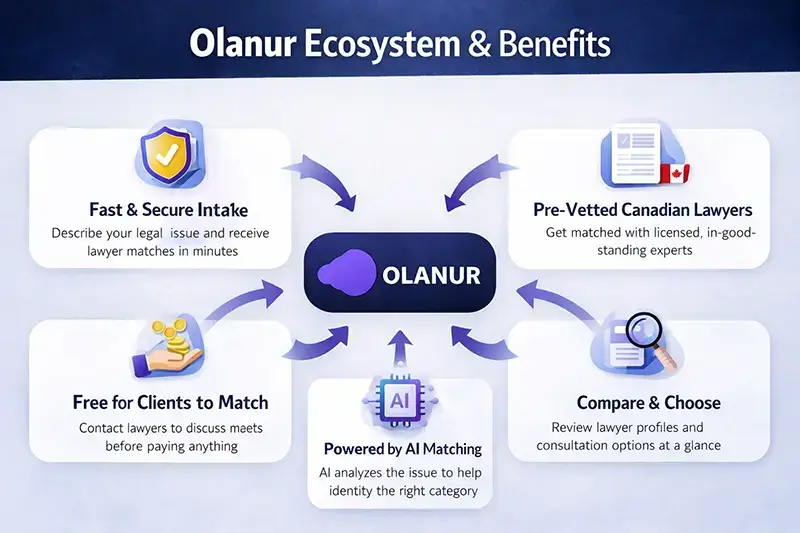
That matters because many users do not know what kind of lawyer they need before they begin. Olanur’s own messaging is built around that exact friction point of Online Lawyer in Canada: people know they have a problem, but not always the correct category or best path.
A practical checklist before you choose
Before you hire an online lawyer in Canada, make sure you can answer these questions clearly:
- What exact legal category does my issue likely fall into?
- Is the lawyer licensed in the relevant province?
- Do they handle this case type regularly, not occasionally?
- How is the consultation structured and billed?
- What documents should I prepare first?
- What happens after the consultation if I decide to move forward?
- Am I choosing based on real fit or just convenience?
That checklist will save more money than most people expect.
For specific lawyer helps needed regarding the lookup steps, see our detailed lawyer lookup guide.
Frequently Asked Questions
How do I hire an online lawyer in Canada?
To hire an online lawyer in Canada, start by identifying your legal issue, then compare lawyers based on practice area, province, experience, consultation format, and fees. A platform like Olanur can simplify the process by helping you describe your issue and get matched with relevant licensed lawyers.
Is hiring an online lawyer in Canada safe?
Yes, hiring an online lawyer in Canada can be safe if you use a reputable platform and verify that the lawyer is licensed and in good standing in the relevant province. You should also review their experience, consultation process, and communication style before moving forward.
What should I check before choosing an online lawyer in Canada?
Before choosing an online lawyer in Canada, check the lawyer’s practice area, provincial licensing, experience with similar cases, consultation fees, responsiveness, and whether they regularly handle the type of matter you have.
How much does it cost to hire an online lawyer in Canada?
The cost to hire an online lawyer in Canada depends on the lawyer, the complexity of the matter, and the fee structure. Some lawyers charge flat fees, while others bill hourly. On Olanur, users can get matched and compare options before deciding which lawyer to contact.
Can I hire an online lawyer in Canada for family, business, or tax issues?
Yes, you can hire an online lawyer in Canada for many types of legal matters, including family law, business disputes, employment issues, tax problems, contracts, and more. The key is to choose a lawyer whose experience matches your specific case type.
What are the biggest mistakes people make when hiring an online lawyer in Canada?
The most common mistakes include choosing based only on convenience, ignoring provincial licensing, focusing too much on reviews, waiting too long to seek help, and not comparing lawyers based on actual fit for the case.
How does Olanur help me hire an online lawyer in Canada?
Olanur helps users hire an online lawyer in Canada by letting them describe their legal issue in plain language, using AI to identify the likely legal category, and matching them with relevant licensed lawyers based on fit, location, and related factors.
Final thoughts
The easiest way to make a bad legal decision is to move fast without structure.
The smartest way to hire an online lawyer in Canada is to combine speed with verification—which is exactly why structured matching tends to outperform raw Google search for legal needs. That means understanding the issue, checking the fit, respecting jurisdiction, and using a process that helps you compare intelligently instead of guessing under pressure. If you are a lawyer who can provide their services to pre-qualified clients in need, you can register at For lawyers page.
That is why Olanur’s model is compelling. The platform is built to help users describe their issue once, identify the likely legal category with AI, and connect with pre-vetted, licensed lawyers matched to their needs, location, and context. It also makes clear that users remain in control of whom they choose, and that the platform itself does not provide legal advice.
Related guides
- How to find a lawyer in Canada (2026 cornerstone guide)
- How to find a trustworthy lawyer in Canada (red flags & warnings)
- Finding online lawyers in Canada: Google vs matching platforms
- Online lawyer in Canada: 2026 guide
- Need a lawyer urgently? 7 fast ways to find one in Canada
- Lawyer lookup in Ontario: find the right lawyer in minutes