Wrongful dismissal Ontario claims are one of the most misunderstood areas of Canadian employment law. If you were recently fired, laid off, or pushed to resign, your employer almost certainly told you the offer was “fair” and gave you a deadline to sign. Here is what they did not tell you: in Ontario, most terminations that look routine are technically wrongful dismissals, and most employees walk away with a fraction of what they are legally owed.
This guide walks you through the four types of wrongful dismissal in Ontario, a 60-second self-test to see if you have a case, and the exact steps to take before you sign anything. By the end, you will know whether to negotiate, walk away, or call an employment lawyer today.
If you are holding a termination letter right now, do not sign it today. In Ontario, you have up to two years to bring a wrongful dismissal claim, but the moment you sign a release, that window closes permanently.
A wrongful dismissal in Ontario is not what most people think. It is not the same as being fired for a bad reason. Under Ontario law, an employer can generally end an employment relationship for almost any legal reason, or no reason at all, as long as the dismissal does not violate the Ontario Human Rights Code or other protected rights.
A dismissal becomes wrongful when the employer fails to meet their legal obligations on the way out. Specifically, when they fail to provide:
Proper notice of termination, or pay in lieu of notice
The full common-law reasonable notice period (which is usually much higher than the statutory minimum)
Continuation of benefits during the notice period
Payment of bonuses, commissions, or other compensation that would have been earned during the notice period
In other words: a wrongful dismissal in Ontario is almost always about money and notice, not about the reason for termination. If you were terminated and the package you were offered does not reflect your full common-law entitlement, you may have a wrongful dismissal claim — even if your employer was polite, professional, and gave a perfectly legal reason for letting you go.
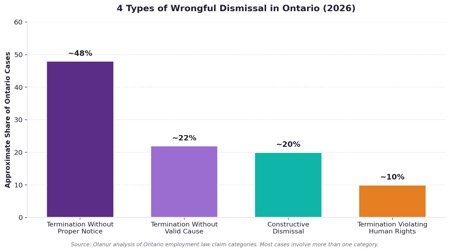
The four types of wrongful dismissal claims in Ontario. Most cases involve termination without proper notice — meaning the employer offered too little severance.
The 4 Types of Wrongful Dismissal Ontario Recognizes
1. Termination Without Proper Notice (the most common form)
This is the bread and butter of wrongful dismissal Ontario claims. Your employer terminates you without cause, gives you the Ontario Employment Standards Act (ESA) minimum (usually a few weeks of pay), and asks you to sign a release. The problem: the ESA is a floor, not a ceiling. Your common-law entitlement is almost always significantly higher. Accepting the ESA-only offer when you were owed common-law notice is the textbook wrongful dismissal scenario.
2. Termination Without Valid Cause
Employers sometimes try to avoid paying any severance by claiming “just cause” — that you were fired for serious misconduct. The legal bar for proving cause is extremely high in Ontario. If your employer alleged cause but cannot prove serious wrongdoing, the dismissal is wrongful and you may be entitled to additional damages on top of regular notice.
3. Constructive Dismissal
Constructive dismissal is when your employer makes a fundamental change to your job without your consent, and you resign because of it. Common examples include a significant pay cut, a demotion, a forced transfer, removal of major responsibilities, or sustained workplace harassment. Even though you technically resigned, the law treats it as if you were dismissed. We cover this in detail in our guide on workplace changes that may amount to constructive dismissal.
4. Termination Violating Human Rights
If your dismissal was connected to a protected ground, age, disability, pregnancy, race, religion, sexual orientation, family status, or others, the dismissal is wrongful regardless of any notice provided. These cases can also include human rights damages on top of common-law notice.
The 60-Second Wrongful Dismissal Ontario Self-Test
Answer yes or no to each of the questions below. If you answer yes to three or more, you very likely have a wrongful dismissal claim worth getting reviewed by an Ontario employment lawyer.
Were you given less than one month of severance per year of service?
Are you over 50 years old?
Did you work for the employer for more than 5 years?
Did your employer give you a short deadline (under 14 days) to sign the release?
Were you in a senior, managerial, or specialized role?
Did your duties, pay, or reporting structure change significantly in the year before you left?
Did your employer claim “cause” but you do not think there was serious misconduct?
Were you on a leave (medical, parental, disability) when terminated, or shortly after returning?
If you said yes to 3 or more of these questions, your wrongful dismissal Ontario claim is almost certainly worth more than the offer on the table. Most Ontario employment lawyers will review your termination package for free.
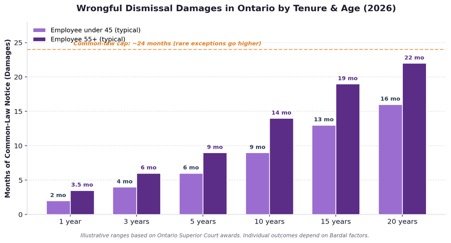
Typical common-law notice awards in Ontario by tenure and age. Older long-tenured employees receive significantly longer notice periods because the law assumes a longer job search ahead.
Typical common-law notice awards in Ontario by tenure and age. Older long-tenured employees receive significantly longer notice periods because the law assumes a longer job search ahead.
What You Can Claim in a Wrongful Dismissal Ontario Lawsuit
If you have a successful wrongful dismissal claim, your damages can include far more than just a few extra weeks of pay. Ontario courts may award:
Common-law reasonable notice — usually 1 to 2 months per year of service, capped around 24 months. This is the core of your claim. For a full breakdown by age and tenure, see our guide on how much severance you are entitled to in Ontario.
Continuation of benefits — health, dental, and life insurance during the notice period.
Bonus and commission — any bonuses or commissions you would have earned during the notice period.
Bad faith damages — if the employer acted dishonestly, harassed you on the way out, or made false cause allegations.
Human rights damages — when discrimination played a role in the termination.
Punitive damages — rare, but awarded in cases of egregious employer conduct.
One important 2026 update: in Williamson v. Brandt Tractor Inc., the Ontario Court of Appeal confirmed that income earned during the notice period — even from a lower-paying job — generally reduces wrongful dismissal damages. Translation: if you find work after termination, document your income carefully, because it factors into the math.
Don’t sign your termination package until you know what you’re owed. Olanur’s AI matches you with a vetted Ontario employment lawyer in minutes — free to use, no obligation. Most lawyers on Olanur will review your wrongful dismissal Ontario case at no cost.
5 Mistakes That Kill a Wrongful Dismissal Ontario Claim
1. Signing the release within the employer’s deadline
Employers often pressure you to sign within 5–10 days. There is no legal rule requiring this. Signing locks in the deal and ends every claim you might have had. Always ask for an extension in writing — it is almost always granted.
2. Missing the two-year limitation period
In Ontario, you have two years from the date of termination to file a wrongful dismissal claim under the Limitations Act, 2002. Miss it and your claim is permanently barred, even if you would have won. The clock typically starts on the date the notice of termination is given, not your last day of work.
3. Filing with the Ministry of Labour AND suing
If you file an ESA complaint with the Ontario Ministry of Labour for the same termination, you generally cannot also sue for wrongful dismissal. You must choose one. Almost always, suing for wrongful dismissal recovers far more — but you need legal advice before deciding.
4. Failing to mitigate
You are legally required to look for comparable work after termination. Keep a written log of every job application, interview, networking event, and recruiter contact. Without this, your damages can be reduced significantly.
5. Negotiating directly with the employer
Anything you say to HR or your former boss can be used against you. Once an employment lawyer sends a demand letter on your behalf, the dynamic changes completely. Most wrongful dismissal Ontario cases settle within weeks of a properly drafted demand letter — often for several times the original offer.
When to Hire a Wrongful Dismissal Ontario Lawyer
Not every termination needs a lawsuit. But there are clear signals that your wrongful dismissal Ontario case is worth at least a free consultation:
Your offer is at or near the ESA minimum, regardless of your tenure
You are 50+ with 5+ years of service
You held a senior, managerial, or specialized role
Your employer claims “just cause” but you do not believe there was serious misconduct
You were terminated during or shortly after a protected leave
Your job, pay, or duties changed significantly in the months before you left
A wrongful dismissal in Ontario occurs when an employer terminates an employee without providing proper notice, without a valid cause, in a way that fundamentally changes job terms (constructive dismissal), or in violation of human rights law. The most common type is termination without sufficient common-law notice.
How much can I get for wrongful dismissal in Ontario?
Wrongful dismissal Ontario damages are based on common-law reasonable notice, typically 1 to 2 months per year of service, capped around 24 months. A 50-year-old employee with 10 years of service might be entitled to 12-14 months of pay plus benefits, bonuses, and potentially additional damages — far more than the ESA minimum of a few weeks.
How long do I have to sue for wrongful dismissal in Ontario?
You have two years from the date of termination under Ontario’s Limitations Act, 2002. The clock typically starts on the date you receive notice of termination. Missing this deadline permanently bars your claim, so do not delay seeking legal advice.
Is constructive dismissal the same as wrongful dismissal in Ontario?
Constructive dismissal is one type of wrongful dismissal. It happens when your employer makes a fundamental change to your job — significant pay cut, demotion, harassment, or major change in duties — and you resign as a result. The law treats it as a dismissal even though you technically quit.
Do I need a lawyer for a wrongful dismissal Ontario claim?
While not legally required, having an employment lawyer dramatically improves your outcome. Most Ontario employment lawyers offer free wrongful dismissal consultations, and many work on contingency for stronger cases. Negotiating directly with your employer almost always results in a lower settlement than negotiating through counsel.
Can I sue for wrongful dismissal if I signed a release?
Generally, no. Once you sign a release, your right to sue is permanently extinguished. There are narrow exceptions — for example, if the release was signed under duress or without the chance to get legal advice — but they are difficult to prove. This is why getting legal review before signing is critical.
Next Steps
Wrongful dismissal in Ontario is one of the most under-claimed areas of employment law. The vast majority of Ontario employees who could pursue a wrongful dismissal claim never do — usually because they signed too fast, missed the limitation period, or simply did not know they had a case.
If you have been terminated, laid off, or pressured to resign, the highest-value 30 minutes of your week is a conversation with an employment lawyer. Olanur makes that conversation effortless.
Get your wrongful dismissal Ontario case reviewed today. Tell our AI what happened. We will match you with a pre-vetted Ontario employment lawyer who handles wrongful dismissal cases just like yours. Free to use Olanur, no obligation, no upfront cost.
Disclaimer: This article is for general informational purposes only and does not constitute legal advice. Olanur is a technology platform, not a law firm or lawyer referral service. Wrongful dismissal Ontario outcomes depend on the specific facts of each case. Always consult a licensed Ontario employment lawyer about your situation.
Kevin Rouzbeh is a legal content specialist focused on Canadian law and access to justice. He writes about employment law, tax issues, and how technology, especially AI, is transforming the way people find and work with lawyers in Canada. His work aims to simplify complex legal topics and help readers make informed decisions with confidence.