Prefer to listen?
When you look for a lawyer near you in Canada, every directory gives you a list of names. Olanur gives you two numbers next to each name, a match percentage and an approximate distance, and once you understand what those numbers are actually doing, the list stops being a list and starts being a decision.
This is not a small change. Most Canadians who set out to find a lawyer end up in the same loop: a Google search, three or four firm websites, a couple of phone calls that end in "we don't really handle that." The Canadian Bar Association has long flagged that a significant share of people facing serious legal problems never get to a lawyer at all, and friction during the discovery stage is one of the bigger reasons. The two numbers Olanur surfaces are designed to cut that friction at the exact point where most people give up.
Here is what they mean, when each one matters more, and the cases where they pull in opposite directions.
What you actually see in the dashboard
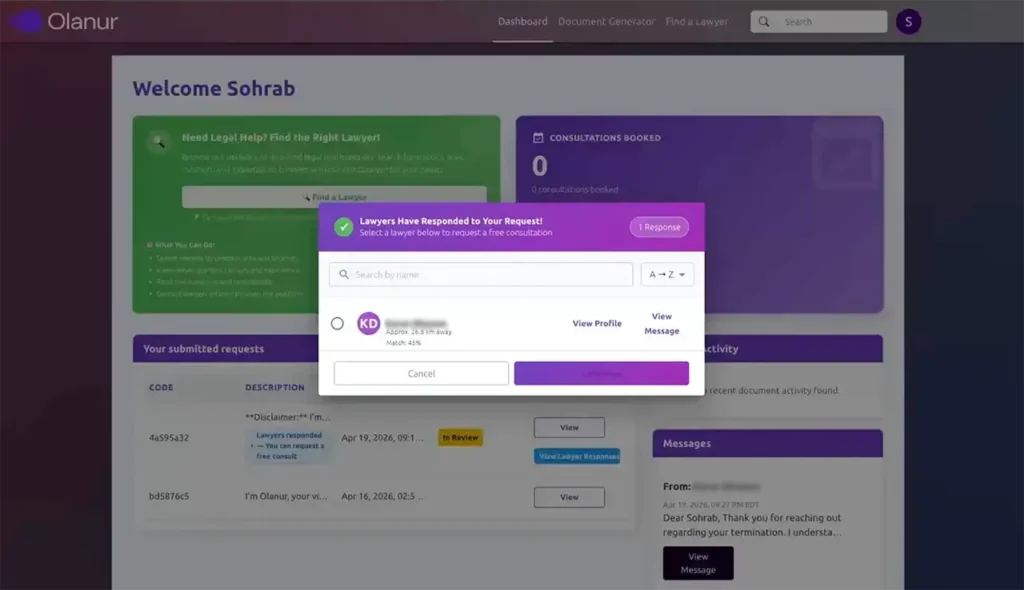
After you describe your issue and lawyers send back proposals, Olanur lays out a side-by-side view. For each proposal, you see the lawyer's name, profile, and fee structure, and, importantly, two markers:
-
Match percentage: a score out of 100 that summarizes how closely this lawyer's practice profile and stated specialization fit your specific issue.
-
Approximate distance: how far the lawyer's main office is from the postal code you entered when you submitted your request.
That is it. Both numbers are visible before you click anything. If you have ever scrolled a generic lawyer directory and felt like you were comparing apples to oranges, this is the direct response to that problem. (For a walk-through of how the rest of the platform fits together, the full step-by-step guide on how Olanur works covers each stage.)
The interesting part is how the two numbers interact, because the right answer is rarely "the closest one" or "the highest match." It is usually a balance, and the balance shifts depending on the kind of legal problem you have.
Distance matters more than people expect, for some matters
There is a popular idea that legal work has "gone virtual," and to a degree it has. Consultations happen over Zoom. Documents move through portals. But the underlying system is still provincial, and Canada has eleven separate sets of professional rules, ten provinces plus the territories under their own arrangements. The Federation of Law Societies of Canada manages the National Mobility Agreement, which lets common-law-province lawyers practise in other common-law provinces for up to 100 days a year. But Quebec runs on civil law, the territories operate under a separate Territorial Mobility Agreement, and even within the common-law provinces there are procedural rules that do not transfer cleanly across borders.
In other words, "Canadian lawyer" is not really a unit. Quebec lawyer, Ontario lawyer, Alberta lawyer - those are the real units, and they each come with their own courts, registries, and timelines.
How much physical proximity matters within a province depends heavily on the matter type. Real estate transactions are tied to land titles offices and local registry rules. Family law motions often happen at the specific courthouse where the file lives. Criminal matters are tied to where the charge was laid. Tax disputes with the CRA, on the other hand, are federal, a Calgary-based tax lawyer can represent a Toronto client without anyone leaving their desk.
Here is roughly how the dependency on proximity breaks down across common Canadian matter types:
How much physical distance matters by legal matter type Bar chart scoring how strongly proximity matters for each Canadian legal matter type, on a 1 to 10 scale. Real estate scores 9, family law in court 8, criminal defence 8, civil litigation 7, business disputes 5, wrongful dismissal 4, immigration 3, tax disputes 2.
How much physical distance matters by matter type
1 = barely matters · 10 = critical
The takeaway: if your matter is a real estate closing or a contested family law file, the closest qualified option often is the right answer. If you are dealing with a CRA reassessment or an immigration appeal, distance shouldn't drive the decision at all.
For matters that involve repeated court appearances, criminal defence, family trials, civil litigation, there is one factor most people forget. Many Canadian lawyers bill for travel time. If your file involves four or five appearances at a courthouse 90 minutes from the lawyer's office, you can be looking at several billable hours per appearance just for the drive. Picking a lawyer 10 minutes from the courthouse instead of 90 isn't sentimentality. It is a real cost difference over the life of a file.
What the match percentage is actually measuring
The match percentage isn't one thing. It is a weighted score across several dimensions of fit, and the weighting itself shifts based on what kind of issue you described in the intake step.
What goes into the match percentage
Approximate weighting of inputs (weighting shifts based on matter type)
In rough terms, the system looks at:
Legal category fit. Does the lawyer's primary practice area cover the matter you described? This carries the most weight.
-
Sub-issue alignment. Within the category, do the lawyer's stated specializations match your specific situation? "Family law" is broad; "high-conflict parenting time disputes" is specific. The closer the sub-issue match, the higher this signal scores.
-
Jurisdictional fit. Is the lawyer licensed and practising in the province where your matter sits?
-
Urgency match. If your issue is time-sensitive, can the lawyer take it on that timeline?
-
Budget and fee compatibility. Do their fee ranges fit what you signaled when you submitted your request?
-
Language preference. Important for clients who want to discuss their case in a language other than English.
A 92% match doesn't mean "this lawyer is 92% likely to win your case." It means the platform's confidence that this lawyer is a good practical fit for your situation, based on what you have shared and what the lawyer has declared about their practice. The number is a starting point for your judgment, not a substitute for it.
That distinction matters because legal outcomes are determined by the lawyer–client relationship, the facts of the case, and the law, not by an algorithm. If you want a deeper take on what to look for once you have narrowed your shortlist, the guide on how to find a trustworthy lawyer in Canada walks through the credibility signals (law society standing, communication style, fee transparency) that the match percentage doesn't capture on its own.

Where the two numbers pull in different directions
This is where most people make the wrong call.
The reflex is to pick the closest lawyer. It feels safer. But sometimes the highest-match lawyer is two cities over, and for the right kind of matter, that is the better choice. Other times, a 78% match across town beats an 89% match three hours away because the file involves court appearances every six weeks.
A simple way to think about it:
Reading the two numbers together
Three Olanur user scenarios across the trade-off quadrants
James, Vancouver
93% · 25 min · wrongful dismissal
Marie-Claude, Montreal
96% · Calgary lawyer · CRA audit
Reza, Mississauga
84% · 6 km · real estate
Skip, low match + far
low match + far rarely fits
The top-left quadrant, high match, close, is the easy decision. The bottom-right, low match, far, is an easy pass. The other two quadrants are where you actually have to think.
Family law matters involving contested parenting or property disputes are covered in our guide on family lawyers in Canada.
For a CRA tax dispute? Take the high-match lawyer regardless of distance. (See the breakdown of why CRA tax disputes call for specialized counsel.) For a contested custody motion in Ontario Family Court? Take the closer one if the match is reasonable, because you will see them in person more than once.
Three scenarios that show how this plays out
For a full explanation of what real estate lawyers handle and why local presence matters in Ontario closings, see our guide on real estate lawyers in Canada.
The Mississauga real estate closing. Reza is buying a townhouse and the deal is closing in 18 days. Two lawyers send proposals: 84% match, 6 km away in Mississauga, and 91% match, 47 km away in downtown Toronto. The closer one wins almost every time. Real estate closings involve in-person signing, title work tied to the local registry, and a clock that doesn't move. Seven percentage points of match aren't worth 47 kilometres of friction here.
The Quebec resident with a CRA audit. Marie-Claude is a freelance designer in Montreal facing a multi-year tax reassessment. She gets two strong proposals: 79% match in Laval, 20 minutes away, and 96% match in Calgary. The Calgary lawyer is a former CRA prosecutor who specializes in exactly the GST disagreement she is facing. Distance is irrelevant, CRA disputes are federal, conducted through written submissions and remote hearings. She picks Calgary. The 17-point match difference is the entire decision.
The Vancouver wrongful dismissal. James was let go after eight years, and the severance offer is well below what he thinks he is owed. He gets a 93% match from a downtown employment lawyer 25 minutes from his Burnaby home, and an 89% match from a lawyer in Surrey, 12 minutes away. Both can handle his matter, and most of the work will happen by email and phone. He goes with the higher match, the small distance difference doesn't outweigh four points of fit, and the matter doesn't need many in-person meetings. (For the framework on how severance and wrongful dismissal claims actually unfold, the piece on how much severance you may be entitled to in Ontario lays out the structure, BC follows similar principles.)
The pattern across all three: distance and match percentage aren't ranked the same way for every type of matter. The right answer comes from reading them together, with the matter type as the tiebreaker.

A practical way to read the two numbers together
A simple decision rule that works for most situations:
If the matter involves multiple in-person appearances, weight distance heavily.
-
If the matter is mostly remote, paper-based, or federal in nature, weight match percentage heavily.
-
If proposals are within 5 percentage points of each other on match, distance breaks the tie.
-
If they are more than 10 points apart, match wins unless distance is genuinely prohibitive.
And one quiet rule on top of that: don't let either number replace the conversation. The platform shows you the two numbers because they are useful inputs. Once you have used them to narrow down to two or three lawyers worth talking to, the Canadian Bar Association directory and provincial law society sites can help verify standing, and your own conversations should answer the questions a percentage cannot, like whether the lawyer explains things clearly, whether their fee structure fits your budget, and whether you actually want to work with them.
If you want to see how the proposals look in the dashboard, the step-by-step walk-through shows the view where match percentage and distance appear side-by-side. And if your matter is genuinely time-sensitive, the piece on finding a lawyer in Canada urgently covers what changes when you don't have weeks to compare.
Frequently asked questions
For most consultations, no, video calls are standard now. But for matters that involve court appearances, document signings, or in-person meetings with opposing counsel, the office location still affects how the file unfolds. Lawyers also often bill for travel time, which adds up over a long matter.
There is no universal threshold. An 80% match for a routine matter (like a simple severance review) is usually plenty. The same 80% on a complex multi-jurisdictional dispute might mean you should keep looking. Read the percentage in the context of how complex and specialized your issue is.
Often yes, depending on the matter. Federal matters (tax, immigration, federal court litigation) and remote work like contract review can usually be handled by a lawyer in any province. Provincial litigation, family law, real estate, and criminal cases generally need a lawyer licensed in your province, though the National Mobility Agreement allows temporary practice across common-law provinces in some cases.
No. Submitting your request and seeing matched lawyers is free. You only enter into a fee agreement with the lawyer you choose, and that agreement is between you and them, not Olanur.
All lawyers on Olanur are pre-vetted and confirmed to be in good standing with their provincial law society before they can send proposals. As a final due-diligence step, you can also verify a lawyer's standing yourself through the relevant law society directory before signing a fee agreement.
A closing thought
Most "find a lawyer" platforms hand you a directory and walk away. The point of putting match percentage and distance side-by-side is to take the two variables that matter most at the start of the search and put them in plain sight, before you spend an hour reading bios. Used together, they answer the two questions you actually need to answer first: is this person right for my problem, and is the practical setup workable for the way my matter will unfold?
If you are at the stage of comparing lawyers, start a request and see your matches. If you are earlier, still trying to figure out whether you even need a lawyer, the broader guide on how to find a lawyer in Canada is a better starting point.
Aiden Bennett
Legal Technology & General Legal Contributor
Aiden writes on AI in law, digital copyright, legal technology platforms, and how Canadians can find and access legal help online, with a focus on making the legal system more approachable.