You filed your taxes. You followed the rules. Then a letter arrived from the Canada Revenue Agency telling you they disagree, and you owe more money. A CRA tax dispute is one of the most stressful legal and financial situations a person or business can face. The deadlines are tight, the stakes are high, and navigating the objection and appeal process without guidance can be costly.
For context on the broader changes driving increased reassessments, our guide on Canada tax changes for 2026 explains the new enforcement priorities and filing rules.
If you've received a notice of assessment or reassessment that you believe is wrong, you have rights. This guide explains exactly what a CRA tax dispute involves in 2026, the steps you can take, and when connecting with a tax lawyer in Canada is not just helpful - it's critical.
⚠️ 2026 Tax Season Alert: The CRA is using advanced AI and machine learning tools to flag returns this season. The number of reassessments is rising. If you receive one, do not ignore it - you have only 90 days to respond.
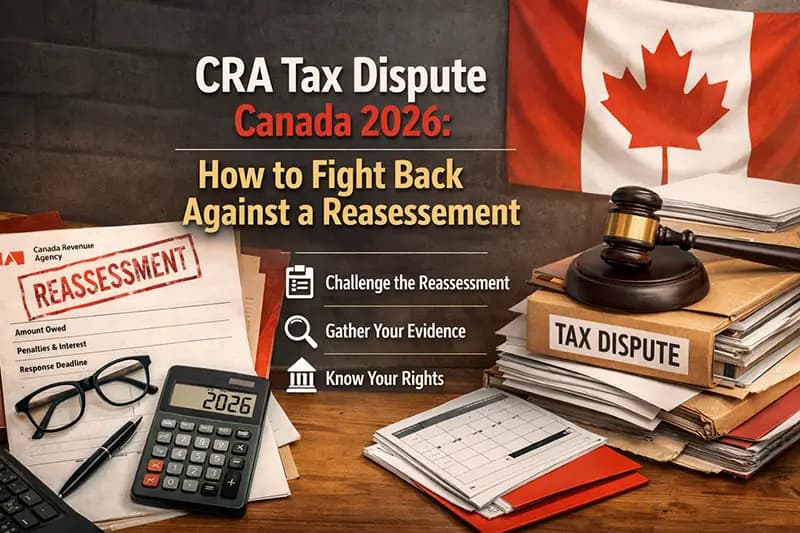
What Is a CRA Tax Dispute?
A CRA tax dispute arises when the Canada Revenue Agency issues a Notice of Assessment (NOA) or Notice of Reassessment that you believe is incorrect. This could happen because the CRA:
• Denied deductions or credits you legitimately claimed
• Reclassified your income or business expenses
• Applied penalties or gross negligence charges
• Audited your return and arrived at a different taxable income figure
• Reassessed prior tax years under the statute of limitations
The formal process for challenging the CRA's position has two main stages: filing a Notice of Objection and, if that fails, appealing to the Tax Court of Canada. Understanding each stage is essential, and getting it right from the start significantly improves your chances of success.
Stage 1: The Notice of Objection, Your First Line of Defence
The 90-Day Deadline You Cannot Miss
Once you receive a Notice of Assessment or Reassessment, you have 90 days to file a formal Notice of Objection with the CRA's Appeals Division. Miss this window and you lose your right to dispute that assessment, unless you can successfully apply for a time extension, which is granted only in limited circumstances and must be requested within one year.
This is not a soft deadline. The CRA enforces it strictly, and many Canadians have lost valid disputes simply because they waited too long.
What the CRA Does With Your Objection
After the CRA receives your Notice of Objection, they assign an Appeals Officer to conduct an independent review. This officer will contact you or your representative to discuss the dispute and review supporting documentation. According to the CRA, medium-complexity income tax objections resolved in January 2026 took an average of 364 days, over a year, to resolve. High-complexity cases take even longer.
During the objection period, the CRA generally postpones collection action on the disputed amount, but interest continues to accrue, and filing the objection also restarts the CRA collections limitation period. This is a critical reason why resolving disputes efficiently, with proper legal support, matters financially.
💡 Pro Tip: How you structure your Notice of Objection determines how strong your position is if the dispute escalates to Tax Court. A poorly written objection can limit your arguments later. This is where a tax lawyer's expertise is invaluable.
Stage 2: Appealing to the Tax Court of Canada
If the CRA's Appeals Division confirms the reassessment, or fails to issue a decision within 90 days of your income tax objection, you have the right to appeal directly to the Tax Court of Canada. You have another 90-day window from the date of the CRA's confirmation to file this appeal.
The Tax Court of Canada offers two procedures:
Informal Procedure: For disputes under $25,000 in tax or $50,000 in loss claims. Less formal, no filing fee, and you can represent yourself, though legal guidance is still strongly advised.
General Procedure: For larger disputes. This is a formal legal proceeding with strict rules of evidence and procedure. Having a tax lawyer represent you is essentially essential here.
It's worth noting that many Tax Court appeals are settled by the Department of Justice before they ever reach trial. A well-prepared case, with strong documentation and experienced legal counsel, positions you to negotiate a favourable resolution without the cost and uncertainty of a courtroom.
The Most Common Reasons Canadians Dispute CRA Reassessments in 2026
The CRA's audit priorities in 2026 have created a surge in reassessments across several key areas. Based on current CRA enforcement trends, the most common grounds for a CRA tax dispute this season include:
Real Estate Transactions: Short-term rental income, GST/HST on new builds, and principal residence exemption claims are all under intense scrutiny. HST alone on a $1 million Toronto property can reach $130,000, making accurate classification a high-stakes issue.
Cryptocurrency: The CRA requires Canadians to report every crypto sale, trade, donation, and purchase. Incorrect or missing crypto reporting is one of the most rapidly growing areas of reassessment. If you know of gains you never reported and the CRA has not raised them yet, coming forward first can waive the penalties and most of the interest a later reassessment would carry, as our guide to CRA voluntary disclosure shows.
Business Expense Disputes: Home office claims, vehicle expenses, and subcontractor payments are frequently challenged by the CRA, particularly for self-employed individuals and small businesses.
Employment vs. Self-Employment Classification: The CRA increasingly challenges whether workers are truly independent contractors or should be classified as employees, triggering payroll obligations and penalties.
If your reassessment falls into any of these categories, the dispute is unlikely to be straightforward. These are exactly the situations that benefit most from experienced legal representation.
Can You Handle a CRA Tax Dispute Without a Lawyer?
Technically, yes, for simple, low-stakes matters. The CRA's objection process is accessible to self-represented individuals, and for straightforward disputes over minor credits or small amounts, you may not need legal help.
But here's the reality: the CRA has experienced tax professionals on its side. They know the rules, the loopholes, and the pressure points. When your financial future is on the line, a large reassessment, a gross negligence penalty, unreported income allegations, or a foreign asset dispute, representing yourself is a significant risk.
A tax lawyer in Canada brings several critical advantages to a CRA tax dispute:
• Knowledge of CRA internal policies and audit procedures that taxpayers simply don't have access to
• Ability to frame arguments strategically from the objection stage forward
• Solicitor-client privilege protecting all communications
• Experience negotiating with CRA counsel before and during Tax Court proceedings
Here is where Olanur lawyer matching platform can help you out find the right lawyer, with expertise in CRA tax dispute in your area in seconds without the need of hours of browsing internet and looking at different websites. If you are looking for a lawyer you can check out find a lawyer and if you are an experienced lawyer looking to help check out for lawyers.

Not sure if your situation warrants legal help? Read our guide on When to Hire a Tax Lawyer in Canada (2026): 7 Warning Signs the CRA Is Coming After You
What Happens If You Do Nothing?
Ignoring a CRA reassessment is the worst possible option. If you do nothing within the 90-day objection window, the assessment becomes final and legally binding. The CRA will then pursue collection, which can include:
• Garnishing your wages or bank accounts
• Placing liens on your property
• Withholding future tax refunds and government benefits
• Referring your file to the CRA's Special Enforcement Program for suspected fraud
The penalties and interest charges that accumulate during inaction can dwarf the original disputed amount. For a detailed breakdown of how CRA penalties compound, see our CRA Tax Penalties Canada 2026: Complete Guide to Fines, Interest & How to Protect Yourself.
Key Deadlines in a CRA Tax Dispute (2026)
Day 0: You receive the Notice of Assessment or Reassessment
Day 90: Deadline to file your Notice of Objection (or apply for extension)
Up to 1 year: Deadline to apply for a late-filing extension if you missed Day 90
90–180 days after objection: CRA must issue decision or you can proceed to Tax Court
90 days after CRA decision: Deadline to appeal to the Tax Court of Canada
What to Do Right Now If You're Facing a CRA Tax Dispute
If you've received a reassessment or are anticipating one, here is what you should do immediately:
1. Note the date on your notice. Your 90-day clock starts from that date.
2. Gather all supporting documents. Invoices, bank records, lease agreements, correspondence, anything that supports your position.
3. Do not contact the CRA informally to "work it out." Informal conversations rarely resolve disputes and can sometimes inadvertently hurt your case.
4. Consult a tax lawyer before filing anything. The way your objection is structured will determine your options down the line.
You can also review what specifically may have triggered the CRA's attention by reading our CRA Audit 2026: Top Triggers and How to Protect Yourself.
External Resources
For the official CRA objection process, visit CRA Objections and Appeals. For information about the Tax Court of Canada's procedures, visit Tax Court of Canada.
Frequently Asked Questions About CRA Tax Disputes in Canada
It depends heavily on complexity. Low-complexity objections resolved in early 2026 averaged 129 days. Medium-complexity cases, including business expense disputes and small corporation issues, averaged over 364 days. High-complexity disputes involving large corporations or anti-avoidance rules take significantly longer.
In most cases, the CRA postpones collection action on amounts in dispute while your Notice of Objection or Tax Court appeal is active. However, interest continues to accumulate on any balance owing throughout this period. Collection is not suspended for certain types of withholding taxes.
You may apply for a time extension, but only within one year of the original deadline. You must provide a valid explanation for why you missed the deadline. These applications are not automatically granted, another reason to act quickly and consult a professional when you receive a reassessment.
Yes, significantly. While a CPA or accountant can provide valuable support with documentation, a tax lawyer is a licensed legal professional who can represent you in formal proceedings, benefit from solicitor-client privilege, and argue your case before the Tax Court of Canada. For serious disputes, especially those involving penalties or potential fraud allegations, a tax lawyer is essential.
Anita Rouzbeh
Tax & Business Law Contributor
Anita covers Canadian tax law and corporate legal matters, including CRA audits, tax disputes, business compliance, and tax planning for individuals and small businesses.