This article provides general information about impaired driving charges in Ontario as of October 2026 and is not legal advice. Statutory references are to the Criminal Code, R.S.C. 1985, c. C-46 (current to 18 July 2026), the Highway Traffic Act, R.S.O. 1990, c. H.8 (consolidation from 1 July 2026), and its regulations on administrative penalties, drivers' licences and conduct review programs, all read on 25 October 2026.
An impaired driving Ontario charge is two cases that start in the same minute. The province takes your licence at the roadside, and often your car, before anyone has proved anything. The federal charge waits in court, where the evidence still has to hold up. By the first court date, that first case can be half over.
So this guide runs on a clock. It follows the stop from the first demand to the years after a conviction, and at each point it says which law is acting, whether a conviction is needed, and whether anything is left to argue. It is the first Ontario guide under our overview of criminal lawyers in Canada, and if you already have a court date, Olanur can match you with a criminal defence lawyer, free.
Impaired driving Ontario at a glance: one stop, two cases
An impaired driving Ontario stop can start two separate cases: an administrative one under the Highway Traffic Act, which needs no conviction and begins at the roadside, and a criminal one under the Criminal Code, which needs proof in court.
| Ontario (Highway Traffic Act) | Federal (Criminal Code) | |
|---|---|---|
| Starts | At the roadside | With the charge; decided in court |
| Needs a conviction? | No | Yes |
| The licence | 7, 14 or 30 days for a warn reading; 90 days for 80 mg or more, a refusal, or a failed drug evaluation | A driving prohibition of 1 to 3 years on a first offence |
| The car | Impounded 7 days (80 mg or more, refusal, drug evaluation) | Nothing at this stage |
| The money | $250 to $550 penalty, plus a $281 reinstatement fee | A fine of at least $1,000 to $2,000 on a first offence |
| Can it be contested? | Only the 90-day suspension, at a Tribunal, on two narrow grounds | Yes, at trial |
Ontario changed several of these rules in 2026, which is why older pages online often disagree with each other:
- 1 January 2026: warn-range suspensions became 7, 14 and 30 days, counting back 10 years (HTA s. 48 (14), (15), as amended by the Safer Roads and Communities Act, 2024). The same date brought an indefinite suspension for a conviction of impaired driving causing death (s. 41.0.1), reducible only after 25 years.
- 1 July 2026: for offences from that date, the ignition interlock is followed by at least six months with no alcohol and no drugs, and installing the device within 30 days can shorten the interlock period, according to Ontario's Ignition Interlock Program page.
One traffic stop, two prosecutions
Ontario acts at the roadside. The Criminal Code waits for a verdict.
Choose what happened at the roadside, then tap any car on either track.
At the roadside
At the station
Day 7
Day 90
In court
Sentence
Years after
OntarioHighway Traffic Act
Criminal Codefederal, in court
Ontario (HTA)
Criminal Code
At the roadside
At the station
no stop
Day 7
no stop
Day 90
no stop
In court
no stop
Sentence
Years after
Ontario · At the roadsideNo conviction needed
90-day suspension and 7-day impound
A reading of 80 mg or more at the station, or a failure or refusal to comply with a demand, means a 90-day suspension and a $550 penalty. The car goes to an impound facility for 7 days at its owner's cost.
Can it be contested? The suspension can be appealed to the Licence Appeal Tribunal ($106) on two grounds only: you are not the person tested, or a medical reason stopped you giving the sample. It keeps running during the appeal. The impound cannot be appealed.
HTA ss. 48.3, 48.4 (1), (13), 50.1 (2), (7); O. Reg. 273/07 s. 1 (4)
Minute one: the demand, and why refusing is its own crime
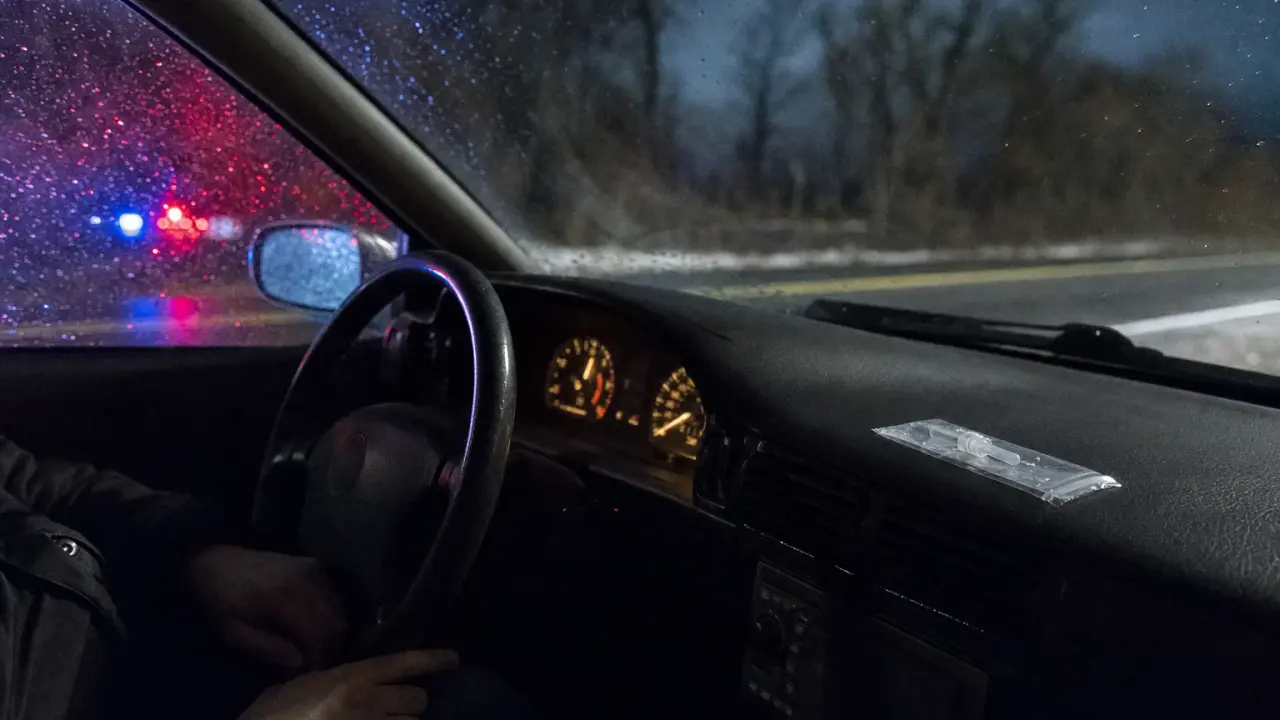
An officer with an approved screening device can demand a breath sample from any driver who has been lawfully stopped, with no suspicion of drinking needed. Refusing without a reasonable excuse is a separate Criminal Code offence.
That first rule, mandatory alcohol screening, sits in s. 320.27 (2) of the Criminal Code, and Justice Canada's own impaired driving page puts it plainly: police can demand a preliminary breath sample "without reasonable suspicion that the driver has alcohol in their body." Where an officer does suspect alcohol or a drug, s. 320.27 (1) also allows a demand for physical coordination tests or an oral fluid drug screen.
Saying no does not end the matter. Under s. 320.15 (1), failing or refusing to comply with a demand, knowing it was made and without a reasonable excuse, is an offence with the same penalty structure as impaired driving, and the minimum fine on a first conviction is $2,000 (s. 320.19 (4)), higher than for most over-80 readings. Ontario treats a refusal like a high reading too: it brings the 90-day suspension and the 7-day impound. Department of Justice materials call impaired driving "the leading criminal cause of death and injury in Canada."
Minute five: the number on the screen decides which law takes over
The roadside reading sorts an impaired driving Ontario case. Under 50 mg of alcohol in 100 mL of blood, a fully licensed adult driver usually goes home. From 50 to 79 mg, Ontario acts alone. At 80 mg or more, both governments act.
- Warn range, 50 to 79 mg. Ontario suspends the licence for 7 days the first time, 14 the second and 30 the third, counting suspensions in the last 10 years (HTA s. 48 (14), (15)). The administrative penalty is $250, $350 or $450 under O. Reg. 273/07. You can ask on the spot for a second test on a different device, and the second result governs (s. 48 (6) to (6.2)). There is no appeal (s. 48 (9)).
- 80 mg or more, or a refusal. The Criminal Code line is 80 mg within two hours of driving (s. 320.14 (1) (b)). Ontario adds a 90-day suspension (HTA s. 48.3), a $550 penalty (O. Reg. 273/07, s. 1 (4)) and a 7-day impound (s. 48.4).
- Drugs. After field sobriety tests, an officer who believes a drug impairs your driving takes the licence for 7 days (s. 48.0.1). A drug evaluation leading to the same view brings 90 days and the impound (s. 48.3.1).
- Young and novice drivers. Anyone under 22, and any G1, G2, M1 or M2 driver, must have a blood alcohol level of zero (s. 44.1), so any alcohol at all can bring a suspension of 7, 14 or 30 days (ss. 48.1, 48.2.1).
A warn reading on its own is not a crime. A criminal charge at that level would have to rest on separate evidence that your ability to drive was "impaired to any degree" (s. 320.14 (1) (a)).
Hour one: the breath room and the two-hour rule
Over-80 cases are proved with two samples into an approved instrument, usually at a police station. The readings are conclusive only if the instrument's checks were done, the samples were at least 15 minutes apart, and the two results were close enough.
Section 320.31 (1) sets those conditions: a system blank test and a calibration check before each sample, an interval of at least 15 minutes, and results within 20 mg of each other once rounded down. Where they are met, the lower reading is the one that counts. Section 320.34 then requires the prosecutor to disclose the blank tests, the calibration checks, any error messages and the results, which is where many defences begin.
Timing matters in a second way. The offence is measured "within two hours after ceasing to operate" the car. If the first sample comes later than that and shows 20 mg or more, s. 320.31 (4) adds 5 mg for every 30 minutes past the two hours. And s. 320.14 (5) protects a narrow group: someone who drank only after driving, with no reasonable expectation of being tested, whose drinking is consistent with being under 80 while driving.
Once you are arrested or detained, s. 10 (b) of the Charter gives you the right "to retain and instruct counsel without delay and to be informed of that right." Whether that right was respected at the station is one of the first things a defence lawyer checks.
Day one to day 90: what Ontario takes before any trial
Within hours of an over-80 reading or a refusal, Ontario has taken the licence for 90 days and the car for 7, charged a $550 penalty, and started the clock on a remedial program. None of it waits for a verdict.
The impound under s. 48.4 is "at the cost and risk of its owner", and the facility can hold the car until towing and storage are paid (s. 48.4 (14)). The owner and the driver are jointly liable for those costs (s. 48.4 (16)), and an owner who lent the car can sue the driver for them (s. 48.4 (17)), for example through Small Claims Court in Ontario. Our guide to stunt driving in Ontario explains the same impound mechanics for a 14-day seizure.
The 90-day suspension can be appealed to the Licence Appeal Tribunal, but only on two grounds: you are not the person who was tested, or a medical reason prevented you from giving the sample (HTA s. 50.1 (2)). The Tribunal's notice of appeal carries a $106 fee per licence, and the suspension keeps running while the appeal is heard (s. 50.1 (7)). The impound itself cannot be appealed (s. 48.4 (13)).
Consider a 34-year-old nurse in Mississauga, stopped at a holiday spot check in her brother's SUV, who blows 90 mg at the station. Both illustrations in this guide are hypothetical. Her licence is gone for 90 days, her brother pays to get his SUV out after 7, and he can recover that from her. Neither Tribunal ground fits her facts. Getting to night shifts for the next three months is now the most urgent problem she has, and nothing in the criminal case can solve it.
Day 90: the plea window that sets your suspension
For a first offence involving alcohol only and no injury, Ontario offers a shorter suspension to people who plead guilty quickly. The deadline is counted from the day of the offence, not the day of the charge or the first court date.
Ontario's Reduced Suspension with Ignition Interlock program has three streams, and the regulation behind it, O. Reg. 287/08, ss. 25 and 27, sets the timing:
| Stream | Who | Minimum suspension | Then an interlock for at least |
|---|---|---|---|
| A | First offence, guilty plea and driving prohibition within 90 days of the offence | 3 months | 9 months |
| B | First offence, not meeting Stream A | 6 months | 12 months |
| D | Second offence, guilty plea and prohibition within 90 days | 9 months | 18 months |
The standard path without the program is a 1-year suspension on a first conviction and 3 years on a second (HTA s. 41 (1)). Drug cases, injury cases and anyone already under an interlock condition are excluded (O. Reg. 287/08, s. 25 (1), (2)).
This is the hardest decision in the whole file. Stream A shortens the time off the road, but only by giving up the trial within weeks, often before the disclosure has been fully reviewed. Ontario's page advises registering for the remedial program "immediately upon conviction" to meet its timelines. Many people choose to have a lawyer review the breath records before deciding, precisely because the window is so short.
Months 1 to 18: where a defence is built
A defence to an impaired driving Ontario charge is built from the disclosure, not from a theory. The questions are concrete: was the stop lawful, was each demand properly made, were the samples taken on time, and did the instrument meet the conditions in s. 320.31.
The first appearance is where the disclosure usually arrives. Legal Aid Ontario's notice to accused persons says you can take it to "a free duty counsel lawyer" at the courthouse and, in many cases, find out what the Crown would recommend on a guilty plea. Anyone wanting to cross-examine the person who signed a breath certificate applies in writing, serves the prosecutor at least 30 days before that application is heard, and the hearing itself has to take place at least 30 days before trial (s. 320.32 (3) to (5)).
Delay is the other lever. In R. v. Jordan, 2016 SCC 27, the Supreme Court set a ceiling: "For cases going to trial in the provincial court, the presumptive ceiling is 18 months from the charge to the actual or anticipated end of trial" (para. 49), not counting delay the defence caused. For offences committed on or after 18 July 2026, a new Part of the Criminal Code adds that a court may stay a charge for delay only if "no other remedy would be appropriate and just" (s. 492.31).
Now consider a contractor in Ottawa, 51, who refuses the roadside test in 2026 and had an impaired conviction in 2014. Ontario counts only convictions within the previous 10 years (HTA s. 41 (3)), so for licence purposes a 2026 conviction would be his first. The Criminal Code has no such limit (s. 320.26), so the Crown could seek the 30-day minimum for a second offence, but only if it notified him before he entered a plea (s. 727 (1)). The same man is a first offender in one system and a repeat offender in the other.
Sentencing: what an impaired driving conviction carries
A conviction brings mandatory minimums: a fine of at least $1,000 for a first offence, 30 days in jail for a second and 120 for a third, plus a driving prohibition of at least one year.
The first-offence fine rises with the reading: at least $1,500 from 120 mg and $2,000 from 160 mg (s. 320.19 (3)), and $2,000 for a refusal. The court also orders a prohibition from driving: 1 to 3 years on a first offence, 2 to 10 on a second, and at least 3 on any later one (s. 320.24 (2)), each plus any time in jail. A 30% victim surcharge is added to any fine (s. 737 (2) (a)).
If there is a conviction
Four consequences, two governments, and they count your past differently
Breath reading, or a refusal
Criminal Code
Court minimum
Criminal Code
Court driving prohibition
Highway Traffic Act
Ontario licence suspension
Ontario
Ignition interlock after
$1,000 fine
Any first offence under s. 320.14 (1) (s. 320.19 (1))
1 to 3 years
Plus any jail term. Interlock driving needs no minimum wait unless the court sets one (s. 320.24 (10) (a))
1 year
Or a minimum of 6 months through the reduced-suspension program, Stream B (HTA s. 41 (1) (f))
1 year minimum
9 months if installed within 30 days of reinstatement, offences from 1 July 2026; Stream B: 12 months
30 days' jail
Only if the Crown gave notice before the plea that it would seek the higher minimum (s. 727 (1))
2 to 10 years
Plus any jail term. No interlock driving for at least 3 months after sentence (s. 320.24 (10) (b))
3 years
If the conviction is within 10 years of the last one (HTA s. 41 (1) (g), (3))
3 years minimum
2 years if installed within 30 days of reinstatement, offences from 1 July 2026
120 days' jail
For each subsequent offence, with the same notice rule (ss. 320.19 (1), 727 (1))
3 years or more
No upper limit, plus any jail term. No interlock driving for at least 6 months (s. 320.24 (10) (c))
Indefinite
May be reduced after 10 years if criteria are met. A fourth conviction within 10 years: no reduction (ontario.ca)
6 years minimum
If the licence is reinstated after at least 10 years
Criminal Code · Court minimum
$1,000 fine
Any first offence under s. 320.14 (1) (s. 320.19 (1))
Criminal Code · Court driving prohibition
1 to 3 years
Plus any jail term. Interlock driving needs no minimum wait unless the court sets one (s. 320.24 (10) (a))
Highway Traffic Act · Ontario licence suspension
1 year
Or a minimum of 6 months through the reduced-suspension program, Stream B (HTA s. 41 (1) (f))
Ontario · Ignition interlock after
1 year minimum
9 months if installed within 30 days of reinstatement, offences from 1 July 2026; Stream B: 12 months
Two ways of counting. The Criminal Code treats any earlier impaired conviction as an earlier offence, with no time limit (s. 320.26). Ontario counts only convictions within 10 years (HTA s. 41 (3)), so the same driver can be a second offender in one column and a first in another.
After the interlock. For offences from 1 July 2026, at least six months with no alcohol and no drugs follow the interlock.
Two things are missing from that list. A discharge is not available, because s. 730 (1) excludes offences with a minimum punishment. The narrow alternative is s. 320.23: with the consent of the prosecutor and the offender, a court can delay sentencing so the offender can attend a treatment program approved by the province, and if it is completed, the minimums need not be imposed. The court also has to weigh listed aggravating factors under s. 320.22, including a reading of 120 mg or more, a passenger under 16, and being paid to drive at the time.
After the conviction: Back on Track, the interlock and zero tolerance
A conviction starts Ontario's longest chain of consequences: a licence suspension of 1 year, 3 years or longer, a remedial program, an ignition interlock, and for offences from 1 July 2026 a zero-tolerance condition after that.
Back on Track, Ontario's remedial program for impaired drivers, says on its own site that convicted drivers pay $894 and that the program "may take up to 11 months to complete", through an assessment, an 8-hour education or 16-hour treatment workshop, and a six-month follow-up. The licence is not reinstated until it is done (HTA s. 41 (4.1)). Drivers who took the $344 program after the 90-day roadside suspension are told that fee does not carry over.
Ontario's Ignition Interlock Program page sets the minimum interlock periods after a conviction at 1 year for a first offence, 3 years for a second, and 6 years for a third where the licence returns after at least 10 years. The device will not start the car above a reading of 0.02, and it asks for rolling re-tests while you drive. For offences from 1 July 2026, installing it within 30 days of reinstatement can shorten those periods to 9 months and 2 years. Drivers pay all installation and maintenance costs. Removing the condition after a conviction takes a Substance Use Assessment form completed by a physician or nurse practitioner, which the Ministry mails six months before the removal date.
Then comes the newest layer. Under Part VII of O. Reg. 287/08, added in 2025 and applying to offences from 1 July 2026, the licence carries a condition of zero alcohol and zero drugs for at least six months after the interlock comes off. A violation brings a fresh roadside suspension and extends the condition.
What a first impaired driving conviction costs in Ontario
The fees and minimums set by law add up to roughly $3,650 to $4,950 for a first conviction, depending on the reading. That is only the part the law prints. Towing, the interlock lease, insurance and a lawyer come on top.
First conviction, Ontario, as of October 2026
The part of the bill the law prints, and the part it does not
Published floor
$3,650
Fees and minimums only. The hatched part is real money that no law or regulation prices.
Left to right in the order the bills arrive, from the roadside to reinstatement
- Penalty for the 90-day suspensionOntario · Roadside · O. Reg. 273/07 s. 1 (4)$550
- Reinstatement after the 90 daysOntario · Day 90 · O. Reg. 340/94 s. 26$281
- Back on Track, administrative programOntario · Day 90 · remedial.net, where the Ministry requires it$344
- Minimum fineCriminal Code · Sentence · Criminal Code s. 320.19$1,000
- Victim surcharge, 30% of the fineCriminal Code · Sentence · Criminal Code s. 737 (2) (a)$300
- Back on Track, convicted-driver programOntario · After · remedial.net$894
- Reinstatement after the 1-year suspensionOntario · After · O. Reg. 340/94 s. 26$281
Not priced by any statute
- Towing and 7 days' storage
- Interlock installation and maintenance
- Insurance at renewal
- A lawyer
- Income lost while not driving
The interlock provider quotes its own fees when you register, and the driver pays all of them (ontario.ca).
No regulator publishes how much a conviction raises insurance premiums. Ontario's three-year driver record lists "Highway Traffic Act and Criminal Code of Canada convictions, suspensions and reinstatements for the past 3 years." The Financial Services Regulatory Authority of Ontario describes drivers who have had "many convictions or at-fault accidents" as high-risk, and says those unable to find coverage in the regular market can turn to the Facility Association, "an insurer of last resort" whose coverage "costs a lot more than regular auto insurance." If the stop followed a collision, the claim itself is a separate dispute, covered in our guide to auto insurance lawyers in Canada.
A lawyer's fee is the other variable. Criminal defence is never billed on contingency in Ontario, because s. 28.1 (3) of the Solicitors Act bars contingency agreements in criminal proceedings, so the fee is never a share of the outcome. Our guide to what a lawyer costs in Ontario explains how flat and hourly fees shift the risk of a long file. Legal Aid Ontario issues certificates in criminal cases to financially eligible people where a custodial sentence is likely, according to its eligibility policy, so a first over-80 charge with no aggravating factors may not qualify. Duty counsel at the courthouse can still give summary advice to anyone charged, "whether or not they qualify for legal aid", according to the same office's notice to accused persons.
Years later: the record, and the licence that comes back last
An impaired driving Ontario conviction is a criminal record. The waiting period before you can apply to have it set aside starts only when the whole sentence is finished, including the fine and any probation.
Under s. 4 (1) of the Criminal Records Act, a record suspension can be requested 5 years after the sentence ends if the Crown proceeded summarily, or 10 years if it proceeded by indictment. That choice is the Crown's, which is one more reason the early negotiations matter.
The licence history follows a different clock. A second conviction within 10 years brings a 3-year suspension and a third an indefinite one (HTA s. 41 (1), (3)). Ontario's impaired driving page says a third-conviction lifetime suspension "may be reduced after 10 years if you meet certain criteria" and that a fourth conviction within 10 years means a lifetime suspension "with no possibility of reduction."
DUI lawyer in Ontario, or a paralegal: who can defend the charge
An impaired driving, over-80 or refusal charge is a Criminal Code prosecution, and defending it is the work of a criminal defence lawyer, often called a DUI lawyer in Ontario. The defences turn on the Charter and the breath evidence.
A licensed paralegal handles provincial offences such as speeding and careless driving, but the Law Society's February 2025 report on paralegal scope describes their criminal-court work as representation in a summary conviction court "for certain offences", so it is worth asking any paralegal directly whether your charge is within their licence. The split between the two professions is the same one our guide to traffic ticket lawyers in Canada describes for driving charges generally.
Whichever firm a search for an impaired driving lawyer in Toronto, Mississauga or Ottawa turns up, checking its licence takes about a minute. The Law Society's lawyer and paralegal directory confirms a lawyer is licensed, and our guide to looking up a lawyer in Ontario explains what each field means. For a first opinion without paying anything, the Law Society Referral Service offers a free consultation of up to 30 minutes, described in our guide to the lawyer referral service in Ontario.
When it helps to talk to a lawyer
A lawyer adds the most to an impaired driving Ontario file before the 90-day plea window closes, and in any case where jail, a long prohibition or a job is at stake.
- Before deciding on Stream A. The plea has to be entered and the prohibition ordered within 90 days of the offence. A review of the breath records usually comes first.
- A refusal charge. It carries a higher minimum fine than most readings, and the defence turns on whether the demand was valid and whether there was a reasonable excuse.
- Any earlier impaired conviction. Watch for a notice that the Crown will seek a greater punishment, because it decides whether jail is mandatory.
- A reading of 120 mg or more, a passenger under 16, or a collision. Each raises the stakes at sentencing.
- A job that depends on driving. A suspension of a year or more can end it, and our guide to employment lawyers when you are fired or laid off covers what happens next.
- A court date this week. Our guide to finding a lawyer in Canada urgently covers the fastest verified routes.
How Olanur helps
We built Olanur so the first call about a charge like this goes to someone who defends this kind of charge. You describe what happened once, and our matching system connects you with verified Ontario criminal defence lawyers who take impaired driving, over-80 and refusal files. Matching is free, and each lawyer sets their own fee, which you see before you book.
If the stop led only to a provincial charge, such as a novice driver's zero-alcohol violation, a traffic lawyer or paralegal may be the better fit, and you can get matched with a traffic professional instead. Our guide on how to find a lawyer in Canada lists the questions worth asking at a first meeting.
Frequently asked questions
At the roadside, a 90-day licence suspension, a 7-day impound and a $550 penalty. On conviction, a fine of at least $1,000 (more for readings of 120 mg or more, or a refusal), a court driving prohibition of 1 to 3 years, an Ontario suspension of 1 year, the Back on Track program and at least a year with an ignition interlock, which Stream A of the reduced-suspension program can shorten.
Since 1 January 2026, warn-range suspensions run 7, 14 and 30 days and count back 10 years, and impaired driving causing death brings a lifetime suspension reducible only after 25 years. For offences from 1 July 2026, the interlock is followed by at least six months of zero alcohol and zero drugs, and installing the interlock within 30 days can shorten it to 9 months or 2 years.
Only on narrow grounds. The Licence Appeal Tribunal can set aside a 90-day suspension only if you are not the person who was tested, or if a medical reason prevented you from giving the sample. The filing fee is $106, and the suspension keeps running during the appeal. The criminal charge is fought separately in court.
Usually, yes. Refusing a lawful demand without a reasonable excuse is its own Criminal Code offence with a $2,000 minimum fine on a first conviction, the same as a reading of 160 mg or more. Ontario also applies the same 90-day suspension and 7-day impound as for a reading of 80 mg or more.
No. A reading of 50 to 79 mg brings an Ontario licence suspension of 7, 14 or 30 days and a penalty of $250 to $450, but it is under the Criminal Code's 80 mg limit. A criminal charge at that level would need separate evidence that your ability to drive was impaired.
A conviction is a criminal record until a record suspension is granted, which can be requested 5 years after the whole sentence ends if the Crown proceeded summarily, or 10 years if by indictment. Ontario's three-year driver record also lists Criminal Code driving convictions, suspensions and reinstatements.
You are not required to have one, and duty counsel can give free advice at the courthouse. Many people hire a criminal defence lawyer because the 90-day plea window, the breath-test records and the Charter issues are technical, and a conviction carries mandatory minimums that apply unless the court delays sentencing for an approved treatment program, which needs the prosecutor's consent.
Before the first court date
An impaired driving Ontario charge splits into two cases that move at different speeds. The roadside case is mostly over by day 90, and almost nothing in it can be argued. The court case decides the fine, the prohibition, the record and how long the licence stays gone, and that is the one a defence can still change.
The most useful weeks are the first ones: while the disclosure is fresh and before the 90-day plea window closes. Our guide on whether you need a lawyer in Canada can help frame the decision, and Olanur can match you with a verified Ontario criminal defence lawyer, free, so the first person you talk to already defends charges like yours.
Priya Kapoor
Family, Real Estate & Criminal Law Contributor
Priya focuses on family law, real estate transactions, criminal defence, and civil disputes, guiding Canadians through some of the most consequential legal moments in their lives.