
Prefer to listen?
This article provides general information about stunt driving charges in Ontario as of September 2026 and is not legal advice. Statutory references are to the Highway Traffic Act, R.S.O. 1990, c. H.8 (consolidation from 1 July 2026), O. Reg. 455/07 on races, contests and stunts, and the Provincial Offences Act, R.S.O. 1990, c. P.33, all read on 29 September 2026.
A stunt driving Ontario charge starts taking things before anyone has proved anything. The officer keeps your licence. A tow truck takes the car, even when the car belongs to your mother or your employer. Those first two penalties run their full course whatever a court decides later, and neither of them can be appealed.
That order decides what a defence can still change, so this guide follows the charge the way it unfolds: the car, the licence, the money, the record, the insurance, and in the worst cases a criminal file. Our overview of the situations where a traffic ticket lawyer earns their fee covers driving charges across Canada more broadly.
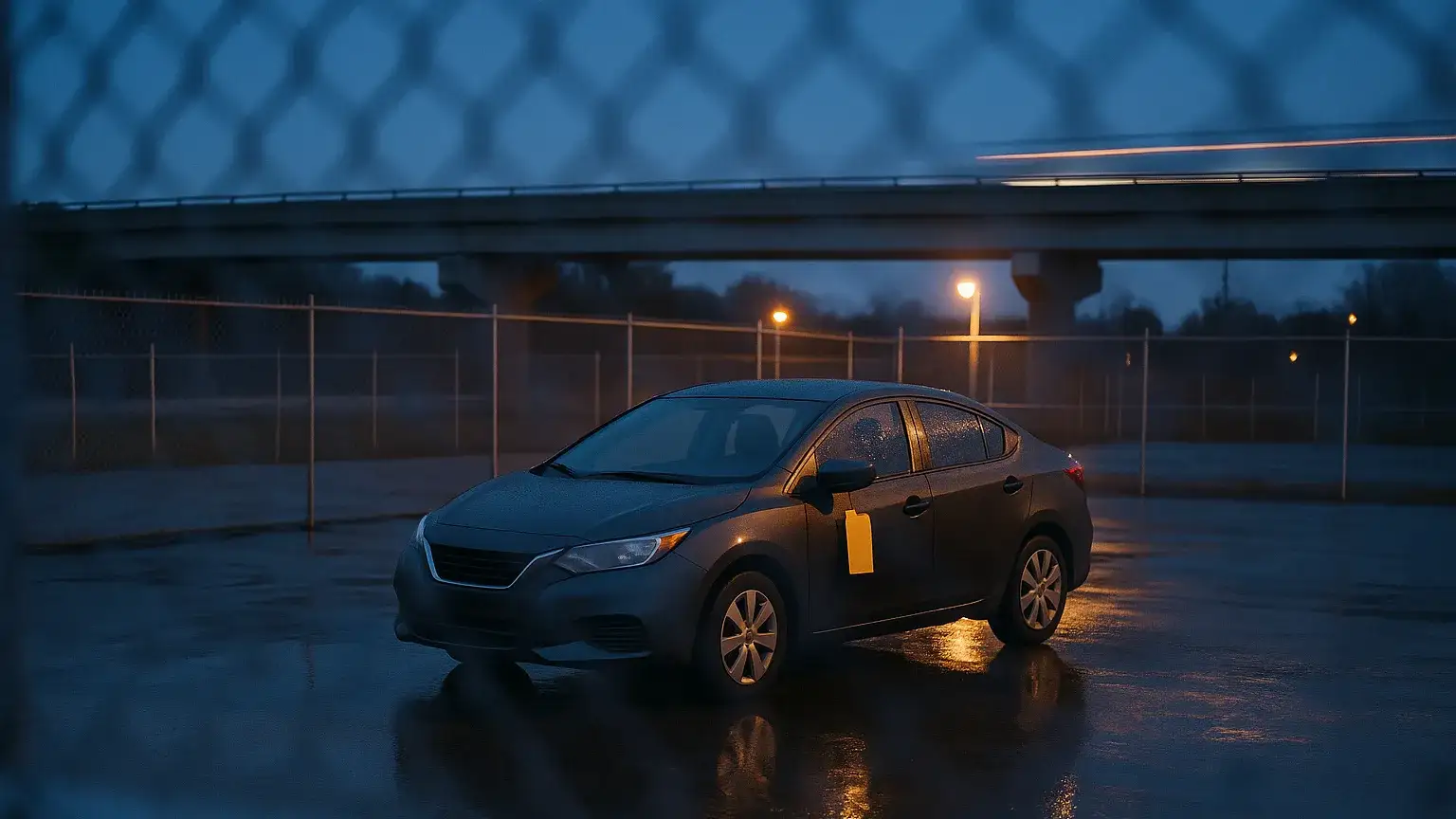
Stunt driving Ontario at a glance: what the charge takes, and when
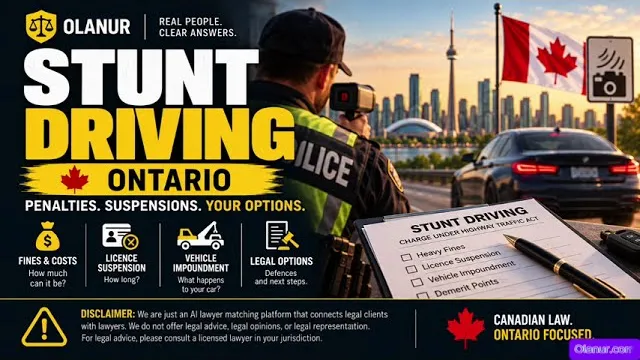
A stunt driving Ontario charge is an offence under s. 172 of the Highway Traffic Act, and it works on two tracks: fixed roadside penalties that apply immediately, and court penalties that apply only on conviction.
| What the charge takes | When | For how long | Can it be contested? |
|---|---|---|---|
| The car | At the roadside | 14 days, at the owner's cost (s. 172 (10)) | No. There is no appeal or hearing (s. 172 (18)) |
| The licence, first time | At the roadside | 30 days (s. 172 (9)) | No, for the same reason |
| The licence, second time | On conviction | At least 1 year, up to 3 on a first conviction (s. 172 (3), (5)) | Yes, by defending the charge |
| The money | On conviction | $2,000 to $10,000, or up to 6 months in jail, or both (s. 172 (2)) | Yes |
| The record | On conviction | 6 demerit points (O. Reg. 339/94) | Yes |
The conviction-stage rules changed on 1 January 2026, when the Safer Roads and Communities Act, 2024 replaced s. 172 (2) to (7). The fine and the suspension lengths were already in place from 2021; what changed is that the suspension now applies automatically by statute instead of by court order, and demerit points are now recorded on top of it.
From the roadside to reinstatement
One charge, two roads: the part you cannot contest and the part you can
Break: no statute sets the court dates
Day 0 · The stop
The officer takes the licence and detains the car. The 30 days run even if the licence is not handed over.
HTA s. 172 (8), (9)
What is stunt driving in Ontario? Three speed rules and a list of stunts
Stunt driving in Ontario is driving "in a race or contest, on a bet or wager or while performing a stunt" (s. 172 (1)), and O. Reg. 455/07 defines those words, including three separate speed rules.
The speed rules sit in s. 3 of the regulation, and every page that says fifty over is describing only one of them:
- Paragraph 7: 40 km/h or more over the limit, where the limit is under 80 km/h. In a 50 zone that is 90 km/h.
- Paragraph 7.0.1: 50 km/h or more over the limit, where the limit is 80 km/h or more. On a 100 km/h highway that is 150.
- Paragraph 7.1: 150 km/h or more, on any road. On a stretch posted at 110 km/h, this rule fires first, at 40 over rather than 50.
The dial below lets you pick a posted limit and see which paragraph applies.
O. Reg. 455/07, s. 3 · speed paragraphs
At what speed does it become stunt driving?
Pick the posted limit, then drag the speed.
Stunt driving by speed
90 km/h is 40 over. That meets para. 7 of s. 3 (40 km/h or more over a limit under 80), so it can be charged under s. 172 of the Highway Traffic Act, with a roadside licence suspension and impound.
- Stunt line for a 50 zone
- 90 km/h
- Margin over the limit
- +40 km/h
Rule that fires: para. 7, 40 km/h or more over a limit under 80.
The stunt line at every common limit
Grey is the posted limit, amber the margin before the charge applies. The margin jumps from 40 to 50 at 80 km/h, then the 150 km/h rule caps it again at 110.
posted limit, km/h
Speed is only part of the definition. The same section lists behaviour that counts as a stunt at any speed, including driving to lift tires off the road or make them lose traction while turning, spinning a car without control, driving with a person in the trunk or while not sitting in the driver's seat, deliberately blocking a vehicle from passing, stopping or slowing down to cut another car off, and driving as close as possible to another vehicle, a pedestrian or a fixed object. It also covers a left turn made just before or as the light turns green, to beat oncoming traffic that was stopped at the same red.
Section 2 separately defines a "race" or "contest", including driving "in a manner that indicates an intention to chase another motor vehicle", and several of its limbs turn on a "marked departure from the lawful rate of speed" rather than a fixed number, so driving below the numeric lines can still be charged.
Since 2021, s. 172 also reaches parking lots, beaches, parks, bike paths and trails, farm fields and sports fields, each of which the regulation calls a "specified place" (s. 5). Only some behaviours apply there: a chase (a race or contest behaviour), lifting the tires or making them lose traction while turning, spinning the car without control, the trunk and the empty driver's seat. The three speed paragraphs are not on that list.
The car: impounded at the roadside for 14 days
When an officer believes on "reasonable and probable grounds" that a person is stunt driving, the officer must detain the vehicle, and it is impounded for 14 days "at the cost of and risk to its owner" (s. 172 (8) and (10)).
Four details in the rest of s. 172 catch people out:
- The owner pays, not the driver. The car goes to an impound facility, and the facility does not have to release it until the removal and storage costs are paid (s. 172 (13)). Those costs are a lien on the vehicle (s. 172 (14)).
- Stolen is the only early exit. An officer may release the car early only where satisfied it "was stolen" when it was driven (s. 172 (12)).
- Nobody hears the owner first. There is "no appeal from, or right to be heard before" the impoundment (s. 172 (18)). The officer must give the owner a copy of the impound notice, in person or by mail (s. 172 (17)).
- The owner can sue the driver. Section 172 (19) lets an owner recover "any costs or other losses incurred" from the person who was driving.
That last right is how a parent, an employer or a friend who lent the car gets their money back. Towing and storage bills are well within the $50,000 limit of Small Claims Court in Ontario, and many owners start with a demand letter before filing anything.
The licence, part one: 30 days before any court
The roadside licence suspension lasts 30 days from the day the officer asks for the licence, "whether or not the person is unable or fails to surrender" it (s. 172 (9)).
There is no hearing and no appeal (s. 172 (18)). Section 172 (21) adds that the suspension and impoundment "do not constitute an alternative to any proceeding or penalty": the prosecution continues regardless. The roadside penalties are the only part of the case that is certain, and the only part a defence cannot touch. The province lengthened the impound in 2021, when the Moving Ontarians More Safely Act, 2021 raised it from seven days to 14. Its announcement reported that roadside suspensions for street racing and stunt driving "increased 130 per cent between 2013 and 2019".
What can make the 30 days worse is driving during them. Under s. 53 (1) of the Act, driving while suspended carries a fine of $1,000 to $5,000 on a first offence, and s. 53 (3) adds a further six-month suspension served after the current one. Higher fines for this offence have been passed but are not yet in force. Someone who has a court date approaching and no licence may find our guide to finding a lawyer in Canada urgently useful for the fastest verified routes.
The licence, part two: what a conviction adds
On conviction, the driver's licence is suspended for at least one year on a first conviction, at least three years on a second, and indefinitely on a third or later, under s. 172 (3).
Since 1 January 2026 the minimum applies by operation of the Act rather than by a court order. The court can go higher only where it considers an extension "proper and desirable for the protection of the public" (s. 172 (5)), up to three years on a first conviction and ten on a second. Before a plea is taken, s. 219 (1) requires the court clerk to warn the accused that on conviction "your driver's licence shall be suspended for the period prescribed by statute".
Highway Traffic Act s. 172 · in force from 1 January 2026
How long the licence goes, at the roadside and on conviction
Earlier stunt-driving convictions in an unbroken 10-year chain:
First conviction: what the Act sets
At least one year, which the court may extend to three, s. 172 (3) (a) and (5) (a).
Plus a fine of $2,000 to $10,000, up to six months in jail, or both (s. 172 (2)). In a community safety zone the minimum fine doubles to $4,000 (s. 214.1 (7)). A fully licensed driver also takes 6 demerit points (O. Reg. 339/94); a novice driver under the novice sanction takes no points and faces that sanction instead (O. Reg. 340/94, ss. 9 and 11 (6)).
Three rules decide which rung applies:
- Order of convictions, not offences. Only "the sequence of convictions" counts (s. 172 (7)).
- A ten-year reset. A conviction more than ten years after the previous one "is deemed to be a first conviction" (s. 172 (7.1)).
- Chains keep counting. An older conviction still counts if no ten-year gap separates it from the next one (s. 172 (7.2)).
One gap in the law is worth knowing about. Section 172 (4) says a third-conviction suspension "may be reduced by the Registrar in the prescribed circumstances". On 29 September 2026 we searched the stunt, demerit, licensing and conduct review regulations, and every Ontario regulation from 2025 and 2026 we could retrieve, and found none that prescribes those circumstances. Ontario's speeding and aggressive driving page still describes the penalty as "a lifetime suspension, reducible after 10 years under certain criteria". Until a regulation sets those criteria, anyone counting on a reduction would want a lawyer to confirm the position with the Ministry.
Novice drivers face a second system on top. Under O. Reg. 340/94, s. 9, a G1, G2, M1 or M2 driver convicted of an offence worth four or more demerit points is suspended for 30 days on a first conviction, 90 days on a second, and has the licence cancelled on a third where each follows the last within five years (s. 10 (4)), restarting at G1 or M1 "without the benefit of any time previously earned" (s. 11 (4)). The novice suspension runs concurrently with any other suspension (s. 11 (2)), and it does not apply to a novice who also holds a full licence in the other class, such as a G2 driver with a motorcycle licence (s. 10 (3)).
Getting the licence back after a suspension on conviction costs a $281 reinstatement fee (O. Reg. 340/94, s. 26 (1.4) (g)). A person convicted under s. 172 "may be required" to complete a remedial driver education course (O. Reg. 287/08, ss. 30 and 31), and the ontario.ca page on speeding and aggressive driving lists "a mandatory driver improvement course, upon conviction". If a full-class licence is suspended for more than a year, re-testing follows: Ontario's reinstatement page lists an eye test for one to three years, a knowledge test, an eye test and two road tests for three to ten, and re-applying as a new driver after ten or more.
The money: a $2,000 minimum and no ticket to pay
The stunt driving Ontario fine on conviction is at least $2,000 and at most $10,000, with up to six months in jail as an alternative or on top (s. 172 (2)). In a community safety zone the minimum fine doubles to $4,000 (s. 214.1 (7)).
That $2,000 floor explains why a stunt driving charge does not arrive as a ticket with a fine to pay. A proceeding started under Part I of the Provincial Offences Act, the ticket system, caps the fine at $1,000 for offences like this one (POA s. 12 (1)). On our reading of those two provisions, the full penalty is only available in a proceeding under Part III, where the accused is served with a summons that requires them "to attend court at a time and place stated therein" (s. 26 (1)). Anyone holding a stunt driving summons is expected in court on that date, in person or through a representative (s. 50 (1)).
The record: six demerit points, and none under the novice sanction
A stunt driving Ontario conviction carries 6 demerit points under the Table to O. Reg. 339/94, the same as careless driving and as speeding by 50 km/h or more.
The regulation normally records no points where the court's penalty includes a suspension, but s. 3 (1) now makes an exception for s. 172, added by O. Reg. 281/25. A fully licensed driver therefore takes both the suspension and the points. Points are totalled over any two-year period of offences (s. 1 (1)), and 15 or more brings a separate suspension (s. 9). A novice driver is treated differently: where the novice sanction applies, "no demerit points shall be recorded in respect of that conviction" (O. Reg. 340/94, s. 11 (6)).
Your insurance: the cost that outlasts the suspension
No statute sets what an insurer does with a stunt driving conviction, so this section relies only on what Ontario and its insurance regulator publish.
Ontario's own page on speeding and aggressive driving states that drivers convicted of aggressive, careless or stunt driving "will experience a substantial increase in their insurance rates or could become uninsurable." The Financial Services Regulatory Authority of Ontario lists "Your driving record" among the factors an insurer uses to set a rate. Its page on high-risk drivers explains that drivers with "many convictions or at-fault accidents" can end up with the Facility Association, "an insurer of last resort" whose coverage "costs a lot more than regular auto insurance". The same page notes that "the insurance industry as a whole cannot refuse to sell you basic insurance."
Insurers work from the driving record, and Ontario's three-year driver record includes "Highway Traffic Act and Criminal Code of Canada convictions, suspensions and reinstatements for the past 3 years". Broker and comparison sites publish percentage increases for a stunt conviction; no regulator does, so this page does not repeat them. If the stop followed a collision, the claim itself is a separate dispute, covered in our guide to auto insurance lawyers in Canada.
Stunt, careless or dangerous: three charges from one piece of driving
The same stretch of driving can be charged under s. 172, as careless driving under s. 130 of the Highway Traffic Act, or as dangerous operation under s. 320.13 of the Criminal Code, and the consequences differ sharply.
| Stunt driving (HTA s. 172) | Careless driving (HTA s. 130 (1)) | Dangerous operation (Criminal Code s. 320.13 (1)) | |
|---|---|---|---|
| Fine | $2,000 to $10,000 | $400 to $2,000 | Up to $5,000 if prosecuted summarily (s. 787) |
| Jail | Up to 6 months | Up to 6 months | Up to 10 years on indictment (s. 320.19 (5)), or two years less a day if summary |
| Licence | At least 1 year on a first conviction | Up to 2 years, at the court's discretion | Ontario suspension of 1 year on a first conviction (HTA s. 41 (1)), plus any court prohibition: up to 10 years on indictment or 3 if summary, plus any jail term (s. 320.24 (5)) |
| Roadside | 30-day suspension, 14-day impound | None in force today (7 days passed, not yet in force) | None in force today (90 days passed, not yet in force) |
| Demerit points | 6 | 6 (none if the court suspends the licence) | Not a demerit offence; a criminal record |
Several changes are passed but not in force. Schedule 5 of the Keeping Criminals Behind Bars Act, 2026 (S.O. 2026, c. 7) would raise the careless driving fine to $1,000 to $5,000, add a seven-day roadside suspension for careless driving (30 days where it causes bodily harm or death), add a 90-day roadside suspension and seven-day impound where an officer believes a driver is committing Criminal Code dangerous operation (new HTA s. 48.5), and raise the fines for driving while suspended. The consolidated Act read on 29 September 2026 still shows all of them as waiting for a date "to be named by order of the Lieutenant Governor in Council".
Racing also crosses into criminal sentencing: s. 320.22 (b) of the Criminal Code makes it an aggravating factor that the offender was "operating a motor vehicle in a race with at least one other motor vehicle or in a contest of speed". Once a charge is criminal, the process, the record and the stakes change, and our guide to criminal lawyers in Canada explains how those cases move. Olanur can also match you with a criminal defence lawyer where the facts point that way.
Whether to fight a stunt driving charge
Fighting a stunt driving charge cannot undo the roadside suspension or the impound, but it is the only way to contest the conviction-stage penalties, which are measured in years rather than days.
The Court of Appeal settled the basic shape of the defence in R. v. Raham, 2010 ONCA 206, the case of a driver clocked at 131 km/h in an 80 zone. Because a conviction can carry jail, the court read stunt driving by speed as a strict liability offence rather than an absolute one: "The Legislature cannot, absent reliance on s. 1 of the Charter, imprison without fault" (para. 51). That opens a due diligence defence, in which the driver shows they "took reasonable steps to avoid committing the offence charged" (para. 48).
The court's own examples were narrow: speeding up for "two or three seconds" in the passing lane to get clear of a vehicle closing from behind, or a speedometer that was malfunctioning without the driver knowing (para. 49). It added that it did not imply the defence "will be readily available" (para. 50). Raham was decided when the regulation had only the 50-over rule, but its reasoning turns on the possibility of jail, which s. 172 (2) still carries.
In practice a defence usually starts with the evidence rather than a theory:
- Disclosure. The Ontario Court of Justice's guide for defendants in provincial offences cases says a defendant is entitled to the relevant information in the prosecutor's hands free of charge, including "investigating officer notes, witness statements, diagrams, and photographs", but "you must ask for it in order to get it."
- A lesser included offence. Where stunt driving by speed is not made out, Raham noted that "a conviction for speeding will often be imposed" instead (para. 50), which POA s. 55 allows for an offence included in the one charged.
- A plea to another offence. Under POA s. 45 (6), a court may accept a guilty plea to a different offence "with the consent of the prosecutor", and s. 45 (3) (d) reminds the accused that the court "is not bound by any agreement". The court's guide adds that in some courts the prosecutor meets defendants before trial, and "by meeting with the prosecutor, you do not give up your right to a trial."
- Charter arguments need a notice of constitutional question served at least 15 days before the trial date, according to the same guide.

Two scenarios show how differently the same charge can land. Both are illustrative, not real cases.
Consider a 19-year-old G2 driver in Brampton stopped at 102 km/h in a 60 zone, in a car registered to a parent. The roadside costs arrive at once: 30 days without a licence, and 14 days of impound billed to the parent, who could later recover it under s. 172 (19). On a first conviction the driver would face at least a one-year suspension, a fine of at least $2,000, and the novice sanction under O. Reg. 340/94, which runs at the same time as the longer suspension.
Now consider a fully licensed delivery driver in their forties clocked at 151 km/h on a highway posted at 110. Paragraph 7.1 applies, not the 50-over rule, so the charge rests on one kilometre an hour over the 150 line. For a driver whose job depends on a licence, a year's suspension is a year's income at risk, and the precision of the speed evidence becomes the whole case.
Whether a defence is worth paying for is arithmetic only you can finish: a fine of at least $2,000, a suspension of at least a year, six points and the insurer's response at renewal, against the fee. Lawyers and paralegals may quote a flat fee for a traffic defence or bill by the hour, and our guide to what a lawyer costs in Ontario explains how each model shifts the risk of a long file. For a first opinion without paying anything, the Law Society Referral Service offers a free consultation of up to 30 minutes, described in our guide to the lawyer referral service in Ontario.
Stunt driving lawyer or paralegal: who can appear for you
A person charged may appear "personally or by representative" (POA s. 50 (1)), and a representative means someone "authorized under the Law Society Act" to act in the proceeding, which in practice means a lawyer or a licensed paralegal.
A stunt driving charge is a Provincial Offences Act proceeding, and that is squarely inside a paralegal's licence. The Law Society's February 2025 report on paralegal scope, summarising s. 6 of By-Law 4, lists representation "in the Ontario Court of Justice under the Provincial Offences Act" among the things a licensed paralegal may do. The same report limits paralegals to "certain offences" in criminal court, which is where the line tends to fall.
- A traffic ticket paralegal often suits a single s. 172 charge with no collision, where the case turns on the speed evidence and the disclosure.
- A lawyer is often the better fit where there was a crash or an injury, where the facts could support a Criminal Code charge, or where a second or third conviction is in play and the suspension would be measured in years.
The same paralegal-or-lawyer question comes up at the Landlord and Tenant Board, and our comparison of landlord tenant paralegals and lawyers shows how the licence divides the work there. Whoever you choose, checking their status in the Law Society's lawyer and paralegal directory takes about a minute, and our guide to looking up a lawyer or paralegal in Ontario explains what each field means.
How Olanur helps
We built Olanur so the first call about a charge like this goes to someone who handles it. You describe what happened once, and our matching system connects you with verified Ontario traffic lawyers and licensed paralegals who defend stunt driving and licence suspension matters. Matching is free, and each professional sets their own fee, which you see before you book.
If the charge came from a collision, or the facts look closer to dangerous driving, a lawyer is usually the better fit, and our system can route the request that way. Our guide on how to find a lawyer in Canada covers the questions worth asking at a first meeting. You can get matched with a traffic lawyer or paralegal in a few minutes.
Frequently asked questions
Under O. Reg. 455/07, s. 3, the stunt driving Ontario speed rules catch driving 40 km/h or more over a limit below 80 km/h, 50 km/h or more over a limit of 80 km/h or more, or 150 km/h or more on any road. In a 50 zone the line is 90 km/h, and on a highway posted at 110 km/h it is 150, not 160.
The officer takes your licence, which is suspended for 30 days, and the vehicle is impounded for 14 days at the owner's cost under s. 172 (9) and (10) of the Highway Traffic Act. There is no appeal or hearing against either, and the court case carries on separately.
A conviction brings a fine of $2,000 to $10,000, up to six months in jail or both, and a licence suspension of at least one year on a first conviction, at least three years on a second, and an indefinite suspension on a third or later. Since 1 January 2026 that suspension applies automatically by statute, and a fully licensed driver also takes 6 demerit points.
Not in the usual way. A stunt driving charge has a $2,000 minimum fine, while a proceeding in the Provincial Offences Act's ticket system is capped at $1,000 (s. 12 (1)). On our reading, that is why stunt charges proceed by a summons that requires you to attend court. You can appear yourself or through a lawyer or licensed paralegal.
Yes. The 14-day impound applies to the vehicle whoever owns it, and the costs fall on the owner. Section 172 (19) of the Highway Traffic Act lets the owner sue the driver to recover the costs and other losses. Early release is available only if the car was stolen.
Yes. A stunt driving charge is a Provincial Offences Act matter, and the Law Society of Ontario's description of paralegal scope, based on s. 6 of By-Law 4, includes representation in the Ontario Court of Justice under that Act. A lawyer is often the better fit if there was a collision or a Criminal Code charge is possible.
Stunt driving under s. 172 of Ontario's Highway Traffic Act is a provincial offence, not a crime, so a conviction does not create a criminal record. The same driving can instead be charged as dangerous operation under s. 320.13 of the Criminal Code, which carries up to 10 years on indictment, a possible driving prohibition, and a one-year Ontario licence suspension on a first conviction under s. 41 of the Highway Traffic Act.
Before the court date
A stunt driving Ontario charge is really two cases. The first, at the roadside, is over within a month and cannot be argued. The second decides a suspension of at least a year, a four-figure fine and the points on the record, and that is the one a defence can still change.
If you have a summons, the time between now and the first court date is when a review of the evidence is most useful, and our guide on whether you need a lawyer in Canada can help frame that decision. Olanur can match you with a verified Ontario traffic lawyer or paralegal, free, so the first person you talk to already handles this charge.
Priya Kapoor
Family, Real Estate & Criminal Law Contributor
Priya focuses on family law, real estate transactions, criminal defence, and civil disputes, guiding Canadians through some of the most consequential legal moments in their lives.