
This article provides general information about Ontario's statutory accident benefits as of November 2026 and is not legal advice. It was researched from the primary texts, read on 31 October 2026: the Statutory Accident Benefits Schedule, O. Reg. 34/10 (the consolidation from 1 July 2026 and the version in force until 30 June 2026), the amending regulations O. Reg. 383/24 and O. Reg. 58/25, the Insurance Act, R.S.O. 1990, c. I.8, the OPCF 47R endorsement, and published guidance from the Financial Services Regulatory Authority of Ontario (FSRA) and the Licence Appeal Tribunal. No lawyer reviewed it. A licensed Ontario lawyer or paralegal can advise on your own claim.
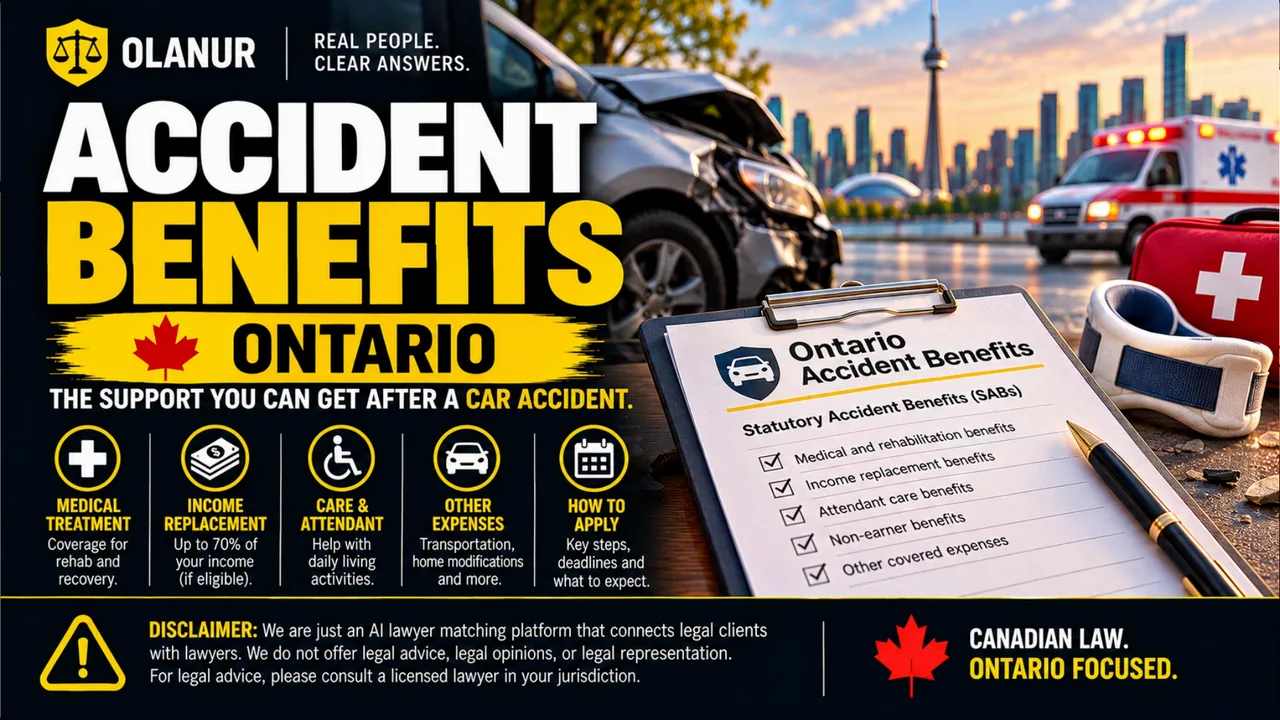
Accident benefits Ontario drivers carry are no longer one standard package. Since 1 July 2026, the only benefits every auto policy must still include are medical, rehabilitation and attendant care, along with the assessments that go with them. Income replacement, the non-earner benefit, caregiver and housekeeping help, and the death and funeral benefits became optional, and the optional ones now follow the people a policy names rather than whoever happens to be in the car.
That second change is the one most summaries skip. Picture a single collision at a Brampton intersection on a wet October evening: the owner behind the wheel, the owner's nine-year-old in the back, a coworker getting a lift in the front seat, and a pedestrian halfway across the crosswalk. Four people, one crash, and under the new rules they can come away with very different benefits.
This guide follows that crash seat by seat. For the wider picture on delays, denials and underpayment, our guide to when an auto insurance lawyer in Canada can help covers disputes with an insurer generally.

Accident benefits Ontario after 1 July 2026, in six lines
Every Ontario auto policy still pays medical, rehabilitation and attendant care benefits. Everything else is now bought, declined, or carried over at renewal, and reaches only the policy's own people.
- Still mandatory: medical, rehabilitation and attendant care benefits, with the same limits as before: $3,500 for a minor injury, $65,000 otherwise, and $1,000,000 for a catastrophic impairment, plus HST (Statutory Accident Benefits Schedule, ss. 14, 18).
- Now optional: income replacement, non-earner, caregiver, housekeeping and home maintenance, lost educational expenses, visitors' expenses, damage to clothing and devices, and the death and funeral benefits (ss. 4.1, 20.1, 25.1).
- Who optional benefits reach: only the named insured, their spouse, the dependants of either, and drivers listed on the policy. This applies to every policy from 1 July 2026, whatever its renewal date (s. 2 (1.0.4)).
- At renewal: what a policy had carries over at the same amounts, unless the named insured agrees in writing to drop or change it (s. 2 (1.0.2)).
- Who pays first: for a crash in Ontario since 1 July 2026, the auto insurer pays medical and rehabilitation costs, other than medication, even when a workplace health plan would also cover them (s. 47 (2.1)).
- Unchanged: the right to sue the at-fault driver, and the right to take a benefit dispute to the Licence Appeal Tribunal within two years of a refusal (s. 56).
What stayed mandatory, and what became a choice
Three benefits stayed compulsory. Nine became optional coverages that every insurer must offer and you may decline, and their old fixed dollar amounts were replaced by whatever amount your policy sets.
The amending regulation, O. Reg. 383/24, was filed in October 2024 and took effect on 1 July 2026. The benefits themselves were kept; what it revoked were the old optional upgrades to them (s. 28 (1), paragraphs 1, 2 and 6), because each benefit's amount is now set by the policy. Each benefit still sits in the Statutory Accident Benefits Schedule (the SABS, the Ontario regulation that sets what an auto policy pays after a crash, regardless of who caused it). What changed is whether a policy includes each benefit and how much it pays. This is the Ontario accident benefits chart in one place: the standard accident benefits Ontario policies carried until 30 June 2026, and where each benefit stands now.
| Benefit | Standard until 30 June 2026 | From 1 July 2026 | SABS section |
|---|---|---|---|
| Medical and rehabilitation | $3,500 minor injury; $65,000 otherwise; $1,000,000 catastrophic (shared with attendant care) | Mandatory, same limits | ss. 15 to 18 |
| Attendant care | Up to $3,000 a month, or $6,000 if catastrophic | Mandatory, same limits | s. 19 |
| Income replacement | 70% of gross weekly income, up to $400 a week | Optional; weekly maximum set by the policy | ss. 4.1, 7 |
| Non-earner | $185 a week | Optional; amount set by the policy | s. 12 |
| Caregiver | $250 a week, plus $50 for each additional person; catastrophic impairment only | Optional; the new standard covers any impairment | s. 13 |
| Housekeeping and home maintenance | $100 a week; catastrophic impairment only | Optional; any impairment, for 104 weeks unless catastrophic | s. 23 |
| Lost educational expenses | Up to $15,000 | Optional | s. 21 |
| Visitors' expenses | Reasonable and necessary, for 104 weeks unless catastrophic | Optional, up to the policy's maximum | s. 22 |
| Damage to clothing, glasses, hearing aids | Reasonable expenses | Optional, up to the policy's maximum | s. 24 |
| Death | $25,000 to a spouse; $10,000 to each dependant | Optional | s. 26 |
| Funeral | Up to $6,000 | Optional | s. 27 |
Two points sit under the table. Insurers must offer every optional benefit and cannot refuse to sell one: FSRA's Q&A for insurers says the coverages are "only optional for the insured to purchase." And for a new policy, the amount of each optional benefit is whatever the insurer has filed and you have chosen. It appears on the Certificate of Automobile Insurance, the page of your policy that lists every coverage and limit.
Your renewal date, and the signature that changes it
If your policy renewed on or after 1 July 2026 and you signed nothing, you kept every benefit you had, at the same amounts. Dropping or reducing one takes a written agreement between you and the insurer.
Whether the change hit every policy on 1 July or only at renewal is a common point of confusion, and the regulation answers it directly. Section 2 (1.0.2) of the SABS says that on a renewal, the old benefits "are deemed to continue as optional benefits in the amounts previously payable under the contract unless the named insured and the insurer agree, in writing" to decline or change them. FSRA adds that there is no time limit: "Expiring policies must renew with pre-July 2026 coverages and limits until the consumer agrees to make changes in writing."
Three details follow, and each can matter in a renewal conversation:
- Opting out ends the old package. FSRA's guidance is that a customer who opts out moves to the insurer's post-July coverages, limits and bundles. A declined benefit can be bought again later in the term, but on those new terms rather than the old ones.
- Changes can happen mid-term. Since 1 July 2026, a named insured and insurer may agree in writing to change the optional benefits on a policy bought before that date (s. 2 (1.0.3)), and an optional benefit can be added at any time before an accident (ss. 4.1 (3), 20.1 (3), 25.1 (3), 28 (3)).
- The "who" changed for everyone on 1 July. The renewal rule protects the amounts of the accident benefits Ontario policyholders already had, not the people they reach. On old and new policies alike, optional benefits now reach only the named insured, spouse, dependants and listed drivers. FSRA's Q&A puts it plainly: "The changes effective July 1, 2026, apply to all customers."
Consider a Mississauga driver whose policy renewed in September. The broker mentioned that declining income replacement would lower the premium, and the driver said they would think about it but never signed anything. The renewal carried income replacement over at the amount the policy already had. If the same driver later declines it in writing, an injury that keeps them off work would leave medical, rehabilitation and attendant care from the auto policy, and lost wages would have to come from somewhere else, such as disability coverage through work.
What you pay is a separate question from what you are covered for. Premiums are rated partly on your conviction record, which runs on a different clock from demerit points, as our guide to demerit points in Ontario explains.
Seat by seat: who can claim what since 1 July
Two questions decide it: whose insurer pays you, and whether that policy names you. Mandatory benefits reach everyone hurt in an Ontario crash involving an insured car; optional ones reach only the people the paying policy names.
The first question is answered by section 268 of the Insurance Act, which sets a priority order. You claim first under a policy you are insured under: your own, one that lists you as a driver, your spouse's, or the policy of someone you depend on. Only if there is none do you claim from the insurer of the car you were in, or of the car that hit you; then from any other car involved; and last, from the Motor Vehicle Accident Claims Fund. Try each seat from the opening crash in the scene below.
One crash, five people: who gets which accident benefits since 1 July 2026
Pick a position in the street scene or from the buttons, then answer the question or two that follow.
3. A friend or coworker getting a ride
- 1A policy you are insured under: as its named insured or a listed driver, or through your spouse or someone you depend on
- 2The insurer of the car you were in, or of the car that struck you
- 3The insurer of any other car involved
- 4The Motor Vehicle Accident Claims Fund, the payer of last resort
Priority order, Insurance Act s. 268 (2). A lower step applies only if no insurer is available above it.
- Medical
- Rehabilitation
- Attendant care
- Income replacement
- Non-earner
- Caregiver
- Housekeeping and home maintenance
- Lost educational expenses
- Visitors' expenses
- Damage to clothing, glasses and devices
- Death
- Funeral
- Higher medical, rehab and attendant care limits
- Dependant care
- Indexation
With no policy of your own, and no spouse or person you depend on whose policy covers you, you claim from the car you were in. Its owner may have bought every optional benefit, but those reach only the owner, the owner's spouse, their dependants and listed drivers. You get the mandatory medical, rehabilitation and attendant care benefits.
If the car has no insurer, the claim moves down the ladder: to any other car involved, then to the Motor Vehicle Accident Claims Fund.
The driver who owns the car
The named insured claims from their own policy and gets whatever it carries. If they declined income replacement in writing, a crash that keeps them off work leaves medical, rehabilitation and attendant care, and nothing for lost wages from the auto policy.
Family in the back seat
A spouse, or a child or anyone else principally dependent on the named insured or the named insured's spouse, claims under that policy and reaches its optional benefits. That holds even if they also have a policy of their own, because someone in a car insured under a household policy claims from that car's insurer (Insurance Act s. 268 (5), (5.2)). "Dependant" in the SABS means a person principally dependent for financial support or care (s. 3 (7) (b)), so it is not limited to children.
A friend or coworker in the front seat
This is the seat the 2026 change affected most. A passenger who has their own policy, or who is the spouse or dependant of someone who does, claims from that policy and gets what it bought. A passenger with no policy of their own, and no spouse or person they depend on who has one, claims from the insurer of the car and receives the mandatory benefits only, even if the car's owner bought every optional benefit available. Those reach only the owner, the owner's spouse, their dependants and listed drivers, not guests.
Behind the wheel of a borrowed car
Being listed as a driver on the car's policy brings its optional benefits within reach (s. 2 (1.0.4) (d)). The OPCF 47R endorsement, the form that now records which optional benefits a policy carries, also has the insurer agree not to rely on the priority rules, so a covered person can claim both mandatory and optional benefits under that policy if they give up a claim under any other. Insurers add the endorsement when optional benefits change mid-term or at the first renewal after 1 July 2026, so an older policy may not carry it yet.
Someone living in Ontario who regularly drives a car made available by a company or other organization, or who rents a car for more than 30 days, is deemed to be that policy's named insured (s. 3 (7) (f)). FSRA encourages insurers to make sure every driver is listed, and anyone who regularly drives a partner's or parent's car may want to check that they are.
On foot or on a bike
A pedestrian or cyclist is a "non-occupant", and the order is the same: first their own policy, or a spouse's, or that of someone they depend on, then the insurer of the car that struck them. A cyclist with no auto policy of their own, and none through a spouse or parent they depend on, who is hit in a Toronto bike lane would claim mandatory benefits from the insurer of the car that struck them. If that car turns out to be uninsured, the claim moves to any other car involved, and failing that to the Motor Vehicle Accident Claims Fund, which FSRA describes as the "payer of last resort".

On a bus or streetcar
One rule predates the reform and surprises people. No accident benefits are payable to a passenger on a public transit vehicle if the vehicle did not collide with another vehicle or object (Insurance Act s. 268 (1.1)). A fall when a streetcar brakes hard is outside the scheme; a collision is inside it, and the priority order above applies.
Treatment funding: the part that did not change
Medical, rehabilitation and attendant care benefits kept their limits: $3,500 for a minor injury, $65,000 for other injuries and $1,000,000 for a catastrophic impairment, plus HST, with optional top-ups to $130,000, $1,000,000 or $2,000,000.
These are the accident benefits Ontario law still guarantees on every policy, and they pay reasonable and necessary expenses: physiotherapy, chiropractic and psychological treatment, medication, assistive devices, home and vehicle modifications, and attendant care (ss. 15, 16, 19). An impairment that is predominantly a minor injury (a sprain, strain, whiplash associated disorder, contusion, abrasion, laceration or subluxation) is treated within the $3,500 cap. For an adult, expenses are covered for 260 weeks, five years, unless the impairment is catastrophic or an option without a time limit was bought (s. 20). The chart draws each limit as the room a person's treatment has: how high the funding goes, and for how long.
The room treatment funding has: Ontario accident benefits limits by injury (SABS, 2026)
Height is the combined medical, rehabilitation and attendant care limit for one accident (log scale). Width is how long expenses can be claimed.
SABS ss. 18 (3) (a), 19 (3), 20 (1)
Like the other optional benefits, those top-ups reach only the named insured, spouse, dependants and listed drivers (s. 28 (2)). Most assessments and reports are paid out of the same limits (s. 18 (5)), which is one reason people with serious injuries watch the balance closely. Whether an injury is "catastrophic" is a separate determination, made on its own application against criteria in section 3.1, and it is often where the largest disputes sit.
Who pays first now: the auto insurer, then your workplace plan
For an accident in Ontario on or after 1 July 2026, the auto insurer pays medical and rehabilitation expenses even if a workplace or private health plan would also cover them. Medication is the exception and still goes to the health plan first.
Before July, accident benefits were the second payer for treatment: if an employer's extended health plan covered physiotherapy, it paid first and the auto insurer covered the rest (s. 47 (2)). O. Reg. 58/25 reversed that. Section 47 (2.1) now requires the auto insurer to pay the portion a "supplementary health insurance plan" would have covered, defined as a group plan through an employer, union or association, or an individual plan bought privately. The rule turns on the date of the accident, not the date of the policy.
Say an Ottawa nurse with group benefits through the hospital is rear-ended on Highway 417 in August 2026 and needs twelve weeks of physiotherapy and a course of prescription anti-inflammatories. The physiotherapy is billed to the auto insurer first, within the medical and rehabilitation limits. The prescriptions still go to the group drug plan first, with accident benefits covering what it does not.
Income replacement, non-earner and caregiver: reading your own numbers
If a policy carries income replacement, it pays 70% of gross weekly income up to the weekly maximum on the certificate, after a one-week wait. A person can receive only one of income replacement, non-earner or caregiver benefits.
The formula in section 7 is unchanged: 70% of gross weekly employment income, less other income replacement such as some disability plan payments, capped at the policy's maximum. What changed is where the maximum comes from. Until 30 June it was $400 a week unless you bought $600, $800 or $1,000. Now it is "the amount fixed by the optional benefit", which a renewed policy carries over and a new policy sets at purchase.
Consider a warehouse worker in Hamilton earning $1,000 a week gross who cannot work for six months after a crash. Seventy per cent is $700. On a policy that carried the old $400 standard into renewal, the benefit is $400 a week; with an $800 limit it would be $700. With income replacement declined, the auto policy pays nothing toward wages, and the gap would have to come from the worker's own disability coverage or a claim against the at-fault driver. Income replacement is not paid for the first week of disability, and after 104 weeks it continues only for a complete inability to do any job the person is reasonably suited for (s. 6).
The other two weekly benefits sit beside it:
- Non-earner benefit: for someone who suffers a complete inability to carry on a normal life within 104 weeks of the accident and does not qualify for income replacement, including full-time students. It is not paid for the first four weeks, before age 18, or beyond 104 weeks after the accident (s. 12).
- Caregiver benefit: for an unpaid primary caregiver living with someone who needs care. Since 1 July the legislated standard covers any impairment, not only a catastrophic one (s. 13 (1)), and FSRA lets insurers also offer a cheaper catastrophic-only version to new customers if it approves their filing.
- One of the three: a person who qualifies for more than one must elect within 30 days of the insurer's notice, and the choice is final, except that a later finding of catastrophic impairment allows a new election to receive the caregiver benefit (s. 35).
Some exclusions apply whatever a policy bought. A driver without a valid licence cannot receive income replacement, the non-earner benefit, or the education, visitor and housekeeping benefits (s. 31 (1) (a) (ii)); our guide to stunt driving in Ontario explains how quickly a licence can be suspended. A conviction for a criminal offence connected with the crash, such as impaired driving in Ontario, has the same effect, and while a charge is pending the insurer holds those payments in trust (s. 31 (1) (d), (3)). Medical and rehabilitation benefits are not part of that exclusion.
The claim against the other driver did not change
The reform left lawsuits alone. If someone else caused the crash, you can still sue them, within Ontario's limits on what can be recovered and the deadlines that start at the crash.
Under section 267.5 of the Insurance Act, an at-fault driver is not liable for income loss in the first seven days, or for more than 70% of gross income lost before trial. Health care expenses and damages for pain and suffering are recoverable only for death, permanent serious disfigurement, or permanent serious impairment of an important physical, mental or psychological function. For 2026, FSRA's indexation guidance sets the deductible on an injured person's pain and suffering damages at $47,913.01, which no longer applies once the award exceeds $159,708.71. Accident benefits received, or that were available, are deducted from damages for income loss, health care and other financial losses, though not from pain and suffering damages (s. 267.8). That rule dates from 1996 and was not amended for the reform.
The Insurance Act expects the injured person to apply for accident benefits and to serve written notice of the intended action on the at-fault driver within 120 days of the crash, or a longer period a court allows (s. 258.3 (1)). A lawsuit can still be started without the notice, but the court weighs that when awarding costs, and no prejudgment interest runs for the time before the notice is served (s. 258.3 (8), (9)). Most injury lawsuits then have to start within two years of when the claim was discovered, under the Limitations Act, 2002. Our guide to how to sue someone in Ontario explains which court hears which claim, and how much a lawyer costs in Ontario covers the contingency fees most injury lawyers work on.
Deadlines after a crash: 7 days, 30 days, 120 days, two years
The accident benefits clock starts within days: notice to the insurer within 7 days, usually of the accident, and the signed application within 30 days of receiving the forms. A missed step in applying does not end a claim if there is a reasonable explanation (s. 34), but that does not stretch the two-year Tribunal limit.
| Step | Time limit | Source |
|---|---|---|
| Tell the insurer you intend to apply for accident benefits | 7 days after the circumstances giving rise to the benefit (usually the accident), or as soon as practicable | SABS s. 32 (1) |
| Return the signed application (form OCF-1) | 30 days after receiving the forms | SABS s. 32 (5) |
| Elect income replacement, non-earner or caregiver | 30 days after the insurer's notice | SABS s. 35 |
| Written notice of an intended lawsuit to the at-fault driver | 120 days after the accident, or longer if a court allows; a late notice affects interest and costs | Insurance Act s. 258.3 |
| Apply to the Licence Appeal Tribunal over a refusal | 2 years after the insurer refuses to pay | SABS s. 56 |
| Start a lawsuit | Generally 2 years from when the claim is discovered | Limitations Act, 2002, s. 4 |
Disputes about whether a benefit is payable, or how much, go to the Licence Appeal Tribunal rather than a court (Insurance Act s. 280). Its filing fee is $106. In its update of 26 June 2026, the Tribunal confirmed that the amendments "do not affect your right to appeal".
When it helps to talk to a lawyer
Most claims start with a phone call to the insurer. Advice tends to help most when coverage itself is in doubt, when a benefit is refused, or when the injury is serious enough that the limits or a lawsuit come into play. Situations where many people get advice:
- The insurer says a benefit is not on the policy, or that you are not a listed driver, spouse or dependant, and you believe otherwise.
- A denial letter arrives, benefits stop after an insurer's examination, or an injury is classed as minor when it does not feel minor. The two-year Tribunal clock starts at the refusal.
- The injury may be catastrophic, or treatment costs are approaching the $65,000 limit.
- Someone else caused the crash and the 120-day notice date is approaching.
- More than one policy could apply: two cars in the household, a company car, a rental, or a ride with a friend who also has insurance.
A car accident lawyer in Ontario often takes accident benefits and injury claims on a contingency basis. Our guide to Ontario's lawyer referral service covers the free first-contact routes, and a quick lawyer lookup in Ontario confirms anyone you hire is licensed. If a deadline is days away, our guide to finding a lawyer urgently in Canada sets out what to do first.
How Olanur helps
We built Olanur so someone hurt in a crash can describe what happened once and be matched with a verified Ontario lawyer who handles accident benefits and injury claims, without phoning around while recovering. Matching is free. Lawyers on our platform help when accident benefits Ontario insurers owe are delayed or refused, from the application itself to a dispute at the Licence Appeal Tribunal, and with the separate claim against an at-fault driver.
Our personal injury lawyer page sets out the Ontario rules in brief and is the quickest way to start.
Frequently asked questions
Since 1 July 2026, every Ontario auto policy must include medical, rehabilitation and attendant care benefits, with limits of $3,500 for a minor injury, $65,000 for other injuries and $1,000,000 for a catastrophic impairment, plus HST. Income replacement, non-earner, caregiver, housekeeping, education, visitor, personal item, death and funeral benefits are optional coverages every insurer must offer.
No, not unless you agree to it in writing. Section 2 (1.0.2) of the Statutory Accident Benefits Schedule says that on a renewal on or after 1 July 2026, the benefits a policy had continue as optional benefits in the same amounts unless the named insured and the insurer agree in writing to decline or change them.
If you, your spouse, or someone you depend on has an auto policy, you usually claim from that policy and get what it carries. If not, you claim from your friend's insurer, but only for the mandatory medical, rehabilitation and attendant care benefits, because optional benefits reach only the named insured, their spouse, their dependants and listed drivers.
Not for most treatment any more. For accidents in Ontario on or after 1 July 2026, the auto insurer pays medical and rehabilitation expenses first, even where a group or individual health plan would also cover them (SABS s. 47 (2.1)). Prescription medication is the exception and still goes to the health plan first.
Not for that accident. The regulation allows an optional benefit to be bought at any time before an accident for which benefits are claimed, and the OPCF 47R endorsement says added coverage applies only from the date the insurer adjusts the premium. Coverage chosen at any point before a crash counts; coverage added afterwards does not reach that crash.
The SABS is the Statutory Accident Benefits Schedule, Ontario Regulation 34/10 under the Insurance Act. It sets the benefits an Ontario auto policy pays to people injured in a crash regardless of who caused it, the limits on each, who can claim them, the deadlines for applying, and the rules for disputes with an insurer.
An application to the Licence Appeal Tribunal has to be started within two years after the insurer refuses to pay the amount claimed (SABS s. 56). Disputes about accident benefits cannot go to court except by appeal or judicial review after the Tribunal decides. The filing fee is $106.
Yes. The 2026 changes did not touch the right to sue. The Insurance Act expects an application for accident benefits and written notice to the at-fault driver within 120 days of the crash, and a missed notice can cost interest and legal costs. Pain and suffering damages require a serious and permanent injury, with a 2026 deductible of $47,913.01 on awards up to $159,708.71.
Before your next renewal
If a renewal notice is on the kitchen table, it can help to read the Certificate of Automobile Insurance with this guide beside it. Check which optional accident benefits Ontario insurers have listed on it, at what amounts, and who is named on the policy, especially anyone in the household who drives the car regularly. Declining a benefit can lower the premium. It can be bought again later, but only on the insurer's post-July terms, and whatever the policy carries on the day of a crash is what covers that crash.
If you are already dealing with a claim, Olanur can match you with a personal injury lawyer for free.
Priya Kapoor
Family, Real Estate & Criminal Law Contributor
Priya focuses on family law, real estate transactions, criminal defence, and civil disputes, guiding Canadians through some of the most consequential legal moments in their lives.