
Prefer to listen?
This article explains constructive dismissal in Ontario as of 2026 and is general information, not legal advice. Entitlement figures reflect the Employment Standards Act, 2000, S.O. 2000, c. 41, and the leading case is Potter v. New Brunswick Legal Aid Services Commission, 2015 SCC 10. Your situation may differ, and an employment lawyer can advise on it.
Constructive dismissal Ontario claims start with a feeling most employees know before they know the legal word for it: the job you agreed to is no longer the job you have. Your pay was cut, your title shrank, your manager moved you to a role nobody wanted, or the workplace turned hostile enough that staying felt impossible. You did not get a termination letter, so it may not look like a firing. Under Ontario law, it sometimes is one.
This guide covers what counts as constructive dismissal, the two legal tests a court applies, the most common examples, how it differs from wrongful dismissal, what you may be owed, and the real risk of resigning too soon. If you are weighing whether your situation needs professional help, our guide on the situations where employment lawyers in Canada help puts it in context, and Olanur can match you with an Ontario employment lawyer for free, with no calls and no pressure.

Constructive dismissal Ontario: the quick answer
Constructive dismissal Ontario is a resignation the law treats as a firing, because the employer fundamentally changed your job or made it unbearable. Here is the short version, unpacked fully below.
- You did not have to be formally fired. When an employer breaks a core term of your employment, the law can treat your resignation as a dismissal you did not choose.
- There are two routes. A single fundamental change (a deep pay cut, a demotion) can qualify, and so can a pattern of conduct, like a toxic or poisoned workplace, that shows the employer no longer means to honour the deal.
- The change has to be substantial. Minor tweaks to duties or a small schedule shift usually do not count. Courts look at whether a reasonable person would see an essential term being taken away.
- A win means wrongful dismissal damages. Proving constructive dismissal puts you in the same position as someone fired outright: you can claim reasonable notice, often well above the ESA minimum.
- Timing matters both ways. Resign too fast and a court may disagree the change was fundamental. Stay too long without objecting and you may be found to have accepted it.
- You usually have two years. Most claims must be started within two years under Ontario's Limitations Act, 2002, so a long wait can quietly close the door.
What constructive dismissal in Ontario actually means
Constructive dismissal happens when an employer, without your agreement, makes a fundamental change to your employment or behaves in a way that breaks the contract, and you resign in response. The law then treats the resignation as a dismissal.
The Supreme Court of Canada set the modern framework in Potter v. New Brunswick Legal Aid Services Commission, 2015 SCC 10. That case recognized two branches. The first branch is a single unilateral act that breaches an essential term, where the court asks whether the breach was substantial enough that a reasonable person would feel a core part of the deal had changed. The second branch is a course of conduct, a series of acts that, taken together, show the employer no longer intends to be bound by the contract.
The key word in both branches is fundamental. An employer in Ontario can make ordinary business decisions, and not every unwelcome change is a dismissal. A new reporting line, a modest adjustment of duties, or a temporary inconvenience rarely rises to the level the law requires. What pushes a change over the line is when it strikes at something central to why you took and kept the job: your pay, your role, your status, or your dignity at work.
The most common constructive dismissal examples
The clearest constructive dismissal examples involve money, rank, or a workplace that becomes hostile. Each one has to be substantial and imposed without your consent to count.
Significant pay or compensation cuts
A meaningful reduction in salary, commission structure, or guaranteed bonus is one of the strongest grounds. Courts have treated sizable unilateral pay cuts as a breach of an essential term, because compensation is at the heart of any employment bargain.
Demotion or loss of responsibilities
A demotion, the removal of your direct reports, or stripping you of the duties that defined your role can amount to constructive dismissal even if your pay stays the same. Status and responsibility are part of the contract, not just the paycheque.
A forced relocation or major schedule change
Being ordered to move to a distant workplace your contract never contemplated, or having your hours or shifts overhauled in a way that upends your life, can qualify when the change is large and one-sided.
A toxic or poisoned work environment
Sustained harassment, bullying, or a manager creating intolerable conditions can fall under the second Potter branch. Where the conduct touches a protected ground such as age, disability, or sex, the Ontario Human Rights Code may add a separate claim on top.
A layoff your contract does not allow
Many employees assume an employer can always impose a temporary layoff. In Ontario, unless your contract or a genuine industry practice permits it, putting you on an unpaid layoff can itself be a constructive dismissal at common law, even when the Employment Standards Act treats the layoff as temporary. The time limits that make a layoff "temporary" at all, and the point where an overlong one becomes a deemed termination, are counted week by week in our guide to termination pay in Ontario.
Constructive dismissal vs wrongful dismissal in Ontario
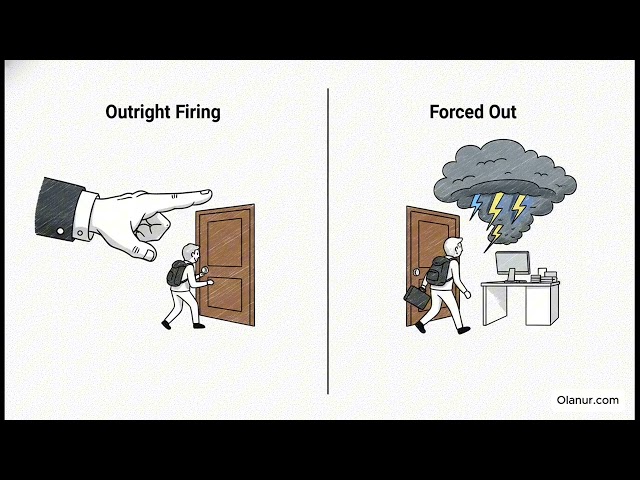
Constructive dismissal and wrongful dismissal are closely related, and the difference confuses a lot of people. In short, wrongful dismissal is about how a firing was handled, while constructive dismissal is about a firing that was never announced.
Both lead to the same place if you succeed: a claim for reasonable notice. The route there is what differs. Our dedicated guide on wrongful dismissal in Ontario covers the outright-termination side in depth, and the table below sets the two side by side.
| Wrongful dismissal | Constructive dismissal | |
|---|---|---|
| Who ends the job | The employer fires you outright | You resign in response to the employer's conduct |
| The trigger | Too little notice or severance on termination | A fundamental change or a toxic workplace forces you out |
| What you prove | The notice or pay offered fell short of your entitlement | The change was fundamental, or conduct showed the contract was abandoned |
| What you can claim | Reasonable notice (ESA minimum plus common law) | The same reasonable notice, once the dismissal is established |
| The main risk | Signing a release before getting advice | A court finding the change was not fundamental, leaving you as having resigned |
One practical takeaway: constructive dismissal is a way into a wrongful dismissal claim, not a separate kind of payout. That is also why employers sometimes prefer to squeeze an employee out quietly rather than terminate, hoping the person simply quits and walks away with nothing.
If the employer has since put a severance offer in front of you, our guide to a severance package review in Ontario covers which parts of that offer can still be changed and which close on signature.
What you may be owed in a constructive dismissal claim
If you prove constructive dismissal Ontario courts treat you as wrongfully dismissed, so your damages are built on reasonable notice: a payment meant to cover the income and benefits you lose while finding comparable work.
There are two layers. The first is the statutory minimum under the Employment Standards Act, 2000. The second is common-law reasonable notice, which is usually larger and is set case by case. The ESA termination scale, as of 2026, looks like this:
| Length of continuous service | ESA notice or pay in lieu |
|---|---|
| 3 months to under 1 year | 1 week |
| 1 to under 3 years | 2 weeks |
| 3 to under 4 years | 3 weeks |
| 5 to under 6 years | 5 weeks |
| 8 years or more | 8 weeks (the maximum) |
On top of that, employees with five or more years of service at an employer with an Ontario payroll of $2.5 million or more may also qualify for ESA severance pay, capped at 26 weeks (Employment Standards Act, 2000, ss. 64 to 65). Those are floors set by statute. Common-law notice, the part most people underestimate, is assessed under the Bardal factors: your age, length of service, the character of your job, and how easily you can find similar work. As a rough guide it can reach around a month per year of service, with a soft ceiling near 24 months in exceptional cases, though every file turns on its own facts.
The chart below shows why the statutory floor can be so misleading. The ESA figures are exact, while the common-law column is an illustrative rule of thumb, and the space between them is what most initial offers leave on the table.
What you may be owed in Ontario: ESA minimum vs common-law notice
Select years of service. Hover, tap, or focus a row for the detail below.
At 8 years of service
The ESA floor is about 16 weeks of pay (termination notice, plus severance pay for a $2.5M+ payroll employer). A common-law rule of thumb points to roughly 35 weeks, leaving an illustrative gap of about 19 weeks that the statutory minimum does not capture. Once a constructive dismissal is established, this is the same reasonable-notice claim a wrongfully dismissed employee would bring.
ESA figures are exact statutory minimums and assume an employer with a $2.5M+ Ontario payroll (so severance pay applies). The common-law column is an illustrative guideline only (about one month per year, soft cap 24 months); actual notice is decided case by case on the Bardal factors of age, service, role, and re-employment prospects, and can land well above or below it.
Because a successful constructive dismissal claim is valued the same way as any other dismissal, the same math applies once the dismissal is established. To put rough numbers to it, our Ontario severance pay calculator estimates the ESA minimum against a common-law range for a non-unionized Ontario employee in about a minute, and our breakdown of how much severance you are entitled to in Ontario walks through the Bardal factors with examples.
How to prove constructive dismissal in Ontario
Proving constructive dismissal in Ontario comes down to evidence that the change was both real and fundamental, and that you did not simply go along with it. Documentation is what separates a strong claim from a weak one.

A few things tend to carry weight. Keep the paper trail: the original offer letter or contract, any old organization charts or pay statements, and the email or memo announcing the change. Note the dates, because timing decides a lot. Raise your objection in writing rather than quietly accepting the new terms, since silence over time can be read as agreement. Where the issue is a poisoned environment, a contemporaneous record of incidents, with dates and witnesses, is far more persuasive than a memory reconstructed months later.
Consider a 47-year-old operations manager in Mississauga earning $95,000 with nine years of service. After a merger, her employer removes her direct reports, cuts her annual bonus, and reassigns her to an entry-level desk with no clear duties. She objects in writing, gets no real answer, and resigns three weeks later. On those facts she has a credible constructive dismissal claim built on a demotion plus a compensation cut. Now say you are a sales representative in Ottawa whose base salary is quietly dropped from $72,000 to $52,000 "while the company restructures." A unilateral cut of that size to core pay is exactly the kind of fundamental breach the first Potter branch describes.
The risk of resigning too soon
The hardest part of any constructive dismissal Ontario situation is that quitting is the very act that triggers the claim, and also the act that can sink it. If a court later decides the change was not fundamental, you are treated as having resigned, which usually means no notice and no damages.
Two traps catch people most often. The first is condonation: if you keep working under the new terms for too long without objecting, you may be found to have accepted them, losing the right to claim. Raising the issue promptly and in writing helps guard against that. The second is the duty to mitigate. After a dismissal you are expected to look for comparable work, and in some cases the Supreme Court has said a reasonable employee may even have to keep working for the same employer for a period, where that can be done without humiliation or a poisoned relationship (Evans v. Teamsters Local Union No. 31, 2008 SCC 20). Because the downside of getting this wrong is so steep, it is often worth getting advice before you hand in a resignation rather than after.
It also helps to know which forum fits. A smaller, clear-cut claim for unpaid wages can sometimes go to Small Claims Court in Ontario, while a larger constructive dismissal case for many months of notice usually belongs in the Superior Court with proper legal help.
When to talk to a lawyer about constructive dismissal
Not every workplace change needs a lawsuit, but some signals strongly suggest a free consultation would pay off. The closer your situation is to the points below, the more a professional read is worth having before you act.
- Your pay, commission, or bonus was cut by a meaningful amount without your agreement
- You were demoted, lost your team, or had the core of your role taken away
- You are being pushed toward resigning, or the environment has become hostile or humiliating
- You were placed on an unpaid layoff your contract never allowed for
- You are 50 or older with long service, where common-law notice tends to be highest
- A resignation deadline or a release is being put in front of you
If any of these fit, a short conversation with an employment lawyer is usually the highest-value move available, and many offer a free initial review. If you are not sure where to start, our guides on whether you need a lawyer in Canada and how to find a trustworthy lawyer in Canada can help you decide, and the broader walkthrough of how to find a lawyer in Canada covers the practical steps.
One note on jurisdiction: if you work for a bank, airline, telecom, or another federally regulated employer, your rights flow from the Canada Labour Code rather than Ontario's ESA, and the analysis changes. A lawyer can confirm which set of rules applies to you.
How Olanur helps you find an employment lawyer in Ontario
We built Olanur to take the hardest step out of getting legal help: working out which lawyer actually fits your situation. Instead of cold-calling firms, you describe what happened once, and our matching system connects you with verified Ontario employment lawyers who handle constructive dismissal and severance matters. There is no cost, no sign-up wall, and no obligation.
For a constructive dismissal question, that often means a quick assessment of whether the change you faced was fundamental, a realistic view of the notice you might be owed, and help deciding whether to negotiate or resign. If you would like to see how the matching works first, our walkthrough of how Olanur works explains it step by step, and lawyer lookup in Ontario covers the Ontario-specific ways to find vetted legal help.
Frequently asked questions
Constructive dismissal in Ontario happens when your employer, without your agreement, fundamentally changes a core term of your job (such as pay, role, or location) or creates conditions so intolerable that you resign. The change has to be substantial, not minor, and the law then treats your resignation as a dismissal.
No, but they are connected. Wrongful dismissal is when an employer fires you without enough notice or pay. Constructive dismissal is when no formal firing happens, yet a fundamental change or a toxic environment forces you out. If you prove constructive dismissal, you claim the same reasonable notice a wrongfully dismissed employee would.
A successful claim entitles you to reasonable notice, the ESA statutory minimum (up to 8 weeks of termination notice, plus up to 26 weeks of severance pay where it applies) and, usually larger, common-law notice. Common-law notice is assessed on the Bardal factors of age, service, job type, and re-employment prospects, and can reach roughly a month per year of service.
A significant, unilateral cut to your base salary, commission, or guaranteed bonus is one of the strongest grounds for a constructive dismissal claim, because compensation is an essential term of the contract. A small or temporary reduction you agree to, by contrast, generally does not qualify. The size and permanence of the cut matter most.
Most constructive dismissal claims must be started within two years under Ontario's Limitations Act, 2002, with the clock generally running from when the fundamental change occurred. Waiting also raises a separate risk: staying too long under the new terms without objecting can be treated as accepting them, so acting promptly protects the claim.
In most cases it helps to get advice before resigning rather than after, because the act of quitting is what triggers the claim and also what can defeat it. If a court later finds the change was not fundamental, you may be treated as having resigned with no entitlement. A lawyer can assess the strength of your case first.
Before you resign
Constructive dismissal in Ontario rewards employees who move carefully and document well, and it punishes those who quit in frustration without a record or a plan. If your pay was cut, your role was hollowed out, or the workplace turned hostile, the change may legally amount to a dismissal, but proving it depends on the facts, the timing, and the evidence you keep.
The highest-value half hour of your week is usually a conversation with an employment lawyer before you make any decision about resigning or signing anything. If you want a professional to assess your case, Olanur can match you with a verified Ontario employment lawyer, free and with no pressure. You can also read the Ontario rules directly on the Employment Standards Act termination guide and confirm your deadline under the Limitations Act, 2002.
Rohan Whitfield
Employment & Immigration Law Contributor
Rohan writes on employment rights, wrongful dismissal, severance entitlements, and Canadian immigration law, helping workers and newcomers understand their legal options.