
This article provides general information about non-compete clauses in Ontario as of November 2026 and is not legal advice. It was researched from the primary texts, read on 22 November 2026: the Employment Standards Act, 2000, S.O. 2000, c. 41 (consolidation from 1 January 2026), Ontario's guide to the Act, decisions of the Court of Appeal for Ontario, the Competition Bureau's open letter of 29 October 2026 and the Parliament of Canada's record for Bill C-31.
A non-compete clause Ontario employers write into an offer letter might say that for twelve months after you leave, you won't work for a competitor within 50 kilometres. Since 25 October 2021 the Employment Standards Act has made most of those clauses void for employees. Most, not all. The ban turns on four facts about you and your clause, and if any one of them goes the other way, the clause falls back to an older test that judges decide case by case.
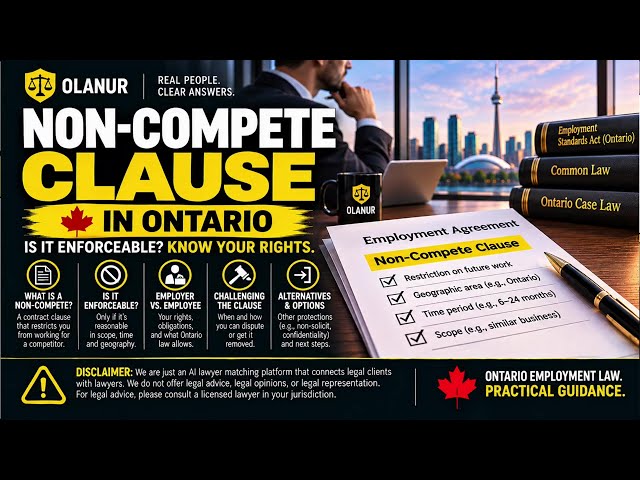
This guide takes those four facts in order, then shows how a court reads a clause the ban doesn't reach. It's written for the person holding the contract, and sits alongside our guide to the employment situations where a lawyer in Canada matters.

Non-compete clause Ontario: the short answer
Ontario bans new non-compete agreements between employers and employees, and makes them void, with two exceptions: executives and the seller of a business. Everything outside the ban is judged under the common law, where a restrictive covenant is unenforceable unless shown to be reasonable.
- The ban: Section 67.2 (1) of the Employment Standards Act says no employer shall enter into an employment contract or other agreement with an employee that is, or includes, a non-compete agreement. Section 67.2 (2) says a non-compete made in breach of that is void.
- The start date: the section is in force from 25 October 2021. Ontario's guide says the ESA does not prohibit non-competes entered into before that date.
- The exceptions: chief-level executives, and a seller of a business who agrees to the non-compete as part of the sale and becomes the buyer's employee immediately afterwards (s. 67.2 (3) to (5)).
- What isn't banned: non-solicitation and confidentiality clauses. Ontario's guide says the ESA "does not prohibit non-solicit agreements or non-disclosure agreements."
- Outside the ban: courts start from the position that a restraint on competing is unenforceable, and uphold one only if the party relying on it proves it is clear and reasonable in activity, time and geography.
Run your clause through the four gates
A non-compete clause Ontario employers use is void under the Act only if it clears four gates in a row: it really restrains competition, you are an employee the ESA covers, you agreed on or after 25 October 2021, and no exception applies. Set your own facts below and see where your clause stops.
Set the four facts about your clause. It only reaches the end of the track if it clears every gate.
- Is it a non-compete?s. 67.1Cleared
- Does the ESA cover you?ss. 1, 3 (2)Cleared
- Agreed on or after 25 Oct 2021?s. 67.2, in force 25/10/2021Cleared
- No exception applies?s. 67.2 (3) to (5)Cleared
- Void
- An employer may not enter into it (s. 67.2 (1)), and if one does, “the non-compete agreement is void” (s. 67.2 (2)).
- Ontario's guide says employees, applicants and former employees can file a claim with the Ministry, generally within two years of the alleged violation, and that being penalized for refusing to sign one is a reprisal.
- Other clauses in the same contract, such as a non-solicit or confidentiality term, are not caught by the ban and are assessed separately.
Gate 1: is it really a non-compete?
A clause is a non-compete under the Act if it stops you from working in competition with your employer's business after the job ends. Clauses that only stop you approaching clients, recruiting staff or using confidential information are a different kind of restraint, and the ban leaves them alone.
The definition in section 67.1 is wide. A non-compete agreement is "an agreement, or any part of an agreement, between an employer and an employee that prohibits the employee from engaging in any business, work, occupation, profession, project or other activity that is in competition with the employer's business after the employment relationship between the employee and the employer ends." Ontario's guide to non-compete agreements adds that a clause counts whether or not it has a time limit or a radius: six months is caught, and so is a clause with no end date.
The heading on the clause doesn't decide anything. The guide gives an example of a paragraph headed "Non-Competition" that only bars contacting the employer's customers for two years, and says that because its substance is about soliciting, it is not a non-compete. The reverse can happen too: a clause called a non-solicit that, in practice, stops you working in your field at all deserves a closer read.
| Clause | What it restricts | Caught by the s. 67.2 ban? | Still tested in court? |
|---|---|---|---|
| Non-compete | Working for, or starting, a competing business for a period (or indefinitely) after you leave | Yes, if the ESA covers you, it was agreed on or after 25 October 2021 and no exception applies | Only where the ban doesn't apply |
| Non-solicitation of clients | Approaching the employer's customers to take their business | No | Yes, for reasonableness |
| Non-solicitation of employees | Recruiting former co-workers away | No | Yes, for reasonableness |
| Confidentiality or non-disclosure | Sharing or using the employer's confidential information | No | Yes |
Section 67.2 (2) voids "the non-compete agreement", which the Act defines to include any part of an agreement. Non-solicit and confidentiality terms in the same contract aren't caught by the ban and are assessed on their own, which is why the rest of the contract is worth reading as carefully as the clause with "competition" in its title.
Gate 2: does the ESA cover you?
The ban protects employees, including job applicants, whose work falls under Ontario's Employment Standards Act. It doesn't reach federally regulated jobs, work performed outside Ontario, genuinely independent businesses, or the people the Act itself excludes.
The main groups outside this gate:
- Federally regulated employees. Section 3 (2) says the Act does not apply where the employment relationship is within Parliament's jurisdiction. The federal list of regulated industries includes banks, airlines and airports, telecommunications, broadcasting and railways that cross provincial or international borders.
- Genuine independent contractors. Ontario's guide says the ESA does not apply to independent contractors. The label in your contract isn't the test, though: the guide says "it is the relationship between the individual and the business (or person) that matters", and section 5.1 bars an employer from treating an employee as if they were not one. Our guide to costly legal issues for Canadian businesses covers misclassification from the business side.
- People the Act excludes. Section 3 (5) lists them. They include business and IT consultants who provide services through their own corporation or registered sole proprietorship at $60 an hour or more under a written rate (s. 3 (7)), and directors of a corporation in that role.
- Work outside Ontario. Section 3 (1) applies the Act where the work is performed in Ontario, or outside Ontario as a continuation of work performed in Ontario.
Unionized employees are still covered by the ban, but Ontario's guide to filing a claim says a claim generally can't be filed by someone represented by a union and covered by a collective agreement, so the Ministry claim route described below generally isn't open to them.
For federal workers, change may be coming. Bill C-31, the Budget 2025 Implementation Act, No. 2, was introduced on 6 May 2026 and would add a non-compete prohibition to the Canada Labour Code. Parliament's record showed it at report stage in the House of Commons, with debate on 4 November 2026. Until it passes and comes into force, it isn't law.
Gate 3: when did you agree to it?
The date that matters is the date you entered into the agreement containing the non-compete. On or after 25 October 2021, the ban can apply. Before that date, Ontario's guide says the ESA does not prohibit it, and the common-law test decides.
The prohibition came in through the Working for Workers Act, 2021, and the ESA's amendment record gives section 67.2 an in-force date of 25 October 2021. A clause signed in 2019 isn't caught by the ban, even if you're reading it in 2026.
The ban covers agreements made at any point, not only on hiring: Ontario's guide gives examples agreed before the job begins, during employment, and with a former employer after it ends. So if you signed a non-compete in 2019, then signed a new contract on a promotion in 2023 that repeats it, the 2023 agreement may be the one that matters. That kind of question turns on the exact documents, and it's one of the details an employment contract review is designed to settle.
Signed in a severance package? Our guide to having a severance package reviewed covers how a non-compete in a release fits with the rest of the offer, and why the date matters there too.
Gate 4: does an exception apply?
Even an employee who agreed after 25 October 2021 can be bound by a non-compete in two situations: they are an executive as the Act defines it, or they sold a business and became the buyer's employee immediately afterwards.
The executive exception
Section 67.2 (4) lifts the ban for executives. Section 67.2 (5) defines an executive as a person who holds the office of chief executive officer, president, chief administrative officer, chief operating officer, chief financial officer, chief information officer, chief legal officer, chief human resources officer or chief corporate development officer, "or holds any other chief executive position." A vice-president, director or senior manager is not on that list. Whether a particular role counts as "any other chief executive position" is a question of fact about the role.
The sale-of-business exception
Section 67.2 (3) applies where a business, or part of one, is sold (a lease counts, under s. 67.2 (5)), the buyer and seller agree as part of the sale that the seller won't compete with the buyer's business afterwards, and the seller becomes the buyer's employee immediately after the sale. Ontario's guide describes this exception for a business operated as a sole proprietorship or a partnership.
Consider a physiotherapist who owns her clinic in Oakville as a sole proprietor, sells it to a regional chain, and stays on as an employee from the closing date. A five-year, 10 km non-compete in the purchase agreement falls inside this exception. It isn't automatically enforceable, but the Court of Appeal in M & P Drug Mart Inc. v. Norton, 2022 ONCA 398, at para. 34, noted that a non-competition covenant in a sale agreement is scrutinized less rigorously than one in an employment agreement.
Ontario's guide makes one point that applies to both exceptions: an employee "may have a greater right under their employment contract or the common law." Falling inside an exception sends the clause to the court test; it doesn't decide the result.
Past the gates: how a court reads the clause
When the ban doesn't apply, a non-compete clause Ontario courts are asked to enforce is presumed unenforceable. The party relying on it has to show it is clear, protects a real business interest, and is no wider in activity, time and geography than needed. In an employment contract, a court won't rewrite a clause that fails.
The test comes from the Supreme Court of Canada in Elsley v. J.G. Collins Insurance Agencies (1978) and Shafron v. KRG Insurance Brokers (Western) Inc., 2009 SCC 6. The Court of Appeal summarized it in Mason v. Chem-Trend Limited Partnership, 2011 ONCA 344, as three questions: did the employer have a proprietary interest entitled to protection, are the time or place limits too broad, and is the clause too broad in the activity it bans "because it prohibits competition generally and not just solicitation of the employer's customers?"
Clarity comes first. Quoting Shafron, the court in Mason wrote that "an ambiguous restrictive covenant is, by definition, prima facie unreasonable and unenforceable." And a judge won't trim a clause into shape: in M & P Drug Mart, the court said it "is not permitted to rewrite a restrictive covenant in an employment contract" to reflect what it thinks would have been reasonable.
| Decision | The clause | Result | The deciding point |
|---|---|---|---|
| Elsley (SCC, 1978) | Manager of a general insurance business, barred from the general insurance business after leaving | Not overly broad | As general manager he had significant knowledge of and influence over the customers, so only a ban on competing could protect the trade connection |
| Shafron (SCC, 2009) | Covenant in an employment contract limited to the "Metropolitan City of Vancouver" | Unenforceable | No legal definition of that area; the court would not fix the wording |
| Mason (ONCA, 2011) | Technical salesperson of 17 years: one year, worldwide, no dealing with any customer from his whole tenure | Unenforceable | Overly broad and unworkable; a separate confidentiality clause already protected the employer |
| M & P Drug Mart (ONCA, 2022) | Pharmacy manager in Huntsville: one year, 15 km, not "concerned with" any similar business | Unenforceable | The wording reached far beyond working as a pharmacist, and the court wouldn't narrow it |
M & P Drug Mart is a useful warning about agreed terms. The pharmacist had legal advice, negotiated the clause, and signed an acknowledgement that it was reasonable. The court still held it unenforceable, saying "the question is one of legal consequences rather than business ethics." That contract dated from 2014, before the ban.
Why a void clause still keeps people put
A non-compete clause Ontario law treats as void, or that a court wouldn't enforce, can still change behaviour. Surveys reported by the Competition Bureau in October 2026 found that 44% of Canadian workers whose non-compete was unlikely to hold up in court would still turn down a competing job that would breach it.
On 29 October 2026, the Competition Bureau wrote to the provinces and territories encouraging them to consider reforms like Ontario's. Citing OECD surveys commissioned in 2025, it reported that Canadian employers say 29% to 39% of private-sector employees are covered by a non-compete, and that 30% of firms using them apply one to every employee, whatever the role.
- All private-sector employeesas employers report it
- Fixed-term contract workers
- Non-managerial or non-professional jobs
- Low-pay workersearning under $3,000 a month
- No access to confidential information
Among Canadian firms that use non-competes, 30% put one in every employee's contract, whatever the role.
Those are national figures, and the Bureau's letter treats Ontario as the province that has already acted. For an Ontario reader the point is narrower: a clause with no legal force can still shape your next move, so it's worth knowing which gate yours stops at.
Three moments when the clause matters
A non-compete tends to surface at three points: when you're asked to sign it, when you want to leave, and when a former employer objects. The useful question changes at each one.

Before you sign
Say you're a software account executive in Mississauga with a January 2026 offer. Clause 12 bars you from working for any competitor within 50 km for twelve months, and clause 13 bars you from soliciting the company's clients for twelve months. Your work is in Ontario for a provincially regulated employer, the date is after October 2021, and you're not a chief-level officer, so clause 12 clears all four gates and section 67.2 makes it void. Clause 13 is a non-solicit, so it stays in play and is judged for reasonableness.
One option is simply to ask for the non-compete to be taken out, which costs the employer nothing it could lawfully keep. Ontario's guide says that being penalized for refusing to enter into a prohibited non-compete is a reprisal, and section 74 of the Act protects an employee who asks the employer to comply with the Act or exercises a right under it.
Before you resign
Now say you're a service manager for a heating and cooling company in Ottawa who signed a contract in 2019 with a two-year, Ontario-wide non-compete. The clause stops at gate 3, so the ban doesn't help. The common-law questions do: whether two years and the whole province are wider than needed for a service manager's role, whether a non-solicit would have protected the employer just as well, and whether the wording is clear.
That read is more useful before giving notice than after, because the answer can shape the resignation itself. If you're leaving because the job changed underneath you, our guide to constructive dismissal in Ontario covers when a resignation is treated as a termination, and our wrongful dismissal guide covers what notice you may be owed.
When the letter arrives
A letter from a former employer's lawyer, sent after you join a competitor, may quote the clause and ask you to stop. It isn't a court order, but it's worth taking seriously, and the gates give you an order to work in: what the clause restricts, whether the ESA covers you, when you agreed to it, and whether an exception applies.
If the clause stopped at none of the gates, a claim with the Ministry may be available: Ontario's guide says employees, applicants and former employees can file one if they believe they entered into a prohibited non-compete on or after 25 October 2021. Claims generally have to be filed within two years of the alleged violation, and generally can't be filed if you've already gone to court on the same issue or are covered by a collective agreement. The guide also says the ESA doesn't stop either side from taking the dispute to court. If the clause sits outside the ban, the reply turns on the court test, which is where a lawyer's read helps most.
If you run the business
A non-compete clause Ontario employers add to an ordinary employee's contract on or after 25 October 2021 is void where the ESA covers the job, so protection now comes from clauses the ban leaves alone: well-drafted non-solicitation and confidentiality terms, kept as narrow as the real interest.
Mason shows why narrow matters. The court pointed to the employer's separate confidentiality clause as significant protection already in place, and found that barring dealings with every customer from a 17-year tenure was unworkable. It also noted the clause wasn't limited to the customers the employee had served himself. If you're also reviewing termination clauses, our guide to termination pay in Ontario sets out the statutory floor every contract has to respect. A term that contracts out of an employment standard is void under section 5 (1).
When it helps to talk to a lawyer
The gate track gives a first read on any non-compete clause Ontario employers hand you; a lawyer adds what a general tool can't: the exact wording, the dates on every document, and how a court would weigh your role.
It can be worth a consultation when:
- A start date or resignation date is under two weeks away and the contract has a non-compete or non-solicit.
- The clause stopped at gate 3 or 4: an older contract, an executive title or a business sale, where the common-law test decides.
- You've received a demand letter or notice of a court motion from a former employer.
- Your title says contractor but your days look like employment.
- The non-compete arrived inside a severance package, where it's tied to money you're being offered. Our guide on how much severance you're entitled to is a useful starting point for the money side.
If the dispute also involves how you were treated before leaving, our guide to workplace harassment in Ontario explains the separate deadlines that may be running.
How Olanur helps
We built Olanur so someone holding a contract with a restrictive clause can describe it once and be matched with a verified Ontario lawyer, without phoning a list of firms. Matching is free, and lawyers on our platform include employment lawyers who review offer letters, non-solicits and non-competes before signing or resigning.
Our employment law page sets out the Ontario rules in brief, and if you'd rather browse names first, our directory of employment lawyers in downtown Toronto lists who practises in the area. When a date is close, our guide to finding a lawyer urgently in Canada sets out what to do first, and you can check any lawyer's licence with the Law Society before you book.
Frequently asked questions
For most employees who agreed to it on or after 25 October 2021, no. Section 67.2 of the Employment Standards Act bars employers from entering into non-compete agreements with employees and makes one entered into in breach void. The exceptions are chief-level executives and a seller of a business who becomes the buyer's employee right after the sale. Clauses agreed before that date, and those covered by an exception, are judged by the courts for reasonableness.
It is a clause or contract that stops someone from working in competition with a business after a relationship ends. The Employment Standards Act defines it as an agreement, or any part of an agreement, between an employer and an employee that prohibits the employee from engaging in any business, work, occupation, profession, project or other activity in competition with the employer's business after the employment ends. The name on the clause doesn't matter; its substance does.
Yes. Ontario's guide to the Employment Standards Act says the Act does not prohibit non-solicit or non-disclosure agreements. They are still tested in court on the same factors as other restrictive covenants: a non-solicit has to be clear and reasonable in the activity it restricts, the area it covers and how long it lasts. Courts have treated a narrow non-solicit as a less restrictive alternative to a ban on competing, which is one reason a broad non-compete can fail the common-law test.
Ontario's guide says an employee who is penalized for refusing to enter into a prohibited non-compete agreement can file a claim, because that is treated as a reprisal. Section 74 of the Act bars an employer from dismissing or otherwise penalizing an employee for asking the employer to comply with the Act or for exercising a right under it. Whether a particular dismissal was a reprisal depends on the facts, and a claim generally has to be filed within two years.
The ban protects employees, former employees and job applicants under the Employment Standards Act, and the Act does not apply to genuinely independent contractors. But a contract that calls someone a contractor doesn't settle it. Ontario's guide says the relationship matters, not the label, and section 5.1 bars an employer from treating an employee as if they were not one. If you work set hours on the employer's equipment under its direction, it is worth checking your status.
The first step is working out whether the clause is void under section 67.2 at all, by checking what it restricts, whether the Act covers you, when you agreed to it and whether an exception applies. If it is void, there is nothing to get out of, and an employment standards claim may be available, generally within two years of the alleged violation. If it isn't, a lawyer can assess whether it fails the common-law test, or negotiate a written release or narrower terms with the employer before you move.
In Ontario, outside the ban, courts apply the test set by the Supreme Court of Canada: a restrictive covenant is presumed unenforceable unless the party relying on it shows it protects a legitimate interest and is clear and reasonable in the activity it bans, the area it covers and how long it lasts. Employment covenants get stricter scrutiny than those in a business sale. A federal bill, C-31, would generally prohibit non-competes in federally regulated workplaces, with exceptions, but had not passed as of 22 November 2026.
Before you sign, or before you resign
If a contract with a non-compete is on your table this week, the four gates are the place to start: what the clause restricts, whether the Employment Standards Act covers you, when you agreed to it, and whether you're an executive or a business seller. For an employee covered by Ontario's ESA (not federally regulated) who agreed to a non-compete on or after 25 October 2021 and isn't an executive or a seller covered by the sale-of-business exception, the clause clears all four and is void. Everyone else is looking at a court test where the wording, the dates and your role decide the outcome.
Either way, a review before you commit can clarify where the clause stands. You can describe your situation once and be matched with an Ontario employment lawyer for free.
Olanur Editorial Team
Canadian legal guides
Olanur's editorial team researches and prepares these guides from sources such as legislation, court decisions and government publications. They are general information, not legal advice.
Read our editorial standards