
This article provides general information about workplace harassment in Ontario as of November 2026 and is not legal advice. It was researched from the primary texts, read on 9 November 2026: the Occupational Health and Safety Act (consolidation from 27 November 2025), the Human Rights Code (from 1 July 2025), the Workplace Safety and Insurance Act, 1997 (from 24 April 2026) and the Limitations Act, 2002 (from 4 December 2024), Ontario's Code of Practice to Address Workplace Harassment and its guide to the law, WSIB Policy 15-03-14, Human Rights Tribunal of Ontario guidance, and Court of Appeal for Ontario decisions cited below. No lawyer reviewed it. A licensed Ontario lawyer can advise on your own situation.
Workplace harassment Ontario law has an odd feature that most guides skip past: the same conduct from one manager can be a safety violation, a human rights breach and the end of your employment contract all at once. Each of those runs through a different office, on a different clock. The order you do things in can matter almost as much as what happened.
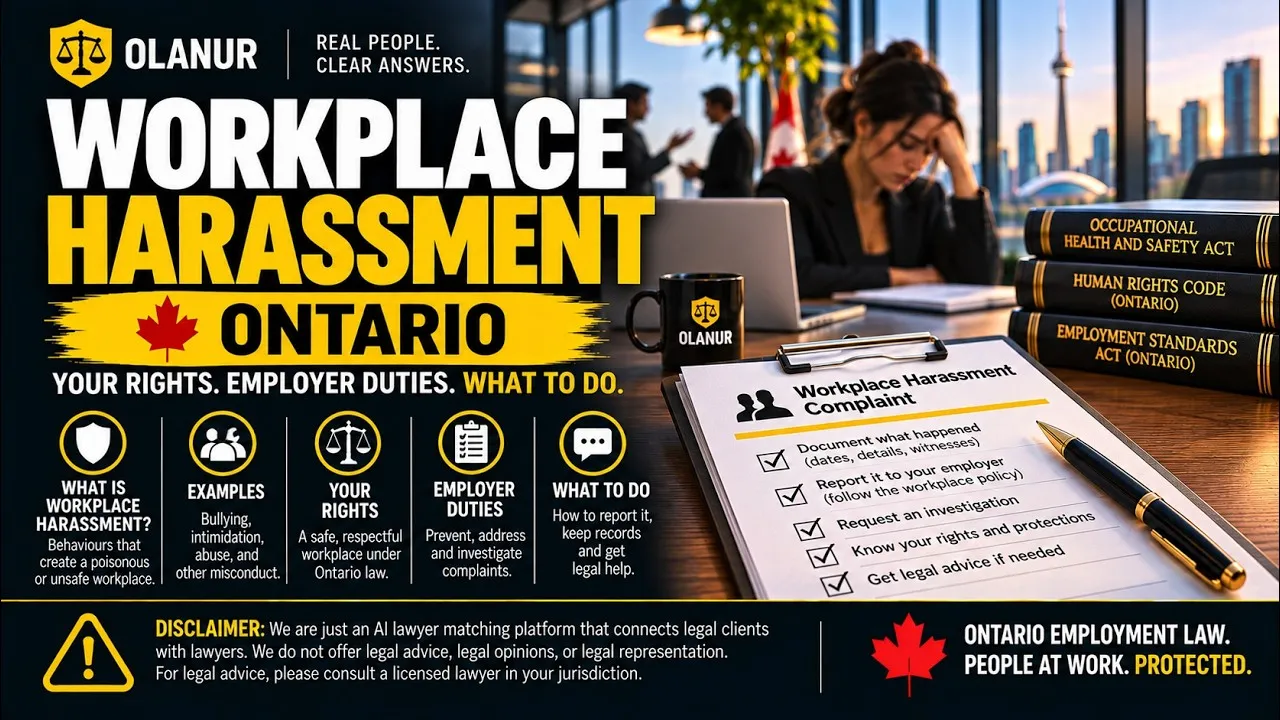
Consider Nadia, a made-up shipping coordinator with six years at a Mississauga warehouse. A new supervisor starts mimicking her accent over the floor radio. Coworkers laugh. She tells herself it will stop. This guide follows her week by week, because that is how harassment usually arrives, and because some of the deadlines that protect her start running long before she feels ready to act.
If you want the wider picture of when workers bring in a lawyer, our guide to employment lawyers in Canada covers it. If someone has threatened to hurt you, call 911 first.

Workplace harassment Ontario, in five lines
Ontario has no single harassment law. Three legal systems can respond to the same conduct, and a fourth can pay benefits if it causes a diagnosed injury and your employer is covered by WSIB insurance. Each has its own test, office and deadline.
- The safety law: the Occupational Health and Safety Act (OHSA) requires employers to have a harassment policy and program, investigate appropriately, and give you the results in writing.
- The human rights law: if the harassment is tied to a protected ground, the Human Rights Code applies, and you generally have one year to apply to the Human Rights Tribunal of Ontario (HRTO).
- The contract: treatment that makes continued work intolerable can be constructive dismissal, where the law treats your resignation as a firing.
- The hard limits: you can't refuse work over harassment alone, ministry inspectors don't award money, and the Court of Appeal has declined to recognize a separate tort of harassment.
- The clocks: six months for a WSIB claim, one year for the HRTO, two years for most court claims, each from its own starting event and often running at once.
Week 1: is this harassment, or just a bad boss?
Under Ontario's safety law, harassment is a course of unwelcome, vexatious comment or conduct against a worker. Tough but reasonable management, and one-off disagreements, generally fall outside it.
The Occupational Health and Safety Act defines workplace harassment in section 1 as "engaging in a course of vexatious comment or conduct against a worker in a workplace, including virtually through the use of information and communications technology, that is known or ought reasonably to be known to be unwelcome". Workplace sexual harassment is included in the definition. Four details decide most arguments:
- "I was joking" doesn't end the question. The wording reaches conduct the person ought reasonably to have known was unwelcome.
- Usually more than once, sometimes only once. Ontario's guide to the law says the conduct typically repeats and can happen within a single day. It also says one unwelcome sexual advance from someone with power over the worker may qualify.
- Home counts. The "virtually" wording took effect on October 28, 2024, and section 3 (1.1) applies the Act to telework in a private residence.
- Managing you isn't harassing you. Section 1 (4) excludes "a reasonable action taken by an employer or supervisor relating to the management and direction of workers or the workplace". The province's guide adds that assignments, schedules and evaluations "not exercised reasonably and fairly" may cross the line.
Pick what is closest to your situation and watch where it goes.
- 1. Occupational Health and Safety ActUsually appliesYour employer, then the Ministry of LabourA course of vexatious comment that is known, or ought to be known, to be unwelcome fits the definition in s. 1 (1).
- 2. Human Rights CodeCan apply, if…Human Rights Tribunal of OntarioOnly if it is tied to a protected ground such as race, age, sex or disability. General rudeness isn't covered.
- 3. Your employment contractCan apply, if…A court, or a negotiated exitIf a reasonable person would find continued work intolerable, it can support constructive dismissal.
- 4. Workplace insuranceCan apply, if…WSIB, if you have a diagnosed injuryWSIB generally treats workplace harassment as a substantial stressor, but a diagnosed mental stress injury is required.
Nadia's accent changes her position. An accent can point to place of origin or ethnic origin, and section 5 (2) of the Human Rights Code gives employees a right to freedom from harassment by the employer, its agents or another employee on those grounds and others, including race, creed, age, disability and sexual orientation. Section 7 (2) covers harassment because of sex. The Code defines harassment in nearly the same words as the OHSA, so one course of conduct can engage both.
A threat is a different category. A statement it is reasonable to read as a threat of physical force that could cause injury is workplace violence under the OHSA. If you have reason to believe violence is likely to endanger you, you can generally refuse the work, though section 43 limits this for some workers, such as hospital and correctional staff, when the danger is a normal part of the job. If the fear extends beyond the job, our guide to a peace bond in Ontario explains the court orders available against anyone, a coworker included.
How common this is, and who is doing it
Statistics Canada's study of harassment in Canadian workplaces found that 19% of women and 13% of men reported harassment at work in the past year (2016 data). The detail that surprises people is the source. Among women who were harassed, a client or customer was named more often (53%) than a supervisor (32%) or a colleague (34%). A broader 2020 survey put lifetime experience of harassment or sexual assault at work at 47% of women and 31% of men.
- Client or customer52.9%
- Supervisor or manager31.6%
- Colleague or peer33.6%
Workplace harassment Ontario employers deal with doesn't always come from inside the company. Ontario's Code of Practice says a policy is expected to cover harassment "from all sources", customers and clients included, and that employers can respond by changing or even refusing service.
That same night: start the record
A dated private record, started early, is often the most useful thing a worker has later. The same notes can support an internal complaint, a tribunal application and a court claim.
Nadia writes hers in the car, before she walks in. Her first entry is three lines long: the date and time, the radio channel, the words used, and the names of the two people who laughed. Many people in her position find it helps to capture:
- Date, time and place, written as close to the event as possible.
- The exact words, in quotation marks where you can remember them.
- Who saw or heard it, including anyone who might be willing to say so.
- What it did to you: missed shifts, sleep, doctor visits. A medical record matters if a WSIB claim is ever considered, because benefits depend on a diagnosed injury.
- What you did next, and how anyone responded.

Keeping the notes somewhere your employer doesn't control, such as a personal device or paper, protects them if your account is shut off. Copying confidential client or company files is a different matter and can create a problem of its own, so many people ask a lawyer first.
Recording is a common question. Section 184 of the Criminal Code makes it an offence to intercept a private communication, but it doesn't apply where one of the parties consents, so recording a conversation you are part of falls outside that offence. Whether your workplace policy allows it, and how a tribunal would treat the recording, are separate questions.
Week 2: reporting it, and what your employer owes you
Ontario employers covered by the OHSA need a harassment policy and a written program. That program is your map for reporting, including who to go to when your supervisor is the problem.
Under sections 32.0.1 and 32.0.6, the policy is reviewed at least once a year and, at workplaces with more than five regular workers, written and posted or readily available electronically. The written program has to:
- Give you a way to report to your employer or supervisor.
- Give you someone else to report to if your employer or supervisor is the alleged harasser.
- Explain how complaints are investigated and dealt with.
- Protect your information, which isn't disclosed unless that is necessary to investigate or take corrective action, or is required by law.
- Explain how you will be told the results and any corrective action.
Nadia asks HR for the program and files a short written complaint, attaching her notes. Putting it in writing and keeping a copy tends to help. If a protected ground is involved, saying so plainly makes it harder to treat the complaint as a personality conflict.
Retaliation has its own rules. Section 50 of the OHSA bars an employer from dismissing, disciplining, penalizing or intimidating a worker for seeking enforcement of the Act, and a worker can take that to the Ontario Labour Relations Board or, in a unionized job, to arbitration. Section 8 of the Human Rights Code separately protects your right to claim and enforce your Code rights without reprisal.
Day 90: the investigation you are owed
The OHSA requires an investigation "appropriate in the circumstances" and written results. Ontario's Code of Practice adds a benchmark: finish within 90 calendar days, and report in writing within 10 more.
Those day counts come from the Code of Practice, which is one approved way for an employer to meet the law. The Act sets no number of days, so 90 days is a fair yardstick and not a stand-alone deadline.
| What you can expect | Where it comes from | What it doesn't give you |
|---|---|---|
| An investigation appropriate in the circumstances | OHSA s. 32.0.7 (1) (a) | A set format, or a guaranteed outside investigator |
| Finished within 90 calendar days, barring extenuating circumstances | Code of Practice, Part III | A fixed legal deadline in the Act itself |
| An investigator not under the alleged harasser's direct control | Code of Practice, Part III | An external investigator every time, though one may be retained where the alleged harasser is an owner or senior executive |
| Results and any corrective action in writing, within 10 calendar days of finishing | OHSA s. 32.0.7 (1) (b); Code of Practice, Part III.B | The investigation report, which is a different document |
| Confidential handling | OHSA s. 32.0.6 (2) (d) | Secrecy from people who need to know to investigate or act |
The government won't investigate the harassment for you. Ontario's guide says inspectors "do not resolve or mediate specific allegations of harassment", don't decide whether someone's behaviour was harassment, and have no authority to order compensation. They check whether the employer met its duties. Under section 55.3, an inspector can order an investigation by an impartial person at the employer's expense. The ministry's contact centre is at 1-877-202-0008.
Eleven weeks in, Nadia gets a letter. It says her complaint was "substantiated in part" and that "appropriate action" was taken. Her supervisor is still there. She wants more detail, and the law probably won't give it to her. That doesn't close her other options, because Ontario's guide says workers may also go to the HRTO on a protected ground, grieve through a union, or pursue civil litigation.
Months 3 to 24: the outside clocks
Nothing in section 34 of the Human Rights Code pauses the one-year limit while an employer investigates. Time spent on the internal route also comes off the outside clocks.
Enter the date of the most recent incident to see how the deadlines line up.
| Route | Who decides | What it can do | Time limit |
|---|---|---|---|
| Ministry of Labour | Inspector | Orders employer compliance; can order an impartial investigation | Not a claim for money |
| Human Rights Tribunal of Ontario | Adjudicator | Compensation, including for injury to dignity, feelings and self-respect; orders to promote compliance (s. 45.2) | 1 year after the incident, or the last in a series (s. 34) |
| Superior Court of Justice | Judge or jury | Damages for constructive dismissal and recognized wrongs | 2 years from discovery (Limitations Act, 2002, s. 4) |
| WSIB | WSIB decision-maker | Benefits for a diagnosed mental stress injury | 6 months after the accident (WSIA s. 22) |
| Union grievance | Arbitrator | Set by the collective agreement | Set by the collective agreement |
The Human Rights Tribunal
The HRTO hears applications filed on its Form 1, now an easy-fill form that is submitted by email or mail. Its pages list no application fee. A late application is possible only if the Tribunal is satisfied the delay was in good faith and causes no substantial prejudice, so missing the year is risky. After filing, the HRTO can direct the parties to mandatory mediation. Rule changes effective August 17, 2026 also cut the time to answer a Notice of Intent to Dismiss from 30 days to 28.
The Human Rights Legal Support Centre helps with applications and legal advice, at 1-866-625-5179. One trap: section 34 (11) bars an application while you are seeking Code damages in a court case on the same facts, so the two routes are usually chosen between.
Court
The Court of Appeal for Ontario declined to recognize a free-standing tort of harassment in Merrifield v. Canada, 2019 ONCA 205, pointing instead to existing claims such as intentional infliction of mental suffering, while saying it was not ruling out a properly conceived tort in future. Section 46.1 of the Code also lets a court award human rights damages only inside another claim, not one based solely on a Code breach. In practice, harassment reaches court attached to something else, often constructive dismissal. Smaller amounts may suit small claims court, and a demand letter is often the first move.
WSIB
WSIB Policy 15-03-14 says workplace harassment "will generally be considered a substantial work-related stressor", which can support benefits for a diagnosed mental stress injury. Ordinary employer decisions are excluded by section 13 (5) of the Act. Entitlement to benefits also replaces the right to sue your employer over the same workplace accident (s. 26 (2)), so it is often worth getting advice before filing.
Month 6: staying, or leaving
Harassment alone doesn't entitle you to stop working, and resigning without a plan can cost you your severance. When treatment makes continued employment truly intolerable, though, the law can treat a resignation as a dismissal.
Ontario's guide is blunt: "work cannot be refused on the grounds of workplace harassment." Leaving is therefore a legal decision as much as a personal one. In Colistro v. Tbaytel, 2019 ONCA 197, the question was framed as whether a reasonable person in the employee's position would consider the employer to have shown an intention to no longer be bound by the contract, by making continued employment intolerable. The employee, with nearly 20 years of service, kept a trial award of pay in lieu of 12 months' notice (a net $14,082 after disability benefits and salary continuance were deducted) and $100,000 in further damages for the manner of her dismissal, after the company hired a former supervisor she had said sexually harassed her. She lost her separate claim for intentional infliction of mental suffering, and a $200,000 costs order against her stood.
How the employer responds can matter as much as the original conduct. In Boucher v. Wal-Mart, 2014 ONCA 419, a manager repeatedly humiliated an employee, who was then told her complaints were "unsubstantiated" and that she would be held accountable for making them. A jury awarded very large damages. On appeal, the $200,000 aggravated award and $100,000 against the manager stood, while punitive damages were cut from $1,000,000 to $100,000 against the company and from $150,000 to $10,000 against the manager. Treat those as unusually strong facts and not a forecast.
Constructive dismissal is judged after you have left, which is what makes it dangerous. Resign too fast and a court may disagree; stay too long without objecting and you may be taken to have accepted the treatment. Our guide to constructive dismissal in Ontario sets out both tests.
With six years of service, Nadia's minimum notice under the Employment Standards Act, 2000 is six weeks (termination pay rules explain the scale), and a court's assessment of reasonable notice can run longer. If her employer offers money to end things, the release deserves a slow read, because signing it can close off claims. Our guide to severance package review in Ontario goes through it line by line, and wrongful dismissal in Ontario covers what happens if she is simply let go.
If you work at a bank, an airline or a union shop
Workplace harassment Ontario rules cover provincially regulated employers. Federally regulated workers follow a different route, and unionized workers usually have a grievance process with its own deadlines, so it is worth checking which applies before relying on any deadline above.
Federally regulated jobs, including banking, interprovincial rail and trucking, airlines, telecommunications and the federal public service, fall under Part II of the Canada Labour Code and the Work Place Harassment and Violence Prevention Regulations, in force since January 1, 2021. Human rights complaints go to the Canadian Human Rights Commission, which may decline complaints based on acts more than one year old, or a longer period it considers appropriate.
Unionized workers generally start with a grievance. The collective agreement sets the steps and the timelines, so a call to your union representative in the first week is usually worthwhile.
When it helps to talk to a lawyer
You don't need a lawyer to file an internal complaint or an HRTO application. Advice tends to pay for itself when you are about to do something hard to undo.
- You are thinking of resigning, or going on leave because of the harassment.
- You have been offered a severance package or asked to sign a release.
- The harasser is the owner, or the investigation looks controlled by the people involved.
- You were disciplined or fired after complaining.
- A deadline is close, or you are unsure whether to use the tribunal, the courts or WSIB.
On cost, our guide to how much a lawyer costs in Ontario explains hourly, flat-fee and contingency options, which employment files can use. The Law Society Referral Service offers a free consultation of up to 30 minutes, and a quick lawyer lookup in Ontario confirms a licence.
How Olanur helps
We built Olanur so a person dealing with something this stressful can describe it once and be matched with a verified Ontario lawyer, without phoning a list of firms or having to find a lawyer in Canada by trial and error. Matching is free. Lawyers on our platform include employment lawyers who act on harassment complaints, constructive dismissal and severance negotiations.
Our employment law page sets out the Ontario rules in brief. If a deadline or resignation date is days away, our guide to finding a lawyer urgently in Canada sets out what to do first.
Frequently asked questions
Under the Occupational Health and Safety Act, workplace harassment Ontario employers have to address is a course of vexatious comment or conduct against a worker, including online, that is known or ought reasonably to be known to be unwelcome. It includes workplace sexual harassment. Reasonable management action, such as fair scheduling or evaluation, is excluded by section 1 (4).
Usually harassment involves more than one incident, and Ontario's guide says the conduct typically happens more than once, though possibly within a single day. A single unwelcome sexual solicitation or advance from a person with power to reward or punish the worker may qualify. A one-time threat of physical force is treated as workplace violence.
The Occupational Health and Safety Act requires an investigation appropriate in the circumstances and sets no number of days. Ontario's Code of Practice to Address Workplace Harassment says investigations are to finish within 90 calendar days unless there are extenuating circumstances, with written results within 10 calendar days after that.
Generally not on harassment alone. The Court of Appeal for Ontario declined to recognize a separate tort of harassment in Merrifield v. Canada, 2019 ONCA 205, though it said it was not ruling out a properly conceived tort in future. Workers may still claim constructive dismissal, intentional infliction of mental suffering or, inside such a case, human rights damages. Most civil claims have a two-year limitation period from discovery under the Limitations Act, 2002.
Bullying isn't a named offence, but repeated bullying can meet the Occupational Health and Safety Act's definition of workplace harassment, and Ontario's Code of Practice lists bullying or aggressive behaviour as an example. Employers then have duties to investigate and report results in writing. Bullying tied to a protected ground can also breach the Human Rights Code.
Section 50 of the Occupational Health and Safety Act prohibits dismissing or disciplining a worker for seeking enforcement of the Act, and section 8 of the Human Rights Code protects against reprisal for claiming Code rights. A worker can bring an OHSA reprisal complaint to the Ontario Labour Relations Board, or to arbitration under a collective agreement.
A poisoned work environment is the term often used where harassment or discrimination has made a workplace intolerable. It often comes up in human rights and constructive dismissal cases. Courts ask whether a reasonable person in the employee's position would find that continued employment had become intolerable.
Not under the OHSA work refusal right. Section 43 allows a refusal where workplace violence is likely to endanger the worker, and Ontario's guide states that work cannot be refused on the grounds of workplace harassment. Workers who feel unable to continue often get advice first, because leaving without a plan can affect constructive dismissal and severance claims.
This week, wherever you are on the calendar
If it has just started, open a notebook tonight and ask for your employer's harassment program. If you have already complained, note the date, count 90 days, and watch the one-year mark from the incident, or the last in a series of similar incidents. If you are close to walking out, it can help to pause before writing that email and get a lawyer's view on what resigning would do to your claims.
Workplace harassment Ontario deadlines don't wait until you feel ready. Whatever stage you are at, Olanur can match you with an Ontario employment lawyer for free, so the first conversation happens before the clocks run down.
Olanur Editorial Team
Canadian legal guides
Olanur's editorial team researches and prepares these guides from sources such as legislation, court decisions and government publications. They are general information, not legal advice.
Read our editorial standards